


Last updated: November 7, 2026
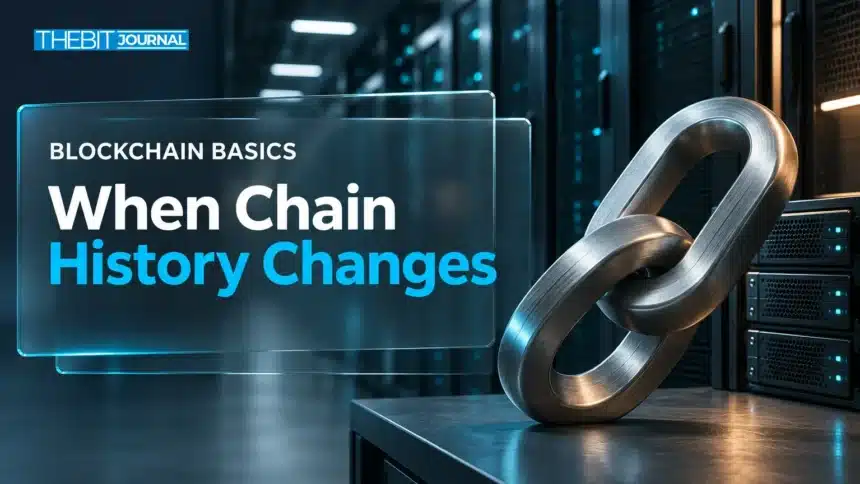
A blockchain reorganization happens when a network switches from one valid chain history to another. It can follow competition between blocks and affect transaction confirmations. What happens next depends on whether affected transactions are included in the accepted chain.
Key Takeaways
- A reorganization replaces blocks with a competing history accepted under the network’s consensus rules.
- Transactions in removed blocks may return to a pending pool, appear in a replacement block or fail validation.
- A reorganization does not by itself mean a blockchain was hacked, but can create confirmation and double-spend risks.
- Proof-of-work chain selection and proof-of-stake finality differ, so risks vary by network.
What a blockchain reorganization changes
Blocks contain transactions and link to earlier history. Competing blocks or branches can briefly exist, and nodes follow a chain they recognize as valid under their consensus rules. If that choice changes, nodes can disconnect previously accepted blocks and replace them with blocks from another branch. This is a blockchain reorganization, often shortened to “reorg.”
The Bitcoin Developer Guide explains that changing a transaction in an earlier Bitcoin block requires changing every block added after it. Each new block increases the proof-of-work cost of rewriting that history. Replacing a recent block is therefore different from altering a transaction deeper in the chain.
A reorganization changes the history a node follows. It does not by itself prove that funds were stolen. Its practical effect depends on whether affected transactions are later confirmed on the accepted chain.

Why does a blockchain reorganization happen?
A short reorg can happen when different parts of a network briefly receive competing valid blocks, then converge on one branch under consensus rules. In proof-of-work systems, nodes use accumulated work to choose a chain. Each added Bitcoin block makes altering earlier history more costly.
Not every chain split has the same cause. Bitcoin’s account of its March 11, 2013 split says a miner running version 0.8.0 produced incompatible block 225,430. Mining pools were asked to return to version 0.7 so the network could follow a chain compatible with all software versions. This was a software compatibility problem, not evidence that every reorg is an attack.
An emergency rollback differs from ordinary competition between blocks. In September 2026, Zano’s emergency release directed nodes to roll back to block 3,833,000, dated August 26, 2026, at 15:50 UTC. Later transactions would no longer be on the chain followed by those nodes. The example shows that reorganizations can have different causes and consequences.

What happens to transactions in replaced blocks?
When blocks are disconnected, their transactions must be checked against the remaining chain. Bitcoin Core’s current implementation attempts to return transactions from disconnected blocks to its mempool if they remain valid. It removes transactions that fail validation, along with transactions that depend on them.
A returned transaction is not guaranteed to appear promptly in a new block. It may remain pending, be included later or become invalid if the accepted chain contains a conflicting transaction or no longer supports its dependencies. A wallet or service may show it as unconfirmed again after its block is removed.
A displayed confirmation is not the same as irreversible settlement. A reorg can expose a service to double-spend risk if it treats a transaction as settled before it has enough confidence in the chain. Reorgs can also lead to delayed settlement or disputes.
How finality affects reorganization risk
Proof-of-work and proof-of-stake networks do not define confidence in exactly the same way. Ethereum’s documentation says it produces a slot every 12 seconds and groups 32 slots into an epoch. Checkpoints finalize when they receive votes representing at least two-thirds of staked ETH. Reversing a finalized block entails major slashing risk for validators.
Finality is a protocol condition, not a claim that reversal is impossible. Ethereum’s proof-of-stake documentation describes the slashing risk associated with reversing a finalized block.
As of November 7, 2026, proposed Ethereum Improvement Proposal EIP-8252 calls for execution-layer clients to retain reconstructible state for 262,144 recent blocks, described as 8,192 epochs or about 36.4 days, to support local recovery from deep reorgs. Created April 24, 2026, it is a proposal, not evidence that the retention requirement is active. On September 7, 2026, the Ethereum Foundation described fast finality as a research direction, with specifications and prototypes underway but no confirmed activation date.

How to interpret a reported reorg
Start with the event’s size and cause. A brief change involving recent blocks is not equivalent to a rollback covering a longer history. Check which chain relevant nodes follow, whether transactions were included again and whether network or client developers have explained what happened. Reporting should distinguish competing blocks from a software fault, coordinated intervention or suspected attack.
For users, the immediate question is whether a transaction remains included and confirmed on the chain the network now recognizes. For operators, handling reorgs is part of validating blocks and updating local state. Confirmation counts do not eliminate risk. Crypto assets also face volatility, software and custody failures, regulation and scams.
Frequently Asked Questions
Is a blockchain reorganization the same as a 51% attack?
No. A reorg describes a change in the chain history a node follows. Competing blocks or software incompatibility can cause one. A 51% attack is one possible attack scenario, not a synonym for every reorganization.
Can a blockchain reorganization reverse a confirmed transaction?
It can remove a transaction from the branch a node previously followed. The transaction may be included on the replacement chain, return to a pending pool or fail validation. The outcome depends on the transaction and the accepted chain.
Does a reorganization mean a blockchain was hacked?
No. Some reorganizations happen as networks resolve competing blocks. A major or unusual reorg may warrant investigation, but the term alone does not establish a hack or explain the cause.
Why do people wait for more confirmations?
As the Bitcoin Developer Guide explains, additional blocks make a recent proof-of-work history more costly to alter. Waiting reduces some settlement uncertainty, but does not eliminate transaction risk.
Sources
- Block Chain, Bitcoin Developer Guide (developer.bitcoin.org)
- validation.cpp, Bitcoin Core (github.com)
- Proof-of-stake (PoS), ethereum.org
This article is for informational purposes only and does not constitute financial or investment advice. Cryptocurrencies are highly volatile; always do your own research before investing.