



Last updated: November 15, 2026
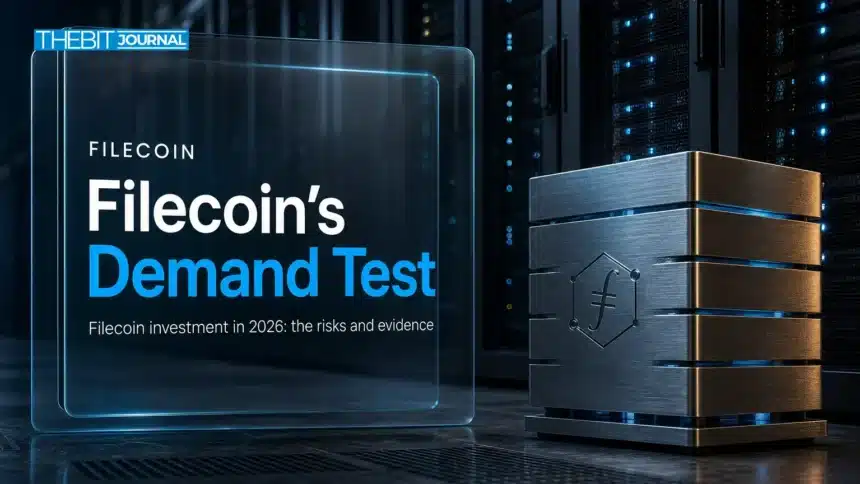
Filecoin investment in 2026 depends on whether demand for its storage services can grow enough to support the token economy. As of November 15, FIL is trading near $0.61, while network revenue data shows that paying-customer traction remains unproven.
Key Takeaways
- CoinGecko recorded FIL at $0.610701 at 17:21 UTC on November 15, 2026, down 47.51% over 30 days.
- Filecoin’s October Solstice upgrade redirects more rewards toward services that attract paying customers.
- Filecoin Onchain Cloud reported $134,000 in annualized on-chain revenue as of November 4, but no recurring power users.
- Volatility, adoption uncertainty, token unlocks and broader crypto-market risk matter to any assessment.
What the Filecoin investment case depends on
Filecoin’s case rests on use of its network services, not simply the existence of storage infrastructure. The key question is whether customers will pay consistently and whether the reward system can direct incentives toward that demand.
Technical activity is not the same as a durable business. A network can ship upgrades and attract providers without showing that customers will keep paying.
Filecoin investment signals from price and revenue
CoinGecko’s market data shows a steep decline across several timeframes. At 17:21 UTC on November 15, 2026, FIL was $0.610701, down 20.29% over seven days and 47.51% over 30 days. Its reported 24-hour range was $0.58801 to $0.648493.
| Measure | Reported figure | Date and time |
|---|---|---|
| FIL price | $0.610701 | November 15, 2026, 17:21 UTC |
| Market capitalization | $516.96 million | November 15, 2026, 17:21 UTC |
| 30-day price change | -47.51% | Through November 15, 2026 |
| 24-hour trading volume | $115.51 million | November 15, 2026, 17:21 UTC |
These figures show recent market weakness, not what FIL will do next. Market capitalization and trading volume also don’t establish lasting customer demand.
Filecoin Public Goods Funding reported $134,000 in annualized on-chain revenue for Filecoin Onchain Cloud as of November 4, 2026, or 54% of its $250,000 target. The tracker also reported zero recurring power users, defined as customers spending at least $500 monthly over the trailing 30 days. Revenue had begun to register, but repeat high-value use was not established.

What the Solstice upgrade changes
Filecoin Mainnet Version 29, known as the Solstice upgrade, went live on October 19, 2026, according to the Filecoin project announcement. It redirects a growing share of block rewards toward services that attract paying customers. New sectors receive the former 10× Filecoin Plus reward multiplier without DataCap approval, while service rewards that fail to meet demand gates are burned.
The design aims to connect rewards more closely to demand, but its results depend on actual use. Filecoin Public Goods Funding reported six approved mainnet storage providers meeting its service-level measure on November 4: five at 100% and one at 97.9%. The tracker also said no beachhead market had been validated.
These are different signals for Filecoin investment. Provider performance reflects service delivery, while validated markets and recurring customers indicate demand. Revenue, paying usage and customer retention are useful measures to watch over time.

Risks to weigh before judging FIL
Filecoin investment and adoption risk
The revenue figures leave uncertainty about customer depth. If paying usage doesn’t grow, incentives and technical changes may not translate into stronger economic demand. The public-goods tracker’s figures are a dated snapshot, not evidence of future performance.
Token supply is another factor. A token-unlock tracker listed 5,330,272 FIL, or 0.3% of total supply and 0.5% of market capitalization, scheduled to unlock on November 15, 2026, with the community as recipient. It also listed a December 15 unlock equal to 0.5% of market capitalization. Unlocks don’t mean tokens will be sold, but can affect the amount of FIL available to trade.
FIL also carries crypto risks, including sharp price swings, possible total loss, exchange or custody failures, smart-contract vulnerabilities, regulatory changes and scams. Broader market conditions can affect risk appetite. The Federal Reserve calendar lists an FOMC meeting for December 8-9, 2026; its effect on FIL is uncertain.
How to assess the Filecoin investment outlook
Rather than rely on one price prediction, compare observable indicators over time. Ask whether annualized revenue rises, customers become recurring users and the network finds a market where services are being paid for. Network performance and FIL’s market price can move differently.
CoinGecko’s November 15 price data and Filecoin Public Goods Funding’s November 4 revenue figures are dated snapshots, and neither settles the long-term case.
So, is Filecoin a good investment in 2026? The evidence is mixed: the project has changed its reward mechanism and reported some on-chain revenue, but the cited tracker showed no recurring power users or validated beachhead market. Execution and market risks remain substantial, and there’s no reliable way to know how FIL’s price will respond.
Frequently asked questions
Is Filecoin investment worth considering in 2026?
It depends on how a person weighs adoption evidence against volatility and execution risk. November 2026 data shows revenue progress, but no recurring power users in the cited Filecoin Onchain Cloud tracker.
What could support FIL demand?
More paying customers and recurring use of Filecoin services could strengthen the demand side of the case. Solstice is designed to direct more rewards toward services that attract paying customers, but longer-term results remain uncertain.
What are the main risks of Filecoin?
Risks include price volatility, uneven customer demand, token unlocks, exchange or custody failures, smart-contract vulnerabilities, regulatory changes and scams. Crypto assets can lose all their value.
Can anyone predict the FIL price reliably?
No. Price predictions are estimates, not guarantees. FIL can be affected by adoption, token supply, broader market conditions and unexpected events, so published outlooks shouldn’t be treated as certain outcomes.
Sources
- Solstice: A New Reward Mechanism for the Filecoin Network (filecoin.io)
- Filecoin price and market data (CoinGecko)
- Revenue Development · Filecoin Public Goods Funding (www.filpgf.io)
This article is for informational purposes only and does not constitute financial or investment advice. Cryptocurrencies are highly volatile; always do your own research before investing.