






According to live market trackers, Aster whales are buying dips, hedging with perps, and feeding fresh liquidity into ASTER as volumes and open interest hold near recent highs.
Spot trades print in a tight band while perp turnover stays brisk, which keeps spreads attractive and invites more Aster whale activity.
Market snapshot
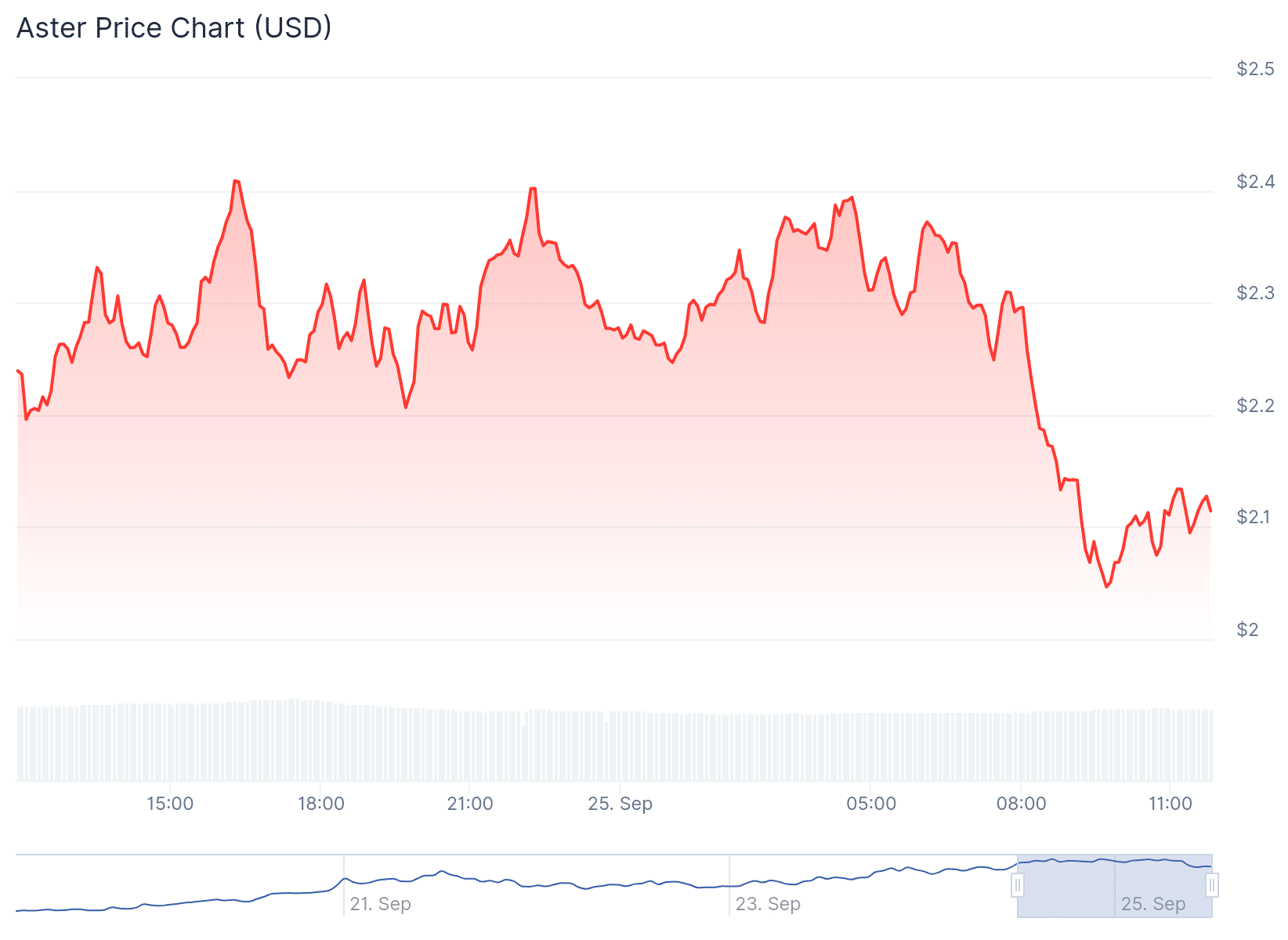
Aster whales leaned into a choppy session with intense tape action. The live feed shows ASTER trading around the $1.90–$2.10 range, with a 24-hour volume exceeding $2.5 billion and a circulating supply of nearly 1.7 billion.
The derivatives dashboard lists open interest at around $1.24 billion, 24-hour perpetual volume near $32.5 billion, and cumulative perpetual volume above $240 billion. The project’s upgrade lane confirms a 1:1 APX to ASTER swap that took effect on September 17, 2025, redirecting legacy liquidity into new order books.
Also Read: Can Aster Token Price Bullish Rally Last? Analysts Warn of Volatility Ahead
Quick table
| Metric | Latest figure | Why it matters |
|---|---|---|
| Spot price (ASTER) | ~$1.90–$2.10 | Anchors funding math and hedge size. |
| Open interest | ~$1.24B | Maps leverage and Aster whale activity |
| Perp volume (24h) | ~$32.5B | Confirms active two-way flow |
| Cumulative perp volume | >$240B | Depth for basis and carry trades |
According to the official upgrade note, the APX to ASTER exchange went live on September 17, 2025. Holders should follow the project’s X updates for timing details.
How Aster whales are trading it
- Funding/carry: Aster whales pair spot with short perps or split venues when funding diverges. They keep delta near zero and target funding payments. Elevated open interest and sustained turnover support these windows, keeping Aster whale activity high.
- Basis rotations: When the spot–perp basis widens, Aster whales buy spot and short perps, then unwind as the basis tightens. This flow explains steady Aster whale activity even when the price chops sideways.
- Inventory timing: Some large holders move inventory off venues to trim visible float, then recycle during bursts in Aster whale activity. That can sharpen moves when new bids hit thin levels.
What could flip the script?
Spread compression cuts carry. If open interest rolls over or turnover fades, Aster whale activity cools, and late entries face whipsaws. Watch three dials: the live spot/volume feed, derivatives metrics, and the migration lane for any timetable changes.
Conclusion
Based on the latest research, Aster whales treat volatility as inventory, not noise. They earn from structure: funding, basis, and precise timing. As long as perp flow and open interest remain firm, Aster whales can continue to extract carry from spreads.
If liquidity thins or spreads snap shut, the same setup can reverse quickly, so sizing and risk controls are crucial.
Also Read: XRP Price Prediction 2025: Can Whales Push It Past $5 After Historic Rally?
Summary:
Aster whales are turning swings into income through funding, basis, and tight inventory timing. Spot trades hover near $2, while 24-hour volume tops $ 2.5 billion. Open interest stands at around $1.24B, with perp turnover nearing $32.5B, which keeps Aster whale activity elevated.
The APX → ASTER migration adds depth and addresses key issues. If spreads compress or liquidity fades, returns fall and reversals bite, so watch OI, turnover, and the upgrade lane.
Glossary of Key Terms
Funding rate: A periodic fee between perpetual longs and shorts.
Delta-neutral: A hedge that offsets price moves while seeking carry.
Open interest: Value of outstanding perpetual contracts.
Basis: The gap between spot and perp prices.
FAQs about Aster Whale Activity
Q1: Why is Aster whale activity elevated?
Funding spreads, strong open interest, and migration-driven liquidity.
Q2: Are the returns stable?
No. Funding and basis change quickly as positions rebalance.
Q3: What should readers track daily?
Live price/volume, open interest, 24-hour perp volume, and migration updates.
Q4: How often do Aster whales act during a session?
They act in bursts around funding resets, major news, and shifts in liquidity. Watch open interest and 24-hour perp volume for early hints.