






Last updated on, 19th July, 2026
U.S. crypto regulation may be nearing one of its most important Senate moments yet. Senator Cynthia Lummis has indicated that lawmakers are preparing for a May markup of the CLARITY Act, giving digital asset markets a fresh reason to watch Washington closely. The bill is not final law, and the path remains messy, but the message is clear enough: Congress is again trying to turn years of crypto enforcement fights into a written rulebook.
CLARITY Act Faces Its May Window
The CLARITY Act is designed to answer a question that has followed crypto for years: who regulates what? At the center is the long-running split between the Securities and Exchange Commission and the Commodity Futures Trading Commission. The bill aims to define when a digital asset falls under securities rules and when it should be treated as a digital commodity.
That matters because unclear rules have shaped listings, custody, token launches, exchange operations and institutional risk models. For large investors, uncertainty is not a small inconvenience. It is often the reason capital stays parked on the sidelines.
Why the Senate Markup Matters
A markup is where lawmakers debate, amend and vote on a bill before it can move further. Senator Lummis’ May timeline suggests the Senate may finally return to a digital asset framework that has already faced delays. The House passed a version of the market structure bill in 2025, but Senate approval remains the larger test.
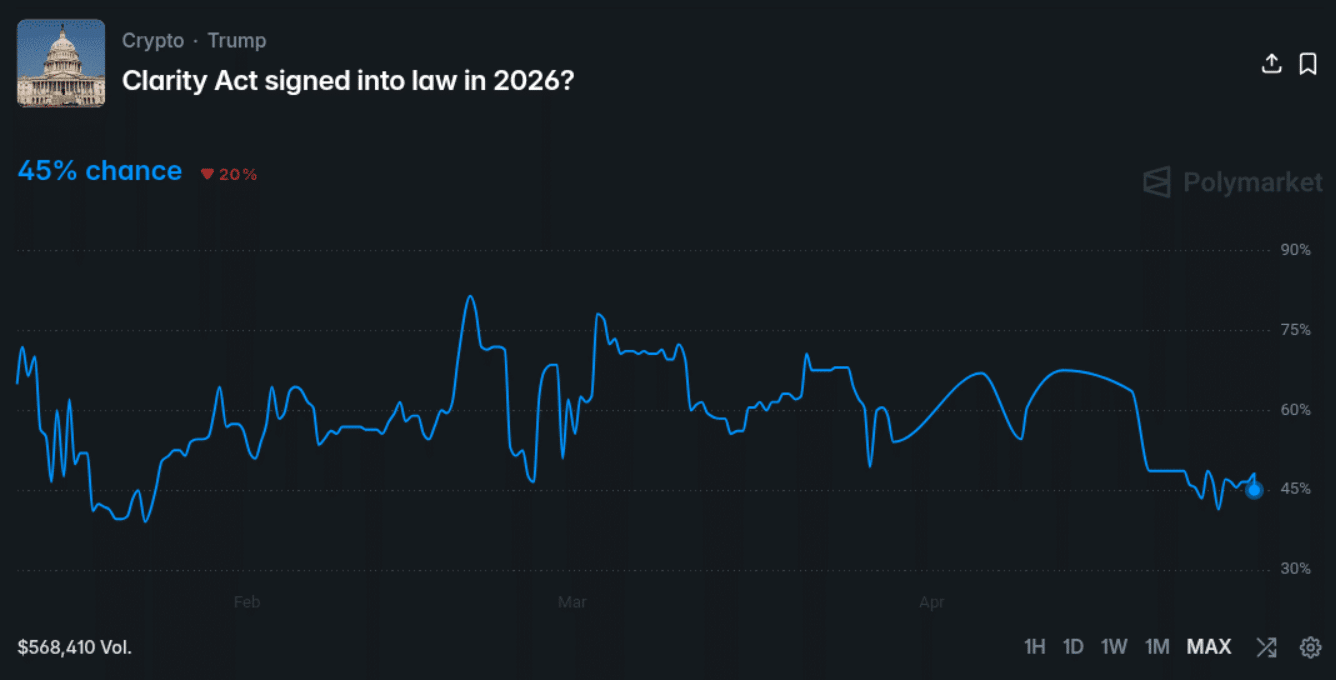
Source: Polymarket
The CLARITY Act still needs committee progress, Senate floor support and possible reconciliation with the House version. In plain English, May is not the finish line, but it could decide whether the bill has enough political oxygen to survive 2026.
Committee Approval Moved the Bill Forward, but Did Not Settle the Rules
The CLARITY Act cleared the Senate Banking Committee on May 14, 2026, in a 15–9 vote, with Democratic Senators Ruben Gallego and Angela Alsobrooks joining Republicans to advance it. The committee text would divide oversight according to the asset and activity involved rather than placing the entire crypto market under one regulator.
The SEC would retain authority over securities, investment contracts, capital-raising disclosures, and certain token issuers, while the CFTC would supervise registered exchanges, brokers, and dealers operating in digital commodity spot markets. The proposal also applies Bank Secrecy Act duties to covered intermediaries, including customer identification, suspicious activity reporting, sanctions compliance, and anti-money-laundering programs. Committee approval is meaningful, but it is not final passage.
The Senate must still reconcile the Banking Committee framework with legislation under the Agriculture Committee’s jurisdiction, resolve outstanding stablecoin and consumer-protection disputes, pass a floor vote, and align the final text with the House bill before it can reach the president.
What the CLARITY Act Could Change
| Market area | Current source of uncertainty | Proposed regulatory direction | Practical effect if enacted |
|---|---|---|---|
| Digital asset classification | Projects often lack a clear test for when a token shifts from a securities offering to commodity-market trading | Establishes statutory definitions and disclosure requirements based on the asset’s structure and distribution | Issuers may receive a clearer route for launching tokens and supporting secondary trading |
| Crypto spot exchanges | Federal oversight of non-security spot markets remains fragmented | Gives the CFTC authority over registered digital commodity exchanges, brokers, and dealers | Trading platforms could face unified federal registration, surveillance, record-keeping, and customer-protection rules |
| Token fundraising | Issuers may face enforcement risk when raising capital without traditional securities registration | Creates a tailored disclosure framework while preserving SEC oversight of investment contracts | Projects may be able to raise funds under defined conditions, resale restrictions, and continuing disclosures |
| Custody and customer assets | Rules vary by business model, regulator, and state | Introduces standards for safeguarding customer funds and separating them from company assets | Customers could receive stronger protection if an exchange or intermediary fails |
| DeFi software and infrastructure | Developers, validators, and interface operators may be treated alike despite having different levels of control | Seeks distinctions between intermediaries that control transactions and providers of non-custodial technology | Some software developers and infrastructure providers may avoid rules intended for financial custodians |
| Anti-money-laundering controls | Compliance coverage can differ across crypto intermediaries | Applies Bank Secrecy Act programs, customer checks, sanctions controls, and suspicious activity reporting to covered firms | Registered platforms would carry compliance duties closer to those of traditional financial institutions |
| Stablecoin rewards | Banks and crypto companies disagree over whether platforms should pay incentives linked to stablecoin balances | Remains an area of negotiation rather than a fully settled market-structure issue | The final language could affect exchange rewards, payment products, and competition for customer deposits |
The bill would not simply label every token a commodity or remove the SEC from crypto oversight. Its central purpose is to connect asset classification with registration, disclosure, custody, trading, and enforcement rules, although the final division of authority may still change during Senate negotiations.
Stablecoin Rewards Remain the Hard Fight
One of the biggest sticking points is stablecoin rewards. Banks argue that crypto platforms should not be allowed to offer yield-like incentives that could pull deposits away from traditional accounts. Crypto firms say overly strict limits would protect banks more than consumers.
This debate is not abstract, stablecoins are now a central part of crypto liquidity, trading settlement and cross-border transfers. If Congress limits rewards too sharply, exchanges and payment firms may need to redesign products. If lawmakers allow broader incentives, banks may face stronger competition for customer cash.
The CLARITY Act therefore sits at the crossroads of crypto policy and traditional finance. It is not only about tokens. It is about who controls digital dollars, who earns from them and how users are protected.
Key Crypto Market Indicators to Watch
Bitcoin remains the market’s first barometer. If traders believe the bill can reduce legal risk, Bitcoin may benefit from stronger institutional positioning, especially through ETFs and custody products. However, price action alone can mislead. Volume, open interest and ETF flows should be watched together.
Ethereum may react differently as clearer rules could support staking services, tokenized assets and DeFi-linked infrastructure, but only if developer protections remain workable. If the final text creates heavy compliance burdens for software activity, Ethereum-linked sentiment may cool.
Altcoins are more sensitive as a clearer SEC-CFTC line could help tokens that have lived under classification risk, yet the same law could also expose weaker projects that fail disclosure or decentralization tests. That is why investors should watch liquidity depth, exchange listings, regulatory language and whale movements rather than headlines alone.
What It Means for Exchanges and Builders
For exchanges, the CLARITY Act could bring registration paths, stronger custody standards and clearer oversight. That may sound restrictive, but mature firms often prefer known rules over surprise enforcement. A football match with strict referees is still easier to play than one where the rules change after every goal.
Builders may gain from clearer treatment of nodes, validators and non-custodial software, depending on the final text. This part matters because DeFi is not a single business model. Some projects control user funds, while others only publish code. Lawmakers will need to avoid treating both as the same thing.
Why Institutions Care
Institutional investors usually move slowly because they have boards, auditors and compliance teams. They are not waiting for perfect crypto rules. They are waiting for rules that can be explained in a risk memo.
The CLARITY Act could help asset managers, banks and public companies assess whether digital assets fit inside formal investment mandates. It may also support tokenization, especially for Treasuries, private credit and settlement systems. Still, clearer law does not remove market risk. It only reduces one layer of uncertainty.
Political Risks Still Hang Over the Bill
The bill faces a narrow calendar and a divided policy environment. Some lawmakers want stronger investor protections. Others worry that too much SEC authority would keep the old enforcement-first model alive. There are also concerns around illicit finance, DeFi treatment and state-level enforcement power.
The Senate Banking Committee has argued that the framework includes anti-money laundering and sanctions-related protections for digital asset intermediaries. Still, critics will keep pressing for tighter safeguards before the bill reaches a broader vote.
Conclusion
The CLARITY Act has become more than another crypto bill. It is a test of whether the U.S. can move from courtroom regulation to market structure law. Senator Lummis’ May signal gives the industry a timeline, but not certainty. For crypto markets, the next few weeks may shape how exchanges list tokens, how stablecoins compete and how institutions read U.S. digital asset risk.
If the Senate moves forward, the market may price in a cleaner future. If the process stalls again, the same old fog returns, and crypto firms may keep looking abroad for clearer lanes.
FAQs
What is the CLARITY Act?
The CLARITY Act is a U.S. digital asset market structure bill that aims to define how crypto assets, exchanges and intermediaries should be regulated.
Why is May important?
May matters because Senator Cynthia Lummis has signaled that lawmakers may mark up the bill during that month, which could move it closer to a Senate vote.
Will the bill make crypto fully legal in the U.S.?
No. The CLARITY Act would not give every crypto activity a free pass. It would create clearer rules, registration paths and compliance duties.
How could Bitcoin react?
Bitcoin may benefit if investors view the bill as reducing U.S. regulatory uncertainty, but price will still depend on liquidity, ETF flows and macro conditions.
Glossary of Key Terms
Markup: A committee process where lawmakers debate and amend a bill.
SEC: The U.S. agency that regulates securities markets.
CFTC: The U.S. agency that oversees commodity derivatives and may gain more digital commodity authority.
Stablecoin: A crypto token designed to track the value of an asset such as $1.
Digital commodity: A crypto asset treated more like a commodity than a security under proposed rules.
Sources
United States Senate Banking Committee