

This article was first published on The Bit Journal. Chainlink is expanding its role in institutional finance by joining Project Pangea, which is an effort among the top-tier banking institutions to utilize stablecoin technology to ensure better foreign exchange settlements between Europe and South Korea.
The project is designed to overcome the inefficiencies in the “traditional” FX market, where trades may still take up to two business days to settle. The participants are looking to use blockchain-based settlement mechanisms in Project Pangea to facilitate quicker and more safe exchanges of currencies.
Project Pangea Targets Atomic Settlements
Project Pangea is a collaboration of Chainlink, FairSquareLab, UniKA and Qivalis. The groups collectively include over 50 banks with assets totaling over $10 trillion, Chainlink said. Qivalis is supported by 37 European banks, and UniKA comprises over 10 commercial banks from South Korea.
The initiative will explore payment vs payment (PvP) transactions between regulated euro and Korean won stablecoins. This agreement means that both sides of a currency trade settle at the same time, so that neither party can finish a transaction while the other is unable to pay out.
This atomic settlement model is being built with Project Pangea to reduce settlement risk for financial institutions and businesses in international payments.
NEW: Chainlink & multinational banking consortia launch Project Pangea to develop a novel solution redefining international FX markets.
Pangea brings together 50+ banks, representing $10+ trillion AUM, to unlock T+0 cross-border settlement via Chainlink & ISO 20022 standards 🧵 pic.twitter.com/hcEjxKthd6
— Chainlink (@chainlink) June 23, 2026
Existing Banking Infrastructure Remains Central

Project Pangea does not intend to force banks to replace their current systems, but will be built on the top of the widely used Swift network and ISO 20022 messaging standards. Financial institutions will still receive instructions via well-known channels and Chainlink’s infrastructure will take those instructions and turn them into settlement actions on the blockchain.
FairSquareLab will serve as the onchain settlement technology and will run the Pangea Layer-1 network. The settlement framework should enable T+0 transactions, atomic FX swaps and on-chain liquidity via the automated market makers smart contracts in Ethereum, Polygon and Pangea L1.
Niki Ariyasinghe, Chainlink’s Vice President for Asia-Pacific and the Middle East said, the project is not an experimental proof of concept. He said:
“This is not just a POC. Everyone’s coming in with their eyes wide open.”
Project Pangea Reflects Growing Stablecoin Adoption

The move comes as a trend for financial institutions to investigate blockchain-based settlement systems. Recently, SWIFT and Bank for International Settlements have been running tokenization and atomic settlement experiments with several central banks and dozens of financial institutions.
Stablecoins have become a means of transferring value outside of traditional banking hours. Higher settlement speed would enhance liquidity and minimise delays for businesses and customers, according to supporters.
Ariyasinghe said, if I’m sending money to you and it’s lost in transit for quite some time, you don’t receive it, and that money isn’t able to be used. To reduce that time as much as possible, for customers to access that money absolutely as fast as possible, has to be a good thing.
Project Pangea Supports Chainlink’s Institutional Push
The new Project Pangea initiative also aligns with Chainlink’s overall institutional approach. The company recently announced that its Cross-Chain Interoperability Protocol (CCIP) ecosystem had secured over $110 billion in total value of tokenized assets and decentralized finance data feeds.
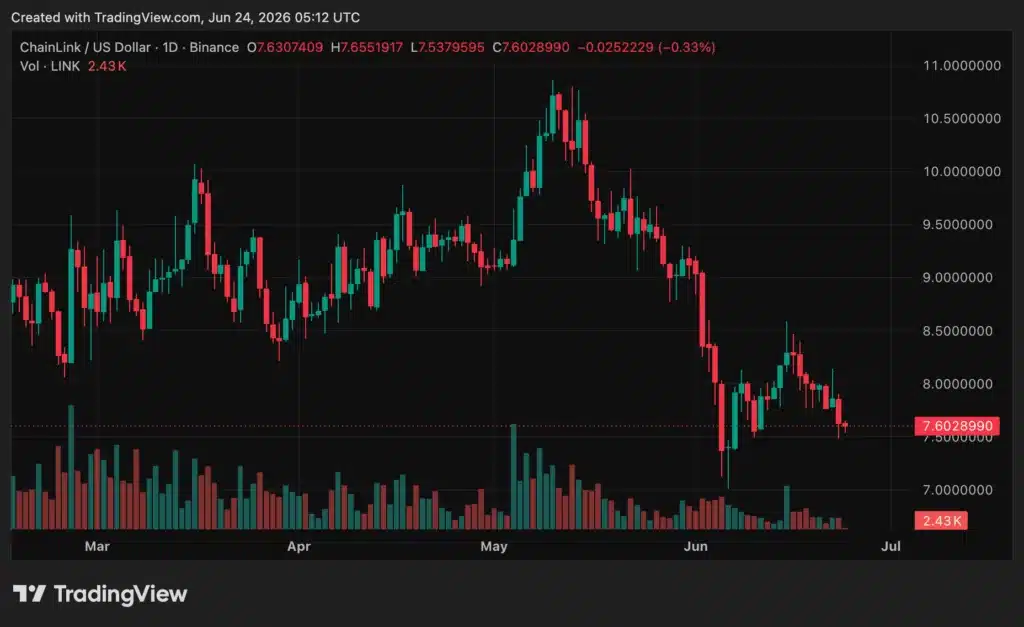
Chainlink’s native LINK token was trading in the $7.59 range with a market cap of approximately $5.68 billion and approximately $246 million in trading volume over the past 24 hours, according to market data.
Project Pangea could be a valuable case study for moving toward stablecoin-based cross-border settlement at institutional scale as banks delve deeper into blockchain financial infrastructure.
Conclusion
With the rise of interest in stablecoin-based payments, Project Pangea could offer a model to modernise cross-border FX settlements without impacting existing banking structures. The project will focus on whether blockchain-powered transactions can meet the speed, compliance, and liquidity demanded by the big financial institutions to adopt it.
Follow us on Twitter and LinkedIn, and join our Telegram channel to be instantly informed about breaking news!
Summary
- Chainlink joined Project Pangea for Europe-Korea FX tests.
- Over 50 banks will trial euro and won stablecoin settlements.
- The project targets instant FX settlement using existing banking systems.
Glossary of Key Terms
Chainlink: Blockchain infrastructure provider.
Project Pangea: Bank-backed settlement initiative.
FX: Foreign exchange trading.
Stablecoin: Fiat-pegged cryptocurrency.
CCIP: Chainlink’s cross-chain protocol.
DeFi: Decentralized financial services.
LINK: Chainlink’s native token.
Liquidity: Ease of asset trading.
Frequently Asked Questions about Project Pangea
What is Project Pangea?
A bank-backed initiative for stablecoin-based FX settlements.
What is Chainlink’s role?
It provides infrastructure for onchain settlements.
What is the goal of Project Pangea?
To enable instant cross-border FX settlements.
References
Disclaimer
The article is purely informational and it is not a financial, investment, or a trading advice. Cryptocurrencies are extremely risky and volatile. Before investing, the readers are to conduct personal research and seek the advice of a qualified financial expert.