

Chainlink is again sitting at a sensitive point in the market, and the next move may decide whether LINK can rebuild confidence or slide back into deeper pressure. The token held firm after fresh concerns around a government-linked transfer to Coinbase Prime, a move that briefly revived fears of possible sell-side activity.
Still, the reaction was not as weak as many traders might have expected. LINK bounced from its recent low, defended a key support region, and kept bullish positioning alive across derivatives markets. For now, the Chainlink price prediction depends less on noise and more on whether buyers can turn defense into momentum.
Chainlink Price Prediction Depends on Support Strength
The latest Chainlink price prediction centers on one simple question: can LINK hold the $7.34 to $7.95 zone long enough to force a stronger recovery? LINK recently traded near $7.78 after rebounding from a June low around $7.34. That bounce mattered because it showed that buyers were still willing to step in near lower levels, even after weeks of weak price action.
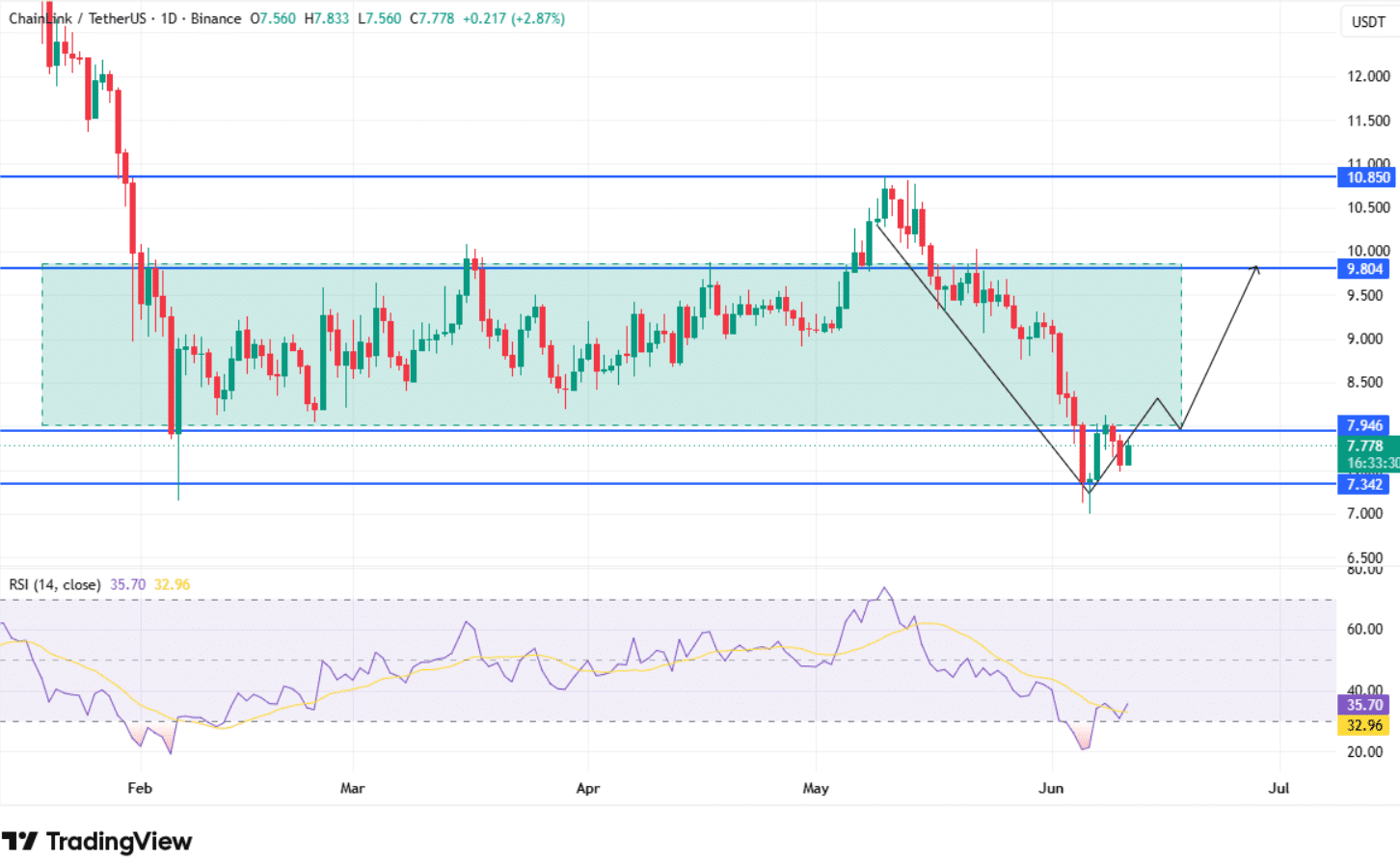
The $7.95 area is now important because it previously acted as the lower edge of a wider consolidation range. If LINK reclaims that level with strong volume, traders may start looking toward $9.80 as the next major resistance. Beyond that, $10.85 remains the larger ceiling. A clean move above those levels would give the market a stronger technical signal, but LINK has not reached that point yet.
This is why the Chainlink price prediction remains cautious rather than fully bullish. Support has held, but a breakout still needs confirmation.
Transfer Concerns Raise Market Caution
Market attention increased after 98,590 LINK, valued at roughly $768,000, moved to Coinbase Prime from wallets linked to seized FTX and Alameda assets. Transfers of this kind can make traders nervous because Coinbase Prime is often used by large institutions and custodial clients. When assets move there, the market sometimes reads it as a possible sign of future selling.
That said, the size of the transfer was small compared with LINK’s broader circulating supply. It was enough to stir concern, but not large enough to change the market structure by itself. In crypto, perception can move faster than facts, and this was one of those moments where traders had to separate wallet activity from actual selling pressure.
For the Chainlink price prediction, the bigger point is that LINK did not collapse after the transfer. Instead, it held support. That gives bulls something to work with.
Binance Traders Stay Heavily Long
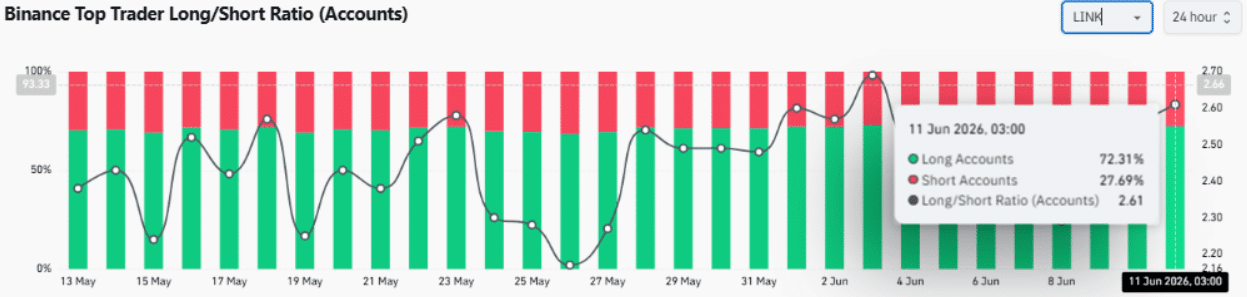
Derivatives data showed that many top traders were still leaning bullish. Binance’s top trader long-to-short ratio stood at 2.61, with 72.31% of accounts positioned long and 27.69% positioned short. That is a clear tilt toward recovery rather than continued downside.
This kind of positioning can cut both ways. On one hand, it shows confidence. Traders are not running for the exits, and many still expect LINK to rebound. On the other hand, crowded long exposure can become risky if price breaks support. When too many traders are on the same side, even a small drop can trigger forced selling.
That makes the Chainlink price prediction more balanced. Bullish traders are still present, but they need price action to back them up.
RSI Shows Sellers Are Losing Grip
The Relative Strength Index, or RSI, recovered to 35.70 after falling near oversold territory. RSI measures market momentum, and readings below 30 often suggest that an asset may be oversold. LINK is not yet in a strong bullish zone because RSI remains below 50, but the recovery shows that selling pressure has eased.
This matters because a market does not need to turn bullish overnight. Sometimes, the first sign of recovery is simply that sellers stop pushing with the same force. LINK appears to be in that stage now. Momentum is still weak, but it is no longer one-sided.
For the Chainlink price prediction, RSI supports the idea of a possible range recovery, not a confirmed trend reversal.
Short Sellers Face Pressure
Liquidation data also offered a useful clue. Short liquidations reached about $57,270, while long liquidations were near $5,040 during the latest session. Binance alone saw around $38,350 in short liquidations compared with about $3,930 in long liquidations.
That gap suggests short sellers were caught offside as LINK rebounded from lower levels. It does not mean a full short squeeze is underway, but it does show that downside aggression is fading. When shorts begin to close or get liquidated, price can move higher faster than expected, especially if spot buyers also step in.
This improves the Chainlink price prediction in the short term, provided LINK holds its support zone.
What Comes Next for LINK?
LINK now needs a firm close above $7.95 to improve market confidence. If that happens, $9.80 becomes the next realistic target. A stronger breakout could then bring $10.85 into focus. Still, failure to hold $7.34 would weaken the setup and may invite another round of selling.
The broader Chainlink price prediction is therefore not about hype. It is about structure. Support is holding, RSI is improving, long traders remain active, and short liquidations show bearish pressure is not as strong as before. But LINK still has work to do.
Conclusion
Chainlink has not delivered a confirmed breakout yet, but it has done enough to keep buyers interested. The recent transfer raised concern, yet price held near key support and derivatives data showed traders still favoring upside exposure. If LINK moves above $7.95 with strength, the Chainlink price prediction could shift toward $9.80 and possibly $10.85. Until then, caution remains fair. The setup is alive, but confirmation is still the missing piece.
Frequently Asked Questions
What is the key LINK support level now?
The key support area sits between $7.34 and $7.95.
What level must LINK break for recovery?
LINK needs to reclaim $7.95, then push toward $9.80.
Is LINK already bullish?
Not fully. RSI is improving, but it remains below 50.
Glossary of Key Terms
Support: A price area where buyers often step in.
Resistance: A price area where sellers may take control.
RSI: A momentum indicator used to track buying or selling pressure.
Liquidation: Forced closing of a leveraged trade when losses grow too large.
Long-to-short ratio: A measure of whether traders are mostly betting on price gains or declines.
Source
Disclaimer: This article is for informational purposes only and does not provide financial advice. Cryptocurrency markets are volatile, and readers should conduct independent research before making investment decisions.