


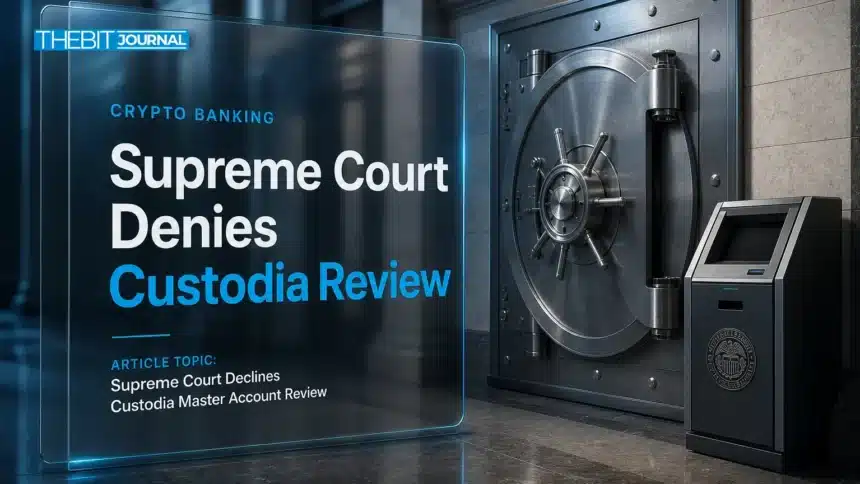

Custodia’s Supreme Court challenge over a master account ended on November 16, 2026, when the Court denied its petition for review. The justices declined to hear the Wyoming bank’s challenge to the Federal Reserve’s refusal of direct access to its payment services. That leaves a lower-court ruling giving Federal Reserve Banks discretion over eligible applicants in place, but the Court did not explain its decision.
Why it matters
A master account provides direct access to Reserve Bank services. Institutions without one may access those services through a correspondent institution. The Supreme Court’s denial leaves in place the Tenth Circuit ruling that Federal Reserve Banks have discretion to reject applications from eligible institutions.
What we know about the Custodia master account decision
The Supreme Court docket for Custodia Bank, Inc. v. Federal Reserve Board of Governors, No. 26-62, records that the justices denied Custodia’s petition for a writ of certiorari on November 16. The order gives no reason. The Court’s docket is the official record.
Bitcoin Magazine reported that the decision closes Custodia’s remaining court path to compel access to a Fed account. The Block also reported that the Supreme Court would not take up the challenge.
How the Custodia master account dispute developed
Custodia applied to the Federal Reserve Bank of Kansas City for a master account in October 2020. Bitcoin Magazine reported that the regional Fed told the bank in January 2021 it was legally eligible and there were “no showstoppers.” Custodia applied for Federal Reserve System membership in August 2021.
The Fed Board issued master-account review guidelines in August 2022. According to Bitcoin Magazine, applicants without federal deposit insurance or supervision by a federal banking agency fall into Tier 3, which generally receives the strictest review. Custodia was in that tier.
On January 27, 2023, the Kansas City Fed rejected Custodia’s account request, citing its crypto-focused business model and concerns about safe and sound banking. The Federal Reserve Board separately denied its membership application. The Board said the proposed activities posed significant safety-and-soundness risks and Custodia’s risk-management framework did not adequately address concerns including money laundering and terrorism financing. The Fed’s statement gives its reasons.
The Tenth Circuit ruled on October 31, 2025, that Federal Reserve Banks have discretion to reject master-account applications from eligible institutions, according to the opinion included in the Supreme Court docket materials. One judge dissented. Custodia filed its Supreme Court petition on July 10, 2026. The docket also records opposition briefs from the Fed Board and Kansas City Fed, plus amicus briefs from the Blockchain Association, the Digital Chamber, Senator Cynthia Lummis and others.
A master account is held at a regional Federal Reserve Bank and provides direct access to Reserve Bank services. Institutions without one may access those services through a correspondent institution acting as an intermediary.

What is still unclear
The Supreme Court docket records the denial without stating a reason. The denial leaves the Tenth Circuit’s ruling in place; the provided docket does not give any further explanation of the Court’s decision.
The immediate effect is narrower: the Tenth Circuit ruling remains in place, and Custodia did not obtain Supreme Court review. The available research does not establish whether the bank plans another route or what steps it may take. It also does not show whether the Fed will change its review standards.
A separate account arrangement was announced on March 4, 2026. The Kansas City Fed approved a limited-purpose account for Wyoming-chartered Kraken Financial for an initial one-year term, with restrictions tailored to its business and risk profile. That approval was separate from Custodia’s application and outcome.
Market snapshot
At 18:13 UTC on November 16, Bitcoin and Ether were higher over 24 hours and down over seven days. This market snapshot does not establish that the Custodia decision caused any price movement.
| Asset | Price at 18:13 UTC | 24-hour change | 7-day change |
|---|---|---|---|
| Bitcoin (BTC) | $64,856 | +0.55% | -13.58% |
| Ethereum (ETH) | $1,816.93 | +0.22% | -14.68% |
The Crypto Fear & Greed Index was 10, classified as Extreme Fear, on November 16. The Block and Bitcoin Magazine covered the legal result and banking access. The provided sources contain no named analyst forecast or market commentary tied specifically to the ruling.
What the Custodia master account ruling means for investors
The decision concerns banking access and regulation. It leaves in place the Tenth Circuit ruling that Federal Reserve Banks have discretion to reject master-account applications from eligible institutions. A bank without a master account may access Reserve Bank services through a correspondent institution. The sources do not quantify any effect on customers or the wider market.
In its membership decision, the Federal Reserve Board cited significant safety-and-soundness risks from Custodia’s proposed crypto activities and said its risk-management framework was insufficient to address concerns including money laundering and terrorism-financing risks.
Developments to watch include any public statement from Custodia about its options, the treatment of other applicants, and whether Kraken Financial’s limited account changes or remains restricted after its initial term. These could provide more evidence about how regional Reserve Banks use their discretion, but would not answer the legal questions the Supreme Court chose not to review.
Bottom line
The Supreme Court’s denial leaves the Tenth Circuit ruling on Federal Reserve discretion in place, without stating a reason. Custodia did not obtain Supreme Court review, and the lower-court ruling holds that Federal Reserve Banks have discretion to reject master-account applications from eligible institutions.
Sources
- Docket for 26-62 (www.supremecourt.gov)
- Federal Reserve Board announces denial of application by Custodia Bank, Inc. to become a member of the Federal Reserve System (www.federalreserve.gov)
- Supreme Court rejects Custodia Bank’s bid for Fed master account (The Block)
This article is for informational purposes only and does not constitute financial or investment advice. Cryptocurrencies are highly volatile; always do your own research before investing.