





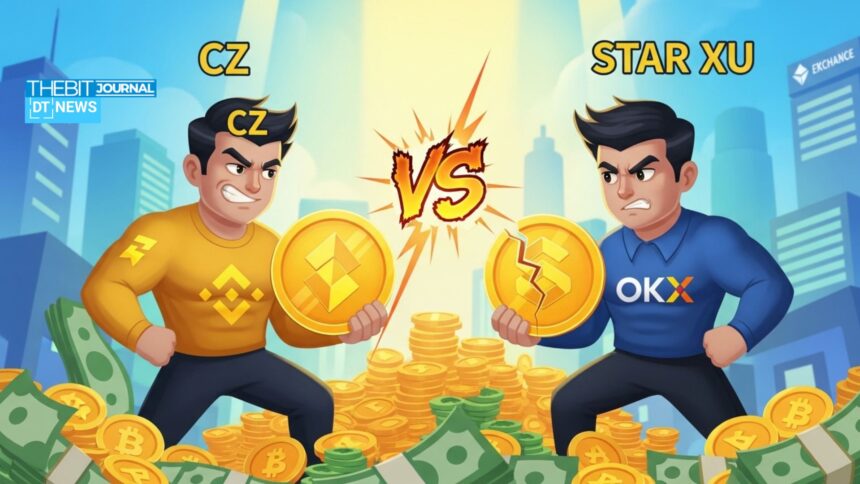

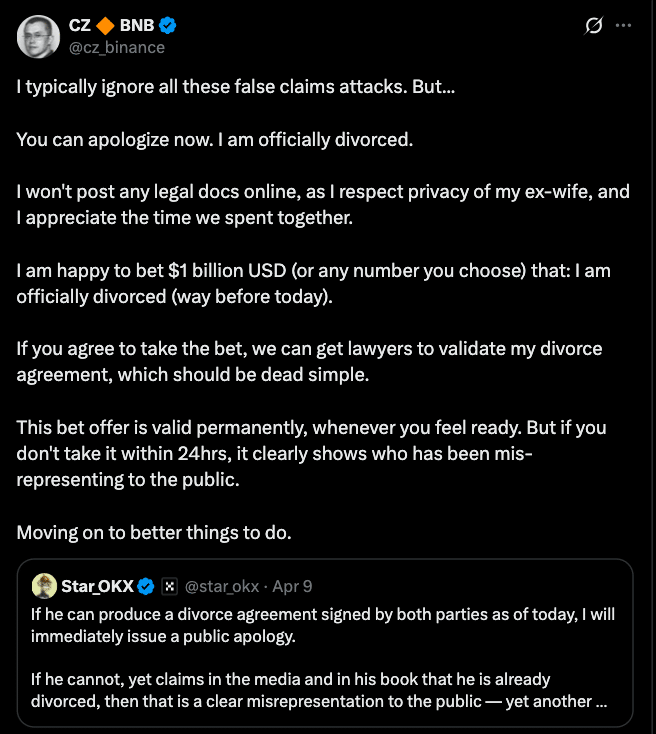
An ongoing crypto feud between CZ vs Star Xu has turned into perhaps one of the most public and consequential clashes in recent crypto history. Changpeng Zhao also known as CZ, publicly challenged Star Xu to a $1 billion bet on X recently, saying he should accept the challenge in 24 hours or be called dishonest.
The bet was over Zhao’s claims about his personal life, including whether or not he is married.
Zhao wrote:
“I am willing to bet $1 billion USD… that I’m officially divorced.
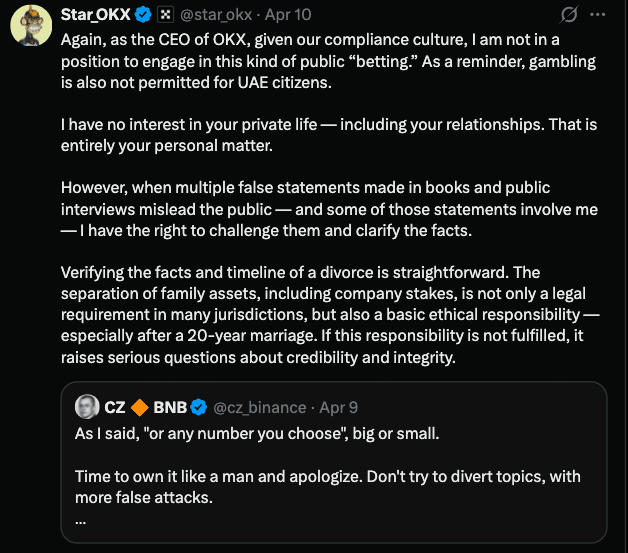
Xu turned the offer down almost immediately, attributing it to regulatory obligations associated with operating a global exchange, and instead pointedly asked whether Zhao’s Binance equity had been legally separated from that of his ex-wife.
A Decade Old RivalryPlays Out in Public
The CZ vs Star Xu fight traces to 2014 when Zhao had briefly worked at OKCoin; the predecessor to OKX. Xu has repeatedly accused Zhao of wrongdoing related to contract disputes from that period, allegations that Zhao has always denied.
This long-standing tension flared again after the publication of Zhao’s memoir Freedom of Money; which revived disputes over past events and reputational claims.
Xu went further; calling Zhao a “habitual liar” while Zhao framed the accusations as part of an ongoing effort to undermine his credibility. Writing on X, Xu asked:
“Has your Binance stake been legally separated with your ex-wife or not?… If he can produce a divorce agreement signed by both parties as of today, I will immediately issue a public apology. If he cannot, yet claims in the media and in his book that he is already divorced, then that is a clear misrepresentation to the public — yet another example of him making such claims with confidence.”
What started as a personal feud quickly escalated into something much bigger, something that now threatens the credibility of centralized crypto exchanges themselves.
Proof of Reserves Is the Actual Battleground
Experts claim that the CZ vs Star Xu feud is not really about personal allegations, but about trust in exchange solvency.
The $1 billion challenge carries an implicit demand to prove transparency in a way the market can’t ignore. This naturally circles back to Proof of Reserves (PoR), a system that exchanges use to prove they have enough assets on hand to cover deposits from their customers.
Proof of Reserves is supposed to be a reassurance but in reality, it has limitations. It verifies assets as of a certain point in time, but does not always reveal liabilities or off-balance-sheet exposure.
And this is where the rift becomes important. If two of the world’s biggest exchanges cannot reach consensus on what is a verifiable truth, then more questions are raised about whether existing models of transparency alone are sufficient.
The exchange-linked tokens such as BNB and OKB, are already reacting on the market as they are sentiment-fueled indicators tied to the confidence of their respective platforms.
The Stakes for Centralized Exchanges: Reputation and Regulation
This feud between CZ vs Star Xu is happening just when centralized exchanges are working to strengthen their standing with regulators across the globe.
According to Xu, engaging in the bet would itself violate those rules, and be inconsistent with a business whose owner bears an obligation to operate a regulated financial platform, quoting compliance arguments.
What flies with crypto-native audiences can seem reckless to regulators considering licensing approvals.
Zhao’s own back story is a further dimension. Serving time for a four-month prison sentence related to anti-money laundering compliance failures at Binance, he rebranded himself as a long-term builder focusing on education, AI and blockchain investments.
But historical events still shape perception. In October 2025, Binance came under fire from traders who attributed about $19 billion in liquidations that occurred during a market crash to alleged system constraints of the platform during peak volatility.
In this regard, even a social media dispute matters because it influences how institutions, regulators and users assess risk.
Market Dynamics: The New Liquidity Is Trust
Trust is now the main currency in the CZ vs Star Xu feud.
Unlike trading volume or product offerings, trust cannot be easily regained once destroyed. Sentiment, especially from institutional players who care about operational reliability and accessibility, is already being impacted by the public nature of this dispute.
Liquidity flows in crypto markets often follow confidence. When users see instability be it operational or reputational, they may move assets to perceived safer platforms or withdraw completely.
Even without a formal resolution, the reputational impact is already being priced into market behavior.
Conclusion
On the surface, the CZ vs Star Xu feud might seem to be a battle of personalities.
It has exposed lingering tensions around transparency, regulatory expectations and the limits of Proof of Reserves as a mechanism of trust.
With two of crypto’s most powerful figures openly calling into question each other’s credibility, the industry now has a moment to reflect. The systems designed to reassure users are now being put to the test not by regulators, but by insiders themselves.
Glossary
Proof of Reserves (PoR): Used by exchanges to show they have enough assets.
Centralized Exchange (CEX): A company-controlled trading and custody platform.
Liquidity: How easily assets can be bought or sold without affecting the price.
UBO (Ultimate Beneficial Owner): The person who ultimately owns or controls a company.
Market Sentiment: In general, the mood of the investors about a particular asset or market.
Frequently Asked Questions About CZ vs Star Xu feud
What started the CZ vs Star Xu feud in 2026?
It came after disputes escalated following the release of CZ’s memoir, which made Star Xu scrutinize claims CZ made about his personal life and business history.
Did they accept the bet for $1 billion?
No. Xu declined to wager, citing regulatory and professional reasons.
What’s the real issue behind the feud?
Centralized exchange Proof of Reserves and transparency concerns.
Why does this matter so much to the market?
It affects trust in the big exchanges, which can have effects on liquidity and investor behavior.
Are Binance and OKX still dominant exchanges?
Yes, both are still among the largest by volume and user base, global crypto exchanges.
References