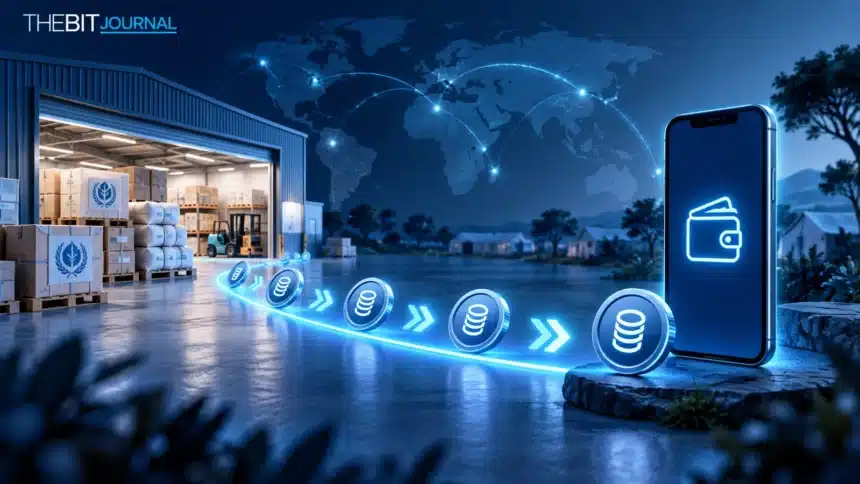

Circle Foundation is funding work with UNDP and the World Food Programme to examine how digital payments can improve the delivery of development and humanitarian assistance. The September 25 announcement focuses on infrastructure and implementation, with the most important test occurring beyond the blockchain: whether recipients can actually access useful funds when they need them.
The announcement describes a UNDP Digital Asset Innovation Pool and separate support through World Food Program USA for WFP-related work. It outlines regulated stablecoin-enabled payments as an additional option. It does not say that the organizations are replacing all existing payment channels or requiring every beneficiary to hold cryptocurrency.
The last mile determines the result
Moving money between institutional accounts is only one stage of delivering aid. A recipient may need local currency, a nearby merchant or an accessible cash-out location. Connectivity, identification requirements and the availability of local financial services can determine whether a technically completed transfer becomes usable assistance.
This is where a payment project’s claimed efficiency needs careful measurement. Lower transfer fees at the sending end do not necessarily mean lower total costs if recipients face expensive conversion or long travel to collect funds. A faster settlement message is also of limited help if the final provider cannot release money promptly.
The relevant comparison is therefore the full journey. How long does it take from authorization to usable funds? What amount reaches the recipient after all charges? How many people fail to complete the process? Those questions make the difference between a successful technology demonstration and an improvement in program delivery.

New infrastructure has to work with local systems
The organizations’ plans include work on operating controls and connections to local providers. That approach recognizes that a global payment rail still meets a local financial environment. A country office cannot assume that the same wallet, identification process or conversion route works equally well in every setting.
For a hypothetical cash-for-work program, the payment record must connect to a verified entitlement while protecting the recipient’s information. Staff need a way to resolve errors, handle lost access and distinguish a delayed payment from an ineligible claim. These requirements exist regardless of whether the transfer uses a bank account, mobile money or a stablecoin-based route.
TBJ’s reporting on the effects of dollar stablecoins on local currencies adds another dimension. The currency in which value travels and the currency in which households spend are not always the same. Exchange rates and local liquidity can affect the final result even when the digital transfer itself is inexpensive.

Safeguards belong inside the design
Humanitarian payments involve people who may have limited ability to absorb mistakes. A sound system needs a practical fallback when a device is lost, a provider is unavailable or the recipient cannot use the proposed channel. Efficiency should not be achieved by transferring an unreasonable operational burden to the person receiving assistance.
Privacy is equally relevant. A transparent ledger can help trace institutional movement of funds, but publishing sensitive personal information would create a different problem. The design must distinguish the records needed for accountability from information that should remain restricted. More visibility is not automatically better for every participant.
The source announcement describes a multi-year testing horizon for WFP corridors. That is a useful reminder that evidence takes time. Performance in one route cannot automatically be generalized to other countries with different financial access, rules or connectivity. A credible assessment should explain where the approach works and where another channel remains preferable.

Success should be visible in delivery metrics
The strongest follow-up would publish comparable results on time, cost, reach and failure rates. It would also explain what happens when a transaction cannot be completed and whether recipients retain a meaningful choice of access method. Those details would help other organizations decide whether the model fits their own programs.
The funding announcement is therefore an institutional development, not proof that a particular stablecoin has already transformed aid delivery. The value of the work will depend on implementation and the evidence it produces. A program can learn something useful even if testing shows that a digital-asset route is suitable only in specific circumstances.
For the stablecoin industry, that is a more demanding benchmark than transaction volume alone. The question is whether a payment reaches the intended person reliably and at an acceptable total cost. Circle Foundation’s support creates room to examine that question in real operating environments, where the success of the final mile matters more than the novelty of the rail.