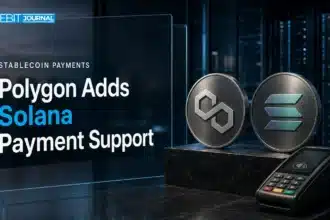


Polygon’s Open Money Stack now supports Solana-based businesses across stablecoin payment flows, connecting bank deposits, on-chain balances and bank payouts, according to NewsBTC’s October 31 report. The coverage follows an October 29 announcement by Polygon Labs. It describes an infrastructure expansion, not evidence of an immediate increase in payment activity.
- According to NewsBTC, Polygon Labs combines account infrastructure, fiat conversion, wallets and routing in the service.
- The company says customers can fund accounts using bank transfers, cards, cash or digital assets.
- Supported tokens can move between Solana, Polygon and other chains, NewsBTC reported.
- Network support doesn’t establish universal availability across banks, tokens or jurisdictions, the report cautioned.
- CoinGecko data showed SOL up 1.12% over 24 hours on October 31 at 17:13 UTC, without establishing a connection to the announcement.
Timeline of the Solana expansion
- October 29, 2026: Polygon Labs announced support for Solana-based businesses throughout a stablecoin payment flow, according to NewsBTC.
- October 31, 2026, 17:00 UTC: NewsBTC published its report on the expansion, describing funding options and cross-chain routing.
- October 31, 2026, 17:13 UTC: CoinGecko’s market snapshot put SOL at $95.87. That snapshot provides market context, not proof of an announcement-driven move.
How the Open Money Stack connects payment steps
According to NewsBTC’s report, Polygon presented the integration as infrastructure that can operate behind a payment app without requiring users to handle bridges directly. The intended benefit is to keep the chain-to-chain transfer process out of the customer’s way.
The service brings together functions that a fintech might otherwise source separately. NewsBTC describes embedded wallets as the account layer, routing as the mechanism for reaching the required settlement network, and off-ramps as the conversion into spendable local money.
The practical issue is the final payout. As NewsBTC explains, a blockchain transfer can settle quickly while the provider still needs to reconcile records, meet local requirements and deal with failures or reversals. Moving tokens and completing a usable payment aren’t the same outcome.
The report says combining these steps behind one interface can reduce the number of separate services a fintech must connect. That is a potential integration benefit, not a measured reduction in costs or failed payments established by the available evidence.
Market context, not evidence of adoption
NewsBTC’s assessment is cautious: product capabilities shouldn’t be confused with settled transactions, recurring fee income or lasting demand. Its report provides no independent customer or analyst reaction demonstrating that the integration has already changed payment activity.
The available market snapshot shows a modest daily gain for SOL alongside gains in Bitcoin and Ethereum. According to CoinGecko, the following figures refer to October 31, 2026, at 17:13 UTC:
| Asset | Price, USD | 24-hour change | 7-day change |
|---|---|---|---|
| Solana | $95.87 | +1.12% | -3.81% |
| Bitcoin | $77,518 | +0.39% | -2.76% |
| Ethereum | $2,249.95 | +0.39% | -2.33% |
Those figures don’t isolate a reaction to the announcement. SOL remained lower over the preceding week, and the available market data contain no Polygon token quote, so they can’t establish a Polygon-specific response.
The Crypto Fear & Greed Index stood at 30, classified as Fear, on October 31, according to Alternative.me. That’s broader sentiment context, not a measure of demand for this payment service.

Outlook depends on implementation, not network labels
The next test for the payment service is operational evidence. NewsBTC identifies verifiable implementation details as the immediate checkpoint, rather than treating stated capabilities as completed outcomes. Evidence of functioning payout routes and fewer failed payments would be more informative than a supported-network announcement alone.
Availability also needs scrutiny. NewsBTC flags customer verification, licensing, settlement times, integration costs and counterparty risks as continuing operational considerations. Country-specific access shouldn’t be inferred from Solana support alone. Nor does support establish that every customer can use every funding option.
For businesses assessing the service, simpler interfaces don’t remove underlying dependencies. NewsBTC’s discussion leaves questions about how providers handle failures or reversals and reconcile records. The report does not establish universal jurisdiction coverage; licensing and local compliance requirements remain relevant to the payment flow.
FAQ
What does the Open Money Stack support on Solana?
According to NewsBTC, it supports Solana-based businesses across funding, on-chain balances and bank payouts. Polygon Labs says the tools combine accounts, fiat conversion, wallets and routing for supported assets and networks.
Does Solana support mean every bank and token is available?
No. NewsBTC explicitly distinguishes network support from universal bank, token or jurisdiction coverage. The report doesn’t establish that every customer can access every funding method or payout route.
Did the announcement cause SOL’s price to rise?
The available evidence doesn’t establish causation. CoinGecko recorded SOL at $95.87, up 1.12% over 24 hours, on October 31 at 17:13 UTC. A price snapshot alone can’t identify what drove trading.
Sources
This article is for informational purposes only and does not constitute financial or investment advice. Cryptocurrencies are highly volatile; always do your own research before investing.