


Last updated: November 19, 2026
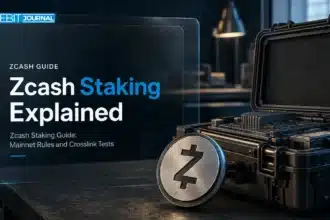
This Zcash staking guide starts with a distinction that can prevent costly confusion: ZEC cannot be staked on the Zcash mainnet as of November 19, 2026. Zcash uses proof of work, while a separate Crosslink project is testing a proposed proof-of-stake layer with test tokens.
TL;DR
- Mainnet ZEC staking and validating are not supported under Zcash’s current proof-of-work design.
- Crosslink staking refers to participation in testing, using cTAZ test tokens and a separate test wallet, not ordinary ZEC.
- Test rewards are program payouts, not a promised or ongoing mainnet yield. Check current official instructions before taking part.
Zcash staking guide: what the network supports
Staking usually means locking or delegating tokens to help a proof-of-stake network validate transactions. In return, a protocol may distribute rewards under its rules. Zcash works differently: miners use computing power to secure its proof-of-work blockchain. ZEC holders do not need to stake or hold coins to participate in mining.
Bitwise’s SEC registration statement, filed November 17, 2026, says ZEC cannot be staked on the Zcash mainnet or used to operate a validating node. It also describes Zcash as a proof-of-work network. That is the clearest answer to searches such as “can you stake Zcash”: not on mainnet under the design described in that filing. The SEC filing also notes a 21 million ZEC supply cap and says miners are not required to hold or stake ZEC.
Mining is not a simple substitute for staking. It involves specialized equipment, electricity, and operational costs, and returns can vary.
Does this Zcash staking guide include Crosslink?
Yes, but Crosslink is a proposal in development, not an active mainnet staking feature. The November 17 SEC filing says the proposed design would add a proof-of-stake finality layer alongside proof of work. It also says Crosslink had not been formally proposed for a scheduled Zcash network upgrade as of that date. A proposal or test does not mean the network has adopted staking.
Crosslink testing has its own rules. The project’s test guide tells participants to use a separate test wallet and cTAZ test tokens, not mainnet ZEC. It describes staking as participation in testing and says only the current test chain earns rewards. The guide also calls for participants to update within a week of releases.
Those details can change as software develops. For example, the guide listed a November 5, 2026 v17 release as a required update and said it used the same test chain as v16 until a network upgrade scheduled for block 165,000. Treat those as dated test instructions, not permanent network rules. Confirm the current release and wallet requirements in the official guide before using any test software.

Crosslink rewards are not a ZEC staking yield
A reported test payout can sound like a return, but it needs context. The Crosslink guide reports that Round 2 paid 25 ZEC in total on October 15, 2026: 19.954 ZEC for mining and staking across 17 participants, plus 5.046 ZEC in discretionary awards to eight contributors. These were reported program payouts, not a stated mainnet staking rate.
That figure does not establish a fixed reward, annual percentage yield, or future payment schedule. It combines activities and discretionary awards, and relates to a particular testing round. The guide says only the current test chain earns rewards. A participant should not assume that an amount paid in one round will recur or that test rewards will carry over to mainnet.
Anyone considering test participation faces software and operational risks, including bugs, changing instructions, and the possibility of losing access to test assets. Test tokens are not a substitute for mainnet ZEC. Be cautious of unsolicited offers claiming that mainnet Zcash staking is available. Never share a seed phrase to join a test or receive rewards.
Pros and cons of Crosslink testing
| Potential benefit | Limit or risk |
|---|---|
| Participants can try a proposed design on a test chain. | Testing does not make staking available on Zcash mainnet. |
| The guide documents test wallet, token, and update requirements. | Instructions can change, and software may have bugs. |
| Past rounds show that program payouts have occurred. | Past test payouts are not a promised yield or ongoing reward. |
This comparison is about technical participation, not a financial recommendation.
Who this Zcash staking guide is for
This guide is useful for ZEC holders checking whether mainnet staking is available, readers comparing proof of work with proof of stake, and technically minded users looking into Crosslink testing. It helps separate a developing test from a feature already running on the production network.
Crosslink testing is not a fit for someone seeking predictable income, a set-and-forget way to earn on mainnet ZEC, or a guarantee that a proposal will become a network upgrade. It may also be unsuitable for people who are not comfortable installing and updating test software or who cannot tolerate the risk of bugs and lost test assets.
ZEC itself carries market volatility and potential total-loss risk. Wallet, exchange, and custody failures can create separate losses, while scams may imitate official programs. The rules governing crypto assets differ by country. Anyone with tax or legal questions should check with a qualified professional in their jurisdiction.
Bottom line
As of November 19, 2026, Zcash mainnet uses proof of work, and ZEC cannot be staked there according to Bitwise’s SEC filing. Crosslink is a separate, developing test of a possible proof-of-stake finality layer. Its test-token rules and past payouts do not amount to a live mainnet staking product or a reliable yield. Keep those distinctions clear, and check the project’s latest instructions rather than relying on old test details.
Sources
- Bitwise Zcash ETF, Form S-1 (www.sec.gov)
- Crosslink test guide (openzcash.org)
- Zcash price and market data (CoinGecko)
This article is for informational purposes only and does not constitute financial or investment advice. Cryptocurrencies are highly volatile; always do your own research before investing.