







With Bitcoin price back above $80,000 after everything seemed like it was going down the path of another bear market, one of the biggest questions in the crypto market has returned: Has Bitcoin already formed its bear-market bottom and if so, when can it reach an all-time high above $126,000?
The answer depends even more on if the institutional demand for spot Bitcoin ETFs continue to absorb sell pressure while macro conditions are steady. While Bitcoin is back at the low-$80,000s price region, the market still faces heavy resistance from investors trapped near the previous cycle peak.
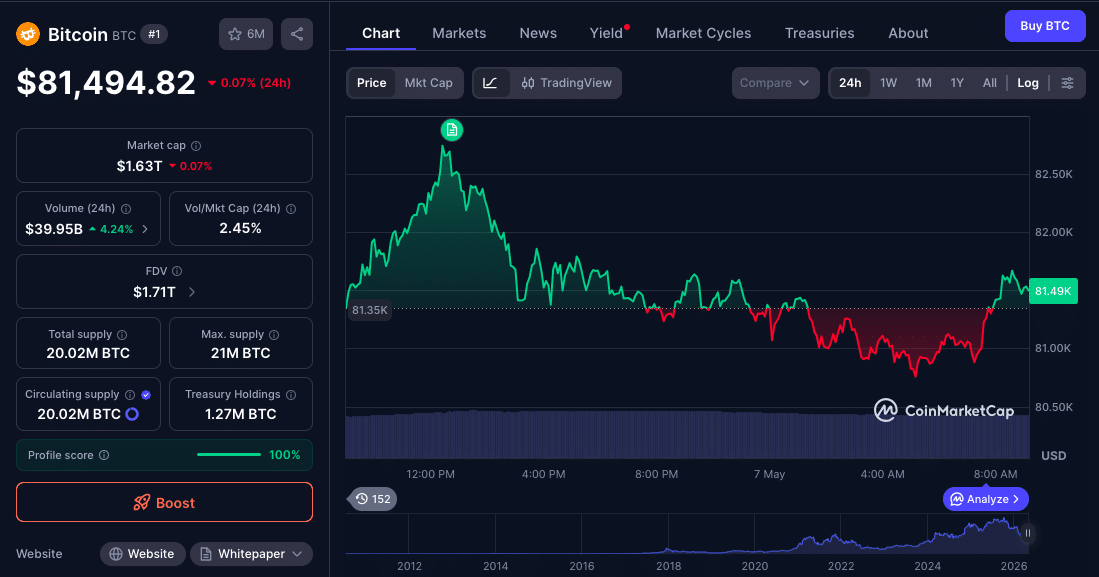
Bitcoin price was trading around $81,494 as at press time, about 30% below its Oct. 6, 2025 peak of $126,198. BTC would require roughly a 54% rally to print a new high from current levels. Recent ETF inflows have lifted sentiment, but analysts say the market still requires better confirmations before declaring the correction over.
Bitcoin Bullish Structure Built on Fund Inflows from ETFs
The strongest support for Bitcoin’s current rebound continues to come from institutional ETF demand.
Recent data showed U.S. spot Bitcoin ETFs attracting hundreds of millions of dollars in daily inflows. Net inflows reportedly reached $629 million on May 1, followed by $532 million on May 4 and another $467 million on May 5.
April has also been Bitcoin ETFs’ strongest month of 2026 so far, with inflows nearing $1.9 billion to $2 billion depending on the data provider tracked.
This, in turn, has allowed for the recovery of Bitcoin from its earlier 2026 lows around $60,000. ETF buying is now cushioning against long-term profit taking into resistance zones, according to analysts.
BlackRock’s BlackRock iShares Bitcoin Trust continues to dominate flows and remains one of the largest regulated gateways for institutional Bitcoin exposure.
The ETF structure has changed how Bitcoin trades this cycle because it allows wealth managers, hedge funds, pension allocators, and traditional firms to gain exposure without directly handling crypto custody.
However, analysts warn that ETF flows alone cannot guarantee a straight path higher. Big inflow momentum may slow rapidly if macroeconomic pressure intensifies or investors start dumping into rallies.
This is why the $82,000-$83,000 area is so critical. Before seeing a real move towards $90,000, Bitcoin needs to turn this range into support.

Heavy Overhead Supply Still Threatens Bitcoin Price Recovery.
Despite the improving ETF narrative, the market still faces major overhead supply.
On-chain analytics data from Glassnode noted that roughly 8.4 million BTC are currently held at a loss across the $80,000-$126,000 range.
That creates difficulty for bulls, as a large number of investors that entered the market towards the 2025 peaks might as well sell once Bitcoin nears their break-even prices.
Instead of a clean breakout, the market is undergoing what analysts call a “supply absorption phase”. Each rally higher is being tested by holders looking to exit positions accumulated closer to the all-time high.
Glassnode also described Bitcoin as stuck at both important realized price metrics and key cost basis levels to further push the idea that the recovery is “not yet confirmed” but rather fragile.
The low-$80,000 region now acts as the market’s first gate. Analysts claim if BTC again fails to hold this level, then the next major support area is between $65,000 and $70,000.
That range has been argued over, whether the bear-market bottom is already in.
Why Analysts Say Bitcoin’s Bottom is Still a “Process”
Many analysts believe that Bitcoin has more of the setup of having bottomed than a confirmed cycle reversal.
Bitcoin bottoms rarely occur in a single event, as history shows. Instead, they follow through lengthy periods of consolidation, core weakness and frequent support retests.
According to recent Glassnode reports, the market is still in redistribution and has not made a confirmation of an uptrend.
This is important considering the market has yet to show with any force that it can absorb sell pressure while maintaining higher support levels.
If Bitcoin price is unable to maintain its recovery, analysts believe that the $65,000-$70,000 zone will be the most crucial area where further downside can be contained.
The outlook that the bottom has solidified would be greatly reinforced by a bounce off of there, as well as continued ETF inflows and better demand in the spot market.
But if that support breaks, the more bearish late-2026 cycle models could return. Some cycle analysts still see possible downside scenarios down to around the $35,000 mark if macro conditions worsen and ETF demand reverses.
Further macroeconomic conditions remain another variable. A surge in oil prices, worries about inflation persisting longer than expected and high Treasury yields keeps risk off on the global stage.
The U.S. Federal Reserve recently asserted by keeping interest rates steady in the 3.50%-3.75% range while warning that inflation is still too high due to rising energy prices and geopolitical tensions.
These issues set limits to how much and for how long risk assets such as Bitcoin can rally.
Galaxy Digital CEO Michael Novogratz recently argued that Bitcoin may struggle to reclaim $100,000 without a more accommodative central-bank backdrop.
Will Bitcoin Price Actually Trade Above $126K in 2026?
Still, analysts rate a new Bitcoin all-time record before December 31, 2026, though with some risk in their estimation.
The most realistic timeline currently points toward late Q3 or Q4 of 2026, assuming several conditions are met first.
To do so, Bitcoin price has to hold the $82,000-$83,000 range as support before reclaiming $90,000 and convert the previous macro breakout at $100,000 into support.
Ongoing buy pressure from newer holders will also need to be greater than the growing sell pressure, so inflows into the ETF must remain persistently positive.
Prediction Markets and Analysts Disagree on How Likely that Outcome is.
Bearish estimates sit around $60,000-$75,000 based on CoinGecko’s aggregated forecasts while institutional-style targets range between $143,000 and $170,000. More aggressive bullish scenarios place Bitcoin above $200,000, though those remain minority views.
Prediction-market pricing is still more conservative. Recent reports have suggested the probabilities placed Bitcoin’s chances of breaching $100,000 by year-end at 48.5%, and around 20.5% for touching $120,000.
Firms such as Bitwise maintain that this cycle may eventually break away from the conventional four-year halving pattern as ETF demand is altering Bitcoin’s supply dynamics.
The ETF market has created a new institutional demand channel that did not exist during previous cycles. Analysts say that is the biggest reason Bitcoin’s 2026 structure looks different from earlier post-halving periods.
That said, traders are seeking evidence before pricing another sizable breakout.
Conclusion
A lot of optimism came with Bitcoin price swinging back up from under $80k, though the market is still in a confirmation and not an entire bull cycle yet.
ETF inflows have substantially eased the sentiment and continue to provide some price action support, but deep overhead supply in the $80k-$126k range is still likely one of the biggest hurdles.
Also, the macroeconomic pressure from high yields, inflation risk and geopolitical instability is still looming in the market.
Meanwhile, analysts are tracking a potential new Bitcoin all-time high above $126,000 sometime in 2026 if BTC can maintain the low-$80,000 region and reclaim higher resistance levels while sustaining strong inflows through spot ETFs.
Glossary
Spot Bitcoin ETF: An exchange traded fund that invests directly in Bitcoin, enabling traditional investors access through regulated financial markets.
Overhead Supply: A price range where many investors previously bought assets and may sell once prices recover to their entry points.
Redistribution Phase: A market period where assets move from one group of holders to another without a confirmed long-term trend reversal.
Support Level: A price area where buying demand is expected to prevent further declines.
Resistance Level: A level where sellers interest increases limiting upward movement
Frequently Asked Questions About Bitcoin Price Action
Is Bitcoin’s bear market over?
Not officially. Some analysts think Bitcoin might be starting a bottoming structure, although it’s still early to confirm whether it has or not depending on how it holds major support zones and the ETF demand.
What price does Bitcoin need to break next?
The immediate levels of $82,000-$83,000 then after that $90,000 and lastly onto $100,000.
Why are ETF inflows significant for Bitcoin?
Spot ETFs offer institutional investors a regulated access to Bitcoin. Increased inflows assist in reducing selling pressure and enhancing market liquidity.
Could Bitcoin price still fall below $70,000?
Yes. If the current rebound fails, analysts say the area of $65,000-$70,000 is a major support for Bitcoin on the downside.
When Will Bitcoin price Hit a new all-time high?
If ETF inflows remain strong and macro conditions improve, projections are currently more realistic for late Q3 or even into Q4 2026.
References