

The crypto market has a way of turning quiet tension into a loud move. One day, charts look stable, traders talk about the next rotation, and sentiment feels “fine.” Then the floor drops out, and everyone suddenly remembers how fast altcoins can fall when liquidity gets nervous.
That is what played out in the latest altcoin market sell-off, where broad downside pressure swept through major tokens and pushed the market into a more defensive posture. Market data showed the total crypto market cap excluding Bitcoin sliding to around $1.2 trillion, a daily drop of roughly $50 billion, which comes out to just over 4% on the session.
This was not a slow bleed. It was active selling, with 24-hour trading volume near $147 billion, a key detail that changes the story. When volume stays high during a decline, it usually signals conviction. That can mean forced exits, panic hedging, or systematic de-risking, but it rarely means casual profit-taking.
Behind the candles, the message was simple: the market shifted from “buy dips” to “protect capital,” and that mood can linger longer than people expect.
A market correction that felt sharper than the headlines
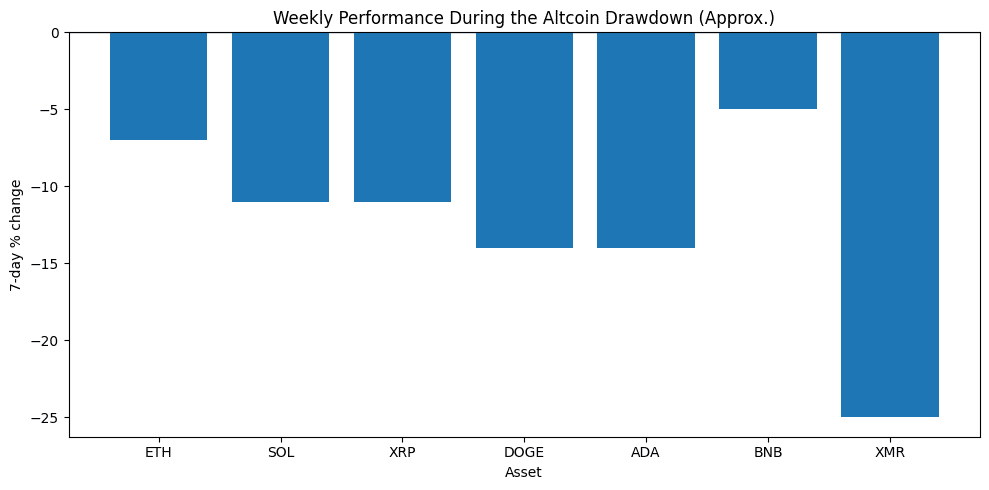
Several major altcoins took real damage as the decline spread across large caps. Ethereum slipped below $3,000 during the drop, marking a notable psychological break for the second-largest asset in the market. In parallel, Bitcoin fell below $90,000, a move that tends to tighten fear across the entire risk curve because it hits confidence first, then leverage second.
This combination is rarely friendly to altcoins as Bitcoin weakness often acts like a gravity well, pulling liquidity away from higher-beta assets. Even when Bitcoin stabilizes quickly, altcoins can continue slipping because traders reduce exposure in layers. First the speculative names get cut, then mid-caps, then the “strong” majors that were holding up a day earlier.
That cascading effect is why an altcoin market sell-off can feel like a sudden storm. It is not always about one event. It is about positioning. When too many traders are leaning the same way, a modest push becomes a tumble.
Why this drawdown looks like risk reduction, not just noise
When crypto sells off alongside broader markets, the reason is often less dramatic than the commentary. It usually comes down to the same old ingredients: uncertainty, leverage, and a rush toward safety.
In this case, the wider macro tone turned defensive, with global markets showing a stronger risk-off impulse as investors weighed fresh geopolitical and policy uncertainty. Crypto does not trade in a vacuum, especially not in 2026, when institutional involvement means correlation spikes can appear quickly during stress.
The important detail is that the decline did not look like low-liquidity slippage. It looked like people choosing the exit, and choosing it fast. That is the hallmark of an altcoin market sell-off that feeds on itself. As prices drop, margin tightens. As margin tightens, positions close. As positions close, price drops again.
Key signals inside the altcoin market sell-off
Chart watchers often focus on price alone, but the healthier approach is to read the full dashboard. Price tells what happened. Indicators explain how it happened.
The most widely watched benchmark for altcoin health is the total crypto market cap excluding Bitcoin, often tracked through the TOTAL2 index. It exists for a reason: Bitcoin is so large that it can hide weakness elsewhere. When TOTAL2 breaks down, it usually means the broader market is losing its footing.
During this slide, several signals lined up in a way that traders recognize instantly.
First, the structure weakened. The market failed to hold a prior support zone and slipped toward levels that previously acted as a base. That matters because altcoins rely heavily on confidence. A market that loses its base tends to invite sellers on every bounce.
Second, volume stayed elevated into the drop. High volume on red days often reflects distribution, meaning sellers are not just trimming, they are actively exiting.
Third, momentum faded. A soft momentum environment turns rallies into shorter-lived events, where buyers struggle to follow through. In practice, that means relief bounces become selling opportunities rather than trend reversals.
Fourth, Bitcoin’s dip below $90,000 added pressure to everything else. Smaller assets typically fall more during stress because liquidity is thinner and traders treat them as optional risk.
When these pieces come together, the market tends to treat the move as more than a single ugly day. It treats it as a warning that the “easy upside” phase has paused. That is why this altcoin market sell-off feels important, even for long-term readers who do not trade short-term candles.
The long-term view: what breaks, and what survives
Not every selloff is a crisis. Some are resets that clean the market, flush out overconfidence, and create healthier conditions for the next leg higher. The problem is that the market rarely signals which one it is in real time.
To make it practical, long-term investors usually watch three core areas during an altcoin market sell-off.
The first is whether the market cap excluding Bitcoin can stabilize above its previous consolidation range. If it fails to hold that zone, downside can extend because there is little structural support until the next major base.
The second is Bitcoin dominance and capital rotation. If Bitcoin stabilizes while dominance rises, it often means money is parking in Bitcoin rather than leaving crypto entirely. That can be painful for altcoins short-term, but it is less destructive than a full exit into cash.
The third is stablecoin behavior. When stablecoin market share remains strong, it suggests capital has not vanished. It has simply moved to the sidelines, waiting for clarity. Recent market data continues to show stablecoins holding a meaningful portion of the total crypto market, which supports the idea that capital is still present, just cautious.

What traders usually miss during drops like this
The most common mistake in a fast decline is assuming the market “has to” bounce quickly because it has already fallen enough. Crypto does not care about fairness. It cares about liquidity.
During an altcoin market sell-off, bounces can be sharp but short, like a ball hitting a staircase. Price snaps up, stops trigger, shorts cover, and then the same sellers return because the larger problem is still unresolved.
That is why the market often needs time, not just a bounce. Time allows volatility to compress, leverage to reset, and buyers to step in without fighting a waterfall.
In practical terms, the healthiest recoveries usually start quietly. They begin when panic fades and volume normalizes. That phase is boring, which is exactly why it works.
What comes next for altcoins in 2026
If the market stabilizes, the next phase often looks like selective strength rather than a broad rally. The “everything pumps together” environment usually comes later, after confidence returns.
If weakness continues, the market may enter a longer consolidation where capital becomes picky and narratives thin out. That can still be constructive long-term because it forces projects to compete on real traction, not hype.
Either way, this altcoin market sell-off is a reminder that 2026 is not just about bullish narratives. It is also about market structure, positioning, and survival.
The projects that hold up best tend to share a few traits: deep liquidity, consistent user activity, and clear market fit. In contrast, tokens that rely mainly on short-term attention often suffer the most when the market turns cautious. That gap between “built to last” and “built to trend” becomes obvious during days like this.
Conclusion
The latest decline was not just another red day. It was a sharp shift in behavior, where the market chose safety over speculation and did it with force. With total crypto market cap excluding Bitcoin falling toward $1.2 trillion and volume staying elevated, the move reflected real selling pressure, not a quiet drift.
For long-term readers, the bigger lesson is not fear. It is awareness. An altcoin market sell-off often reveals where liquidity is strongest, where leverage was hiding, and which assets have real staying power when sentiment turns cold.
The market can recover, but recovery usually comes after structure stabilizes and risk appetite slowly rebuilds. Until then, the altcoin space remains in a phase where patience matters more than prediction.
Frequently Asked Questions (FAQs)
Why do altcoins fall harder than Bitcoin during selloffs?
Altcoins typically have thinner liquidity and higher volatility, so they react more aggressively when traders reduce risk. When Bitcoin drops, investors often cut exposure in higher-risk assets first, which amplifies altcoin losses.
What does “market cap excluding Bitcoin” actually show?
It shows the combined value of the crypto market without Bitcoin included. This helps track the true strength or weakness of altcoins, since Bitcoin alone can dominate the overall market picture.
Does high trading volume during a drop mean the bottom is in?
Not necessarily. High volume confirms strong participation, but it can represent panic selling or forced liquidations. A more reliable sign of stabilization is when volume begins to normalize and price stops making lower lows.
Is this type of drawdown bearish for the rest of 2026?
Not automatically. Some selloffs become healthy resets that clear leverage and create stronger conditions later. The longer-term direction depends on how quickly the market stabilizes and whether capital rotates back into altcoins.
Glossary of Key Terms
Altcoin: Any cryptocurrency that is not Bitcoin.
Market Cap: The total value of a cryptocurrency or group of assets, calculated by price multiplied by circulating supply.
TOTAL2: A widely used benchmark representing the total crypto market cap excluding Bitcoin, often used to measure altcoin strength.
RSI (Relative Strength Index): A momentum indicator that helps gauge whether an asset is overbought or oversold, based on recent price changes.
Support: A price zone where buying historically becomes strong enough to slow or stop declines.
Resistance: A price zone where selling historically becomes strong enough to stall rallies.
Dominance: The share of the total crypto market cap held by a specific asset, commonly tracked for Bitcoin.
Risk-Off: A market mood where investors move away from volatile assets and toward safer holdings.
References