







This article was first published on The Bit Journal.
Ethereum co-founder Vitalik Buterin has publicly flagged some flaws that decentralized stablecoins have yet to overcome.
Responding to comments made about Ethereum’s role in the crypto space, Buterin detailed that three major issues concerning dependence on the USD, oracle exploits, and competition with staking rewards have yet to be fixed.
What Ethereum Wants and the Stablecoin Debate
The conversation that inspired Buterin to respond started with a Cyberpunk lawyer named gabrielShapir0 on X. He claimed that Ethereum is a “contrarian bet” against much of what venture capitalists are supporting in crypto.
“It’s increasingly obvious that Ethereum is a contrarian bet against most of what crypto VCs are betting on,” he wrote, referring to gambling apps, CeDeFi, custodial stablecoins and neo-banks as hot sectors for investment.
The commenter continued saying;
“Ethereum is tripling down on disrupting power to enable sovereign individuals.”

Buterin did not argue with that interpretation. Instead, he took the chance to explain why one of Ethereum’s most critical use cases, which is decentralized stablecoins, remained an unfinished business.
His comments suggest that, even after years of trial and error and real-world use, the basic principles behind Web services are still not solved.
Dollar Pegs Offer No More Than a Temporary Solution
One of Buterin’s key criticisms about decentralized stablecoins is that they’re pegged to the U.S. dollar, an inherently flawed logic in his mind. In his own words, Buterin penned on X:
“We need better decentralized stablecoins. IMO three “We need better decentralized stablecoins. IMO three problems:
Ideally figure out an index to track that’s better than USD price
Oracle design that’s decentralized and is not capturable with a large pool of money
Solve the problem that staking yield is competition…”
Buterin said pegging to the dollar was a good idea in the short term. But depending on a single government-issued currency is counter to a long-term vision of resilient decentralized money, he cautioned.
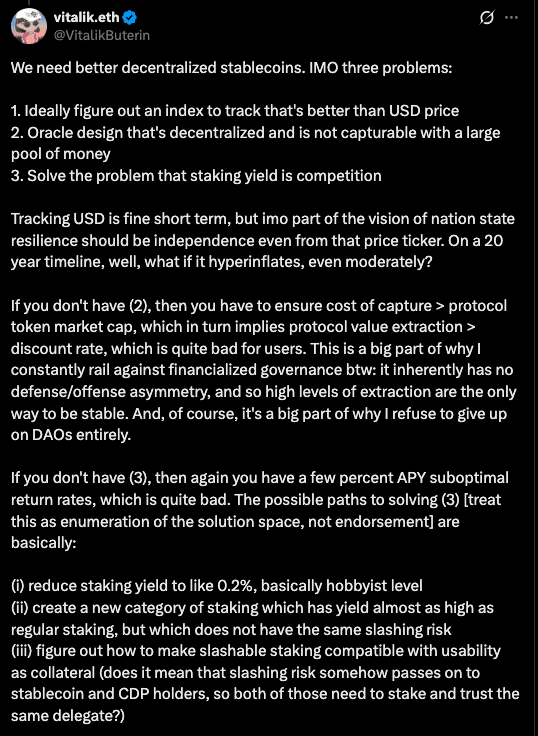
Over long time frames, decades, not months, even mild inflation or shifts in policy could undermine the very peg these systems rely on to remain stable.
His point is simple: The dollar-pegged designs solve today’s problem but not tomorrow’s economic reality.
It has been argued that a truly robust decentralized money should not rely too closely on any one fiat currency to reduce systemic risk.
Oracle Capture: An Obscured Centralization Threat
Buterin’s second point of concern regarding decentralized stablecoins is related to oracles. Stablecoin protocols need external price data in order to update pegs, rebalance assets, or invoke stabilization utilities.
Oracles offer the data but when the oracle system can be taken or hijacked by a big pile of capital, decentralization becomes cosmetic.
From Buterin’s X post:
“Oracle design that’s decentralized and is not capturable with a large pool of money.”
The capture threat arises when Oracle data sources or Oracle operators can be economically or politically influenced by well-funded actors.
In these instances, protocols counterbalance corruption with high costs that are charged either in fees, emissions, or governance power to render manipulation unprofitable, essentially reversing economic defenses into extractive practices, which might ultimately burden users and undermine decentralization.
Critics such as Buterin claim that economically defensive oracles should drive up the price of capture to exceed the entire market value of the protocol, which typically has high impediment costs and likewise yields operating expenses (or governance centralization) at odds with the decentralized ideal.
These trade-offs are central to why decentralized stablecoins have not achieved parity with centralized alternatives in market adoption.
Staking Yield Presents Economic Competition
The third vulnerability Buterin points to is the economic context into which new decentralized stablecoins find themselves inserted; that is, the presence of staking yield on networks like Ethereum.
Staking is the process of holders of a blockchain’s native asset (in Ethereum’s case, ETH) locking up their tokens to help ensure network security and receive return. But such a return can be in direct competition with possible yields from stablecoin systems.
Buterin explained that as long as staking is a safer and easier way to achieve the same return, people will prefer to stake than locking their funds into such stablecoin protocols for lesser return or some risk exposure.
To combat this competition, Buterin described a number of hypothetical paths the sector could take such as drastically slashing staking rewards, offering non-slashing options to stake or allowing for slashable collateral on stablecoin systems.
He stressed however that these are conceptual parts of a solution space rather than endorsements of any particular design, and come with their own risks and implementation complexity.
Conclusion
Vitalik Buterin’s recent critique of the design of decentralized stablecoins reveals three core challenges that, according to him, prevent true decentralization and resilience: these are reliance on the U.S. dollar, potential for capture of oracles and direct competition with staking yield.
His comments, which draw from a philosophical commitment to decentralization, challenge the industry beyond short-term pegging and yield engineering toward designs that can be resilient to political, economic, and governance pressures over decades.
Glossary
Decentralized stablecoins: Cryptocurrencies built to preserve stable value through decentralized methods instead of centralized institutions.
Oracle attack: Exposure of external data sources to manipulation or control by deep pockets.
Staking yield: The rewards received for locking up network tokens (e.g. ETH) in order to secure the blockchain.
Slashing Risk: Penalties levied against staked assets for validator misbehaviour or inactivity.
USD peg: A stablecoin’s effort to keep its value in line with the U.S. dollar.
FAQs About Decentralized Stablecoin Flaws
What did Vitalik Buterin comment on the decentralized stablecoin?
Buterin said the current design of decentralized stablecoins is fundamentally flawed because they are based on the US dollar and exposed to vulnerabilities in oracles, as well and rivalled by staking returns.
Why is depending on the USD problematic?
Tying decentralized money to a single national currency undermines independence and resilience over the long run, Buterin says.
What is oracle capture?
Oracle capture occurs when price feeds are susceptible to influence by large capitals and is not conducive for achieving genuine decentralization.
How does staking yield compete with stablecoins?
Yield on staking is quite attractive for investors taking away the liquidity from collateralized stablecoin systems.
References