




Blockchain technology has grown fast over the past decade. It started with Bitcoin in 2009 and is now used in finance, gaming supply chains, healthcare, and digital identity systems. Behind every blockchain network, there is software. That software is written using programming languages. Some languages work better for blockchain than others. Choosing the right one matters for security, speed, and long-term success.
This guide explains the best programming languages for blockchain development in very easy American English. The sentences are simple. The ideas are clear. The goal is to help beginner students and early developers understand which languages are used and why they matter.
What Is Blockchain Development?
Blockchain development is the formation of a network-inherent software program that is capable of operating on a blockchain. A blockchain is a digital ledger that can be considered public, and it is in fact a very powerful one, since it can accommodate data in a very organized way through blocks, with each block being linked to its previous one. When the data is incorporated, changing it out becomes a nearly impossible endeavor.
There are several aspects in blockchain development. One of them is developing the main blockchain framework. The second one is developing crypto contracts. Crypto contracts are tiny automated programs that execute as soon as the conditions are satisfied. In addition, the process of developing applications that link users to the blockchain is another major part.
The programmers who specialize in blockchain technology create codes for payment, data ownership, and trust. As blockchain infrastructures are very tough to modify once they are brought into operation the code has to be robust and secure.
Why Programming Languages Matter in Blockchain Development
Programming languages decide how blockchain software works. They affect speed safety and cost. Some languages are easy to learn but slow. Others are fast but harder to write.
In blockchain mistakes are expensive. A small bug can lead to stolen funds or broken systems. In 2022 alone more than 3 billion dollars were lost due to smart contract bugs according to Chainalysis reports. Many of these issues came from poor coding or wrong language choices.
The right programming language helps reduce risk. It also makes development easier and faster. That is why choosing the right language is one of the first and most important steps in blockchain development.
Key Factors That Decide the Best Blockchain Programming Language
There are various factors that contribute to the decision of which programming language is the best for blockchain development. Among all these factors, security is definitely the most crucial one. The blockchain code usually governs the digital assets. Therefore, if the code is weak the whole system can be compromised.
Another factor that plays a role in the decision is performance. There are some blockchains that have the capability of processing thousands of transactions in a second. Such blockchains would require the use of very quick languages. Support from the community is another important factor to take into consideration. If there is a big community then there will be a lot of tools, more learning resources, and even quicker problem solving.
Ease of learning matters for beginners. Job demand also matters for those who want blockchain careers. A good blockchain language should balance safety speed and support.
Most Popular Programming Languages Used in Blockchain Today
Today blockchain development uses many programming languages. Some are designed only for blockchain. Others are general purpose languages adapted for blockchain use.
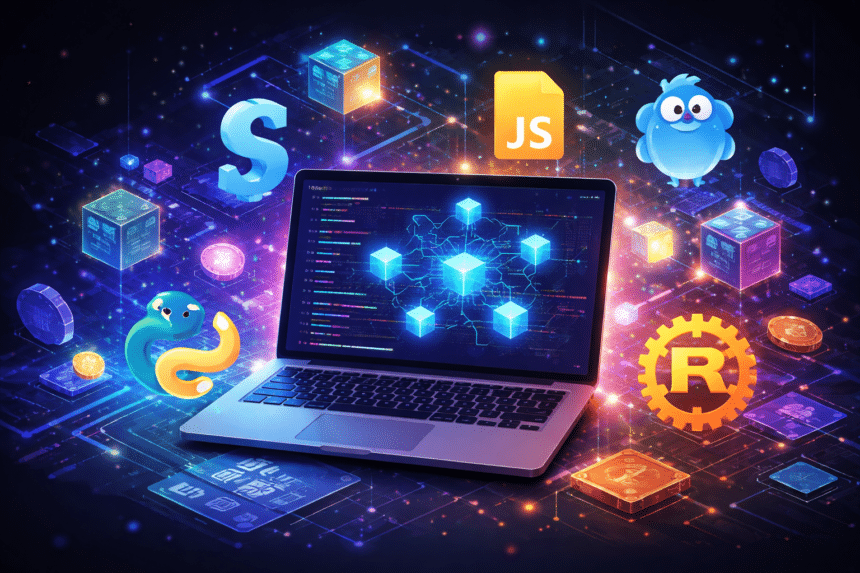
Solidity is used for Ethereum smart contracts. JavaScript is used for blockchain apps and Web3 interfaces. Python is popular for learning testing and research. C Plus Plus is used in Bitcoin and core blockchain systems. Go and Rust are growing fast because they offer speed and security.
Each language has a clear role. No single language is best for everything. The sections below explain each one in detail.
Solidity Programming Language for Ethereum and Smart Contracts
What Is Solidity and Why It Was Created
Solidity is the programming language created specifically for smart contracts. Its primary purpose was to be used on Ethereum blockchain which was established in 2015 and thereby made smart contracts widely used.
Solidity bears a close resemblance to JavaScript. Its main function is to lay down the rules concerning digital money tokens and the decentralized applications. Ethereum Virtual Machine hosts the execution of Solidity code. If it is once deployed then it is very difficult to make changes.
Where Solidity Is Used in Real Blockchain Projects
Solidity is used in most Ethereum based projects. This includes DeFi platforms NFT marketplaces and token systems. Uniswap OpenSea and Aave all rely on Solidity smart contracts.
More than 70 percent of all decentralized apps are built on Ethereum or Ethereum compatible networks according to Electric Capital developer reports. This makes Solidity one of the most important blockchain languages today.
Advantages and Limitations of Solidity
Solidity has strong tooling and a large developer community. Many tutorials libraries and audits are available. However Solidity is risky for beginners. Small mistakes can cause big losses.
| Feature | Details |
| Main Use | Smart contracts |
| Popular Networks | Ethereum BNB Chain Polygon |
| Difficulty Level | Medium |
| Job Demand | Very High |
| Security Risk | High if written poorly |
JavaScript for Blockchain Development and Web3 Apps
JavaScript is a programming language that is widely used around the globe and is among the top programming languages. It is not a language specific to blockchain but still, it is very important for the development of blockchain applications.
The main role of JavaScript in blockchain technology is through the creation of user interfaces that allow interaction with the blockchain. JavaScript is the heavy lifter that powers wallets, dashboards, and Web3 applications. It is the mouthpiece of the smart contracts that users can transact with and execute commands through.
Thanks to libraries like Web3.js and Ethers.js, JavaScript is able to join in on the fun with Ethereum networks. Thus, it is a must for the blockchain development process even though it is not directly used in the blockchain.
| Tool | Purpose |
| Web3.js | Connects apps to Ethereum |
| Ethers.js | Smart contract interaction |
| Node.js | Backend blockchain services |
| React | Web3 user interfaces |
JavaScript is beginner friendly. Many developers start blockchain development using JavaScript because it is easy to learn and widely used.
Python for Blockchain Development and Research
Python is known for simple syntax and readability. It is often the first language learned by beginners. In blockchain Python is used mainly for learning testing and research.
Python helps build blockchain simulations. It is used to test smart contracts and analyze blockchain data. Many blockchain courses use Python because it is easy to understand.
Python is not often used for high speed blockchain networks. It is slower than C Plus Plus or Go. However it remains very useful in early development stages.
C Plus Plus for Core Blockchain Systems
C Plus Plus is one of the oldest and fastest programming languages. It is used to build core blockchain systems where performance matters most.
Bitcoin is written in C Plus Plus. Many early blockchains chose this language because it offers full control over memory and system resources. This helps improve speed and security.
C Plus Plus is hard to learn. It requires deep technical knowledge. It is not ideal for beginners. However it remains critical for blockchain infrastructure.
Go Programming Language for Scalable Blockchains
Go also called Golang is a modern language created by Google. It focuses on simplicity speed and concurrency. Many enterprise blockchain projects use Go.
Hyperledger Fabric uses Go for its core components. Go handles many tasks at the same time which helps blockchains scale better.
Go code is easier to read than C Plus Plus. It is faster than Python. This balance makes Go popular for blockchain networks and backend services.
Rust Programming Language for Secure Blockchain Development
Rust is a modern programming language that gives priority to safety. It actively prevents a large number of common coding mistakes. As a result, Rust has become a hotspot for blockchain applications.
Reasons like the Solana Polkadot and Near blockchains are relying on Rust. These networks are primarily concerned with high performance and security. Rust brings down the number of memory-related bugs which are frequently encountered in other programming languages.
Rust is harder to learn than JavaScript or Python. However it is gaining popularity fast. Developer surveys show Rust as one of the fastest growing blockchain languages in 2024 and 2025.
Java for Enterprise Blockchain Solutions
Java is widely used in business software. Many enterprises already rely on Java systems. This makes Java a natural choice for private and permissioned blockchains.
Hyperledger Fabric supports Java for smart contracts. Java offers stability long term support and strong security tools. Large companies trust Java because it has been used for decades.
Java is not often used in public blockchain networks. It shines in corporate and regulated environments where reliability matters more than speed.
Which Blockchain Programming Language Is Best for Beginners
Initially the simplicity of the programming language is the top priority for the absolute novice. Most of the time Python or JavaScript will be the first considered languages. The reason is their straightforwardness and the vast support available for them.
For those new to programming who want to deal with smart contracts the language Solidity is also used a lot. But it is not that easy and requires extra attention since a mistake might lead to great loss.
One often seen route in educating about the blockchain development is starting with JavaScript or Python and then shifting to Solidity or Rust.
Which Programming Language Is Best for Blockchain Jobs in 2025
Job demand in blockchain development remains strong. Solidity developers are in high demand due to Ethereum dominance. JavaScript developers with Web3 experience also see strong hiring.
Rust and Go developers are seeing growing demand due to newer high performance blockchains. Enterprise roles often require Java skills.
According to LinkedIn job data blockchain roles increased steadily through 2024. Security focused skills are especially valued.
Final Thoughts on the Best Programming Languages for Blockchain Development
Blockchain development depends heavily on programming languages. Every individual language has its own special function. Solidity is the one which makes the smart contracts work. JavaScript is the middleman who links up the people. Python is the assistant that enables the students to learn. C Plus Plus Go and Rust are the ones that create the most reliable and fast networks.
No one programming language is the best option for all blockchain projects. The most suitable one is determined by the project’s objectives, performance demands, and security concerns. The developers who will be able to use these languages will have a solid ground built for the future of blockchain, 2025, and later.
Frequently Asked Questions
What is the best programming language for blockchain development
Solidity is best for smart contracts. JavaScript and Python are good for beginners. Rust and Go are strong for secure networks.
Is Python good for blockchain development
Python is good for learning testing and research. It is not ideal for high speed blockchain networks.
Is Solidity hard to learn
Solidity is medium difficulty. It requires careful learning because small mistakes can be costly.
Which language is best for smart contracts
Solidity is the most widely used language for smart contracts today.
Summary
The development of blockchain is basically determined by the selection of the proper programming language. Different languages have different impacts on the formation and upkeep of blockchain systems. Certain languages are reserved for the development of smart contracts. The rest are used either for the foundational blockchain network or for user connection through web apps.
Solidity is the most important language for smart contract development on Ethereum and similar networks. JavaScript is widely used to build Web3 applications and user interfaces that interact with blockchains. Python is popular for learning blockchain basics testing smart contracts and analyzing blockchain data. C Plus Plus is used for core blockchain systems like Bitcoin where speed and performance are critical.
Go and Rust are rapidly becoming more and more popular in the blockchain area. The preference of Go is for large and enterprise-granted blockchains. Rust has strong security features and is used by modern high-performance networks. Java continues to play a significant role in private and enterprise blockchain-based solutions.
No universal best programming language exists for all blockchain-related projects. Decision on the most suitable one should be based on the project’s aim, whether it is centered around smart contracts, web applications, security, or large networks. Knowledge of these programming languages will assist in creating a solid base for blockchain development in 2025 and on.