






This article was first published on The Bit Journal.
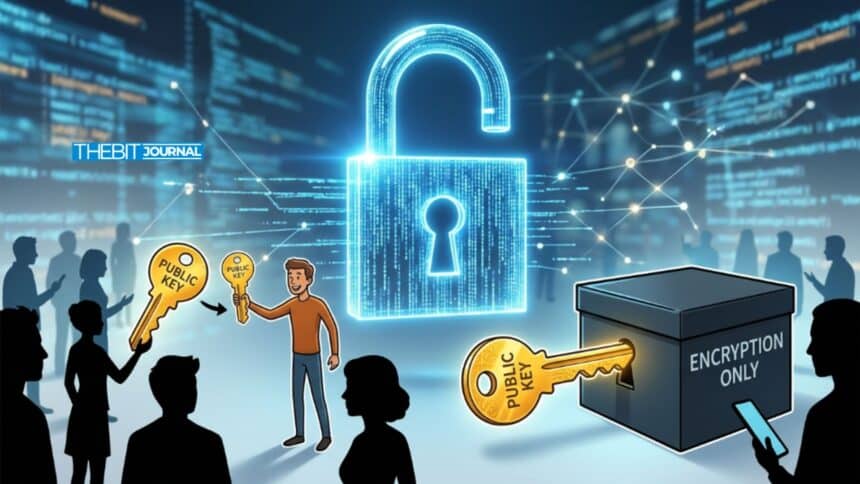
Public key cryptography is the backbone of modern digital security. It uses a key pair: one public and one private, to encrypt, sign, and authenticate data without ever sharing secrets in advance.
In simple terms, it is the shareable half of this pair. Anyone can see or use your public key, but only you (with the matching private key) can unlock the encrypted data or verify signatures intended for you.
They make secure, trusted communication and transactions possible over the open internet and blockchains, from HTTPS websites to cryptocurrency wallets.
Public key cryptography “came to the rescue” of the Internet’s trust problem by eliminating the need for secret key exchange. As Diffie and Hellman’s groundbreaking 1976 invention showed, each user generates a unique key pair, shares only the public half, and keeps the private half secret.
Data encrypted to this key can only be decrypted by your private key, and signatures created with your private key can only be verified with your public key. In short, the public key lets anyone send you secure data or verify your identity (by checking your signature), without ever needing to handle your private key.
How It Works
Public key cryptography also called asymmetric encryption relies on mathematical algorithms where key pairs are mathematically linked. Each pair consists of a public key (shared openly) and a private key (kept secret).
According to MDN Web Docs, “Public-key cryptography is a cryptographic system in which keys come in pairs. One key (the private key) is kept secret while the other is made public”.
You can think of it as a mailbox; the public key is your mailbox address (anyone can drop a letter in), while the private key is the mailbox key (only you can retrieve the letters).
The two keys have distinct functions:
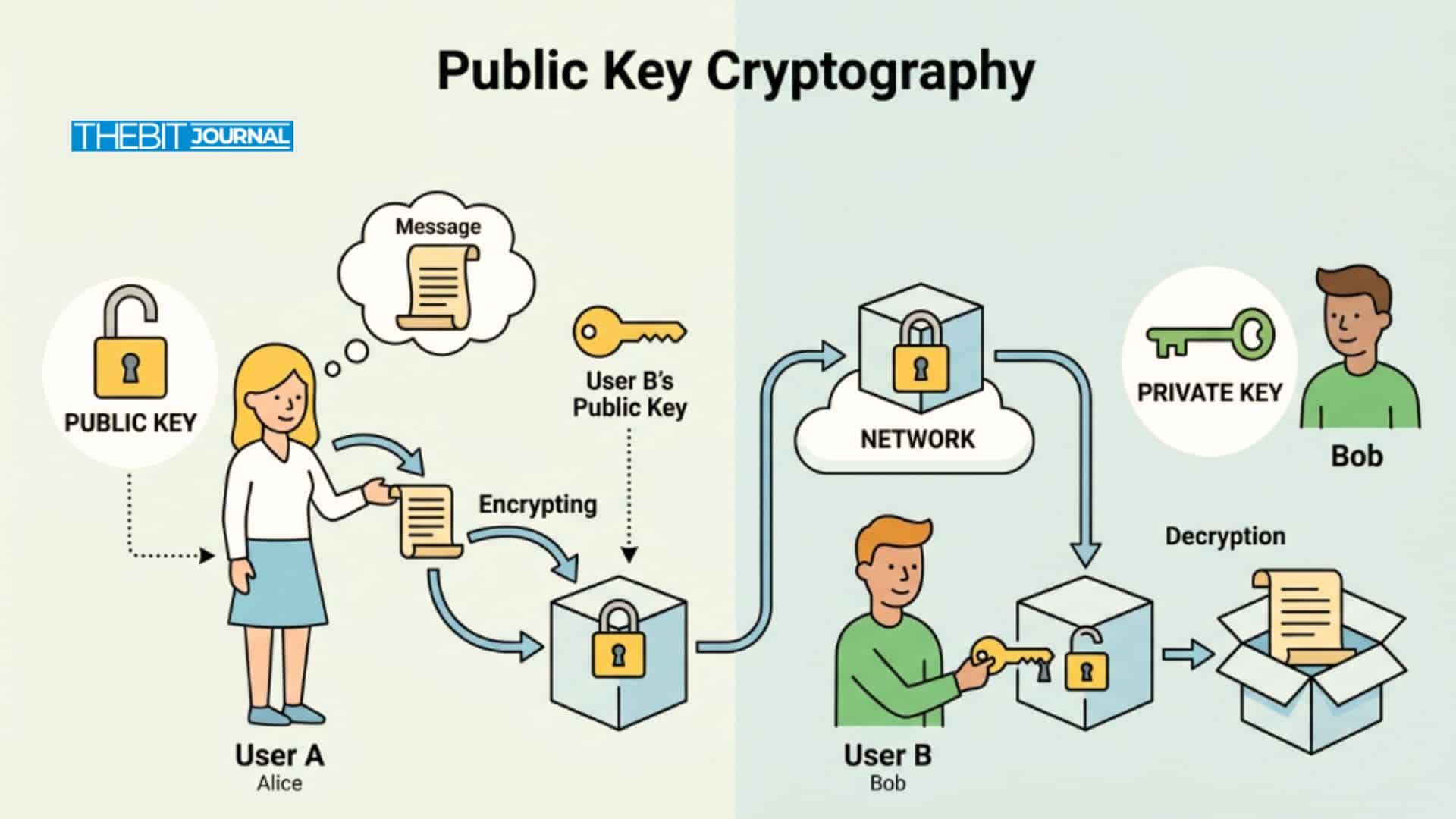
- Encryption and Decryption: Anyone can encrypt a message using your public key, but only your private key can decrypt it. This lets people send you confidential information securely. For example, in email or messaging, you publish your public key, friends encrypt messages to you, and only you can read them.
- Digital Signatures: You sign data with your private key, and others verify the signature with your public key. Each cryptocurrency transaction uses your private key to create a digital signature, which the network then verifies with your public key. In general computing, signing documents or software works the same way. A signed package can be checked by anyone using the public key, proving it came from the private key’s owner.
These roles are complementary. In encryption mode, the public key is used to encrypt, and the private key is used to decrypt. Conversely, for signing, the private key is used to sign, and the public key is used to verify. This design means you can publish the public key widely, even attach it to emails or host it on websites, while the private key stays locked down.
Public Key vs. Private Key: A Comparison
| Aspect | Public Key | Private Key |
| Visibility | Publicly shared (anyone can have a copy) | Secret and confidential (only you hold it) |
| Function | Encrypt data for you; verify signatures you create | Decrypt data sent to you; create digital signatures |
| Use case (Web) | HTTPS/TLS server certificates; blockchain addresses | TLS private key on web servers; wallet key controlling funds |
| Key relationship | One half of an asymmetric key pair, mathematically linked to its private key | One half of an asymmetric key pair, mathematically linked to its public key |
| Security if leaked | Public by design (safe to share) | Compromise of security (attacker gains identity/ability to decrypt) |
Security experts point out that your public key can be shared with anyone, but your private key is the code that will allow anyone access to the funds stored at that public address. In blockchains, your public key is like your account number, all network participants see it (or a hashed version of it) as your wallet address. Meanwhile, your private key must be guarded at all costs, because anyone with it can pretend to be you.
Encryption, Signatures, and Blockchain
Public key cryptography can be seen in many everyday technologies. For instance, when you visit a secure website (HTTPS), your browser fetches the server’s public key certificate. It uses that public key to establish an encrypted channel.
Only the server’s private key can decrypt the session keys that your browser sends. This ensures nobody can eavesdrop or tamper with your data. In effect, the website’s public key is freely known (part of the TLS certificate), but the matching private key remains on the secure server.
In email, protocols like S/MIME and PGP allow anyone to encrypt messages to you using your public key. Only you can open them with your private key.
Similarly, passwordless logins (FIDO2/WebAuthn) rely on public key cryptography. Your device generates a public/private key pair for each site, and the site only ever sees the public key. This is why security bodies express that modern authentication is phishing-resistant provided the private keys are not compromised.
FIDO standards use standard public key cryptography techniques to provide phishing-resistant authentication. No password is sent; instead, the user proves possession of the private key.
In blockchain systems, public keys play a special role. Your cryptocurrency wallet generates a key pair, derives a wallet address from the public key (often by hashing it), and shares that address so others can send you funds.
In blockchains, the public key serves as an address for receiving cryptocurrency or data, while the private key grants control over the associated digital assets.
When you send a transaction, your wallet signs it with the private key, and the network verifies it with your public key, thus proving the transaction really came from your account.
Even beyond cryptocurrencies, public keys are used for digital certificates and identities. Organizations issue certificates that bind public keys to individuals or servers, so others can trust that a key truly belongs to the claimed user.
Certificate Authorities (CAs) manage these and can revoke compromised keys. This is the realm of Public Key Infrastructure (PKI). PKI lets you verify public keys via trusted CAs. If a CA vouches for a public key, you trust that key’s owner.
Why They Matter (and How They’re Secured)
Because anyone can use them to encrypt or verify, public keys are widely shared even published in global directories or on blockchains. Yet the security relies on the private key remaining secret. Modern crypto systems like RSA or elliptic-curve (ECC) are designed so that deriving the private key from the public one is computationally infeasible.
In fact, it’s impossible to find the private key using only the public key due to the one-way math (trapdoor functions).
However, all of this depends on careful key management. A stolen or leaked private key breaks the security. Data meant to be private becomes public, and signatures become forgeable. Organizations must store private keys in Hardware Security Modules (HSMs) or secure vaults, rotate them regularly, and use strong algorithms.
The Post-Quantum Shift
One main trend in 2026 is preparing public key cryptography for quantum computers. Classical public-key algorithms (like RSA or ECC) rely on problems (factoring, discrete log) that a sufficiently powerful quantum computer could solve. NIST warns that administrators should begin transitioning to new standards that can withstand quantum attacks.
By 2030-2035, many agencies plan to deprecate RSA-2048 and ECC P-256. This means that the meaning of a “public key” may change. Future public keys will be larger and based on new math but the core principle stays the same: one key public, one key private.
In fact, today’s public keys are getting much larger to prepare for PQC. A new PQ signature scheme may produce 2,420-byte signatures (and public keys 1,312 bytes) compared to 256-byte RSA signatures.
Expert Insight: Trust via Public Keys
Cybersecurity experts emphasize that public keys enable trust without sharing secrets. Every blockchain transaction uses a public key to verify that indeed the signature was created by the holder of the private key. In other words, the public key itself doesn’t need to be secret; it’s the proof of identity.
This is why even though this key is visible to everyone, attackers still can’t steal funds without the private key. As long as you keep your private key private, no one can move your funds. Even though you are sharing your public key, your address, and the signatures of all your transactions, your funds remain safe.
Public-key cryptography also shifts trust to mathematics and standards. Government and industry bodies maintain algorithms and protocols so that public keys truly belong to who they say.
Organizations like the FIDO Alliance now encourage replacing passwords with public-key “passkeys” which are cryptographic credentials that prevent phishing. All in all, strong public key management and infrastructure enable secure digital identity in 2026.
Conclusion
A Public key is the non-secret half of an asymmetric encryption key pair, intended to be shared openly. It lets anyone send you encrypted data or verify your signed messages. They power everything from HTTPS to cryptocurrency, facilitating secure communication without the need for pre-shared secrets.
Modern security standards and research continue to evolve around public-key cryptography. For instance, building post-quantum-safe key algorithms and phishing-resistant authentication but the basic idea remains that the public key is public and the private key stays private, keeping data secure by design.
As a result, public-key cryptography remains the indispensable foundation for online security in 2026. By separating public and private keys, it provides scalable, trustable encryption and digital signatures across the web and blockchain ecosystem.
They serve as verifiable identities and addresses, while private keys grant control, a duality that will continue to strengthen digital trust as the industry transitions to new cryptographic standards.
Glossary
Asymmetric Cryptography: A cryptographic system using key pairs (public and private). Data encrypted with one key can only be decrypted with the other.
Private Key: The secret half of an asymmetric key pair. Kept confidential, used to decrypt messages or create digital signatures.
Digital Signature: A cryptographic proof generated with a private key that can be verified with the corresponding public key, ensuring data integrity and origin.
PKI (Public Key Infrastructure): A system of digital certificates and authorities that bind public keys to entities.
Post-Quantum Cryptography: New cryptographic algorithms designed to resist quantum computing attacks, which threaten many current public-key algorithms.
Frequently Asked Questions
What is a public key used for?
It encrypts data and verifies signatures. Anyone can use your public key to send you encrypted messages or to check that a message signed by you (with your private key) is authentic.
How does a public key differ from a private key?
A public key is shared openly; a private key is kept secret. The public key allows encryption and signature verification, while the private key allows decryption and signing.
Can someone derive my private key from my public key?
In modern cryptography (e.g. RSA, ECC), deriving the private key from the public key is computationally infeasible. Cryptographic security relies on one-way mathematical problems, meaning you cannot compute the private key even if you know the public key.
Why are they important in blockchain?
In blockchains, public keys (or their hashes) act as wallet addresses. They identify accounts on the network. When you send a transaction, you sign it with your private key; other nodes use your public key to verify the signature, ensuring only the rightful owner could have authorized the transfer.
What happens if it is compromised?
Since they are meant to be public, there is no harm in them being known. The security of your system relies on the private key remaining secret. If someone obtains your public key, they cannot decrypt your data or forge your signatures without the private key.
References
Disclaimer: This article is for educational purposes and does not constitute financial or investment advice. Any information about cryptographic protocols or future standards should be independently verified.