






Ray Dalio has never sounded like a person trying to win applause from crypto Twitter. He tends to talk like a risk manager who has seen a few cycles, a few panics, and a few government moves that change the rules overnight. In a recent interview, he again drew a clean line between Bitcoin as a modern form of money and Bitcoin as something central banks would actually hold as a reserve.
That distinction matters because the market has spent years hoping for a “one day the official world will bless it” moment. Dalio is arguing the opposite. The official world will keep Bitcoin at arm’s length, not because it is useless, but because it behaves in ways that reserve managers do not like.
Dalio’s core argument: reserves are built for control, not for vibes
In the interview, Dalio framed Bitcoin as money in spirit, limited in supply, and treated as money by many. Then he explained why central banks are unlikely to treat it as reserve-grade. His main point is that Bitcoin’s transparency makes it easier to trace and easier to interfere with, which is not how central banks typically think about strategic reserves.
He pushed the comparison that has followed him for years: gold is old, heavy, and inconvenient, yet it is harder to control once it sits outside the system. Bitcoin, by contrast, is digital and globally portable, but the ledger is public. Dalio also added a long-tail worry that reserve managers take seriously, the idea that Bitcoin could be “cracked,” “broken,” or otherwise controlled in a future scenario that is hard to model today.
None of that is a claim that Bitcoin is going to zero. It is a claim about who buys it when the goal is national insurance.
Why central banks still behave like central banks
A reserve asset is not chosen because it is exciting. It is chosen because it is liquid in a crisis, politically workable, and operationally boring. That is why gold remains a steady feature of official thinking, even when it looks like a relic.
Central banks have been adding to gold reserves at a pace that is hard to ignore. In 2024, official sector net purchases exceeded 1,000 tonnes again, with reported additions of 1,045 tonnes. In late 2025, gold also hit new records, supported by safe-haven demand and continued central bank buying, which is the kind of headline that quietly reinforces the “gold still works” mindset inside reserve committees.
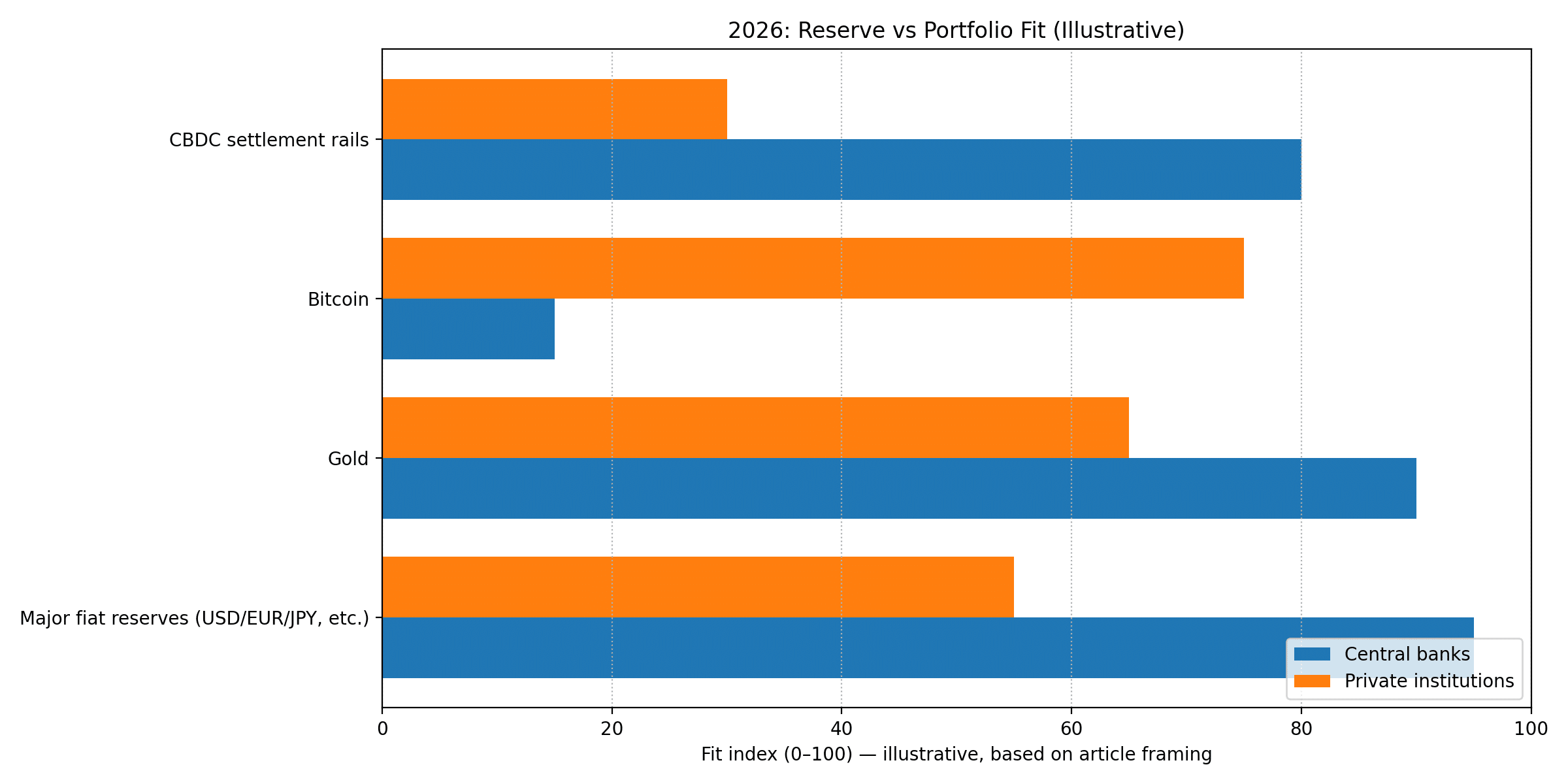
Currency reserves tell a similar story of caution. The International Monetary Fund’s COFER data shows total global foreign exchange reserves around $13.0 trillion in 2025 Q3, with the US dollar share near 56.92% and the euro around 20.33%. That is not a world stampeding into a new reserve standard overnight.
So Dalio’s view is less a personal opinion and more a description of how institutions behave when their job is not to “outperform,” but to survive.
The market’s counterpoint: Bitcoin does not need central banks to matter
Here is the twist: Bitcoin can grow into a major macro asset even if central banks never put it on the balance sheet.
The last few years have built a parallel pipeline of demand that looks more like institutional portfolio plumbing than retail speculation. Spot Bitcoin ETFs, prime brokerage access, improved custody, and more mature derivatives markets have turned Bitcoin into something allocators can hold without reinventing their internal controls. Dalio even acknowledged he keeps some exposure, while still ranking it behind gold.
That creates a likely 2026 reality: central banks remain skeptical, but Bitcoin keeps getting absorbed into private balance sheets, pension-style portfolios, and corporate finance playbooks. In other words, Bitcoin’s adoption may look less like a ceremonial “reserve asset” announcement and more like slow, steady normalization, the way the internet became essential without any central authority declaring it a reserve network.
The 2026 prediction: “Reserve asset” stays mostly gold, “hedge asset” stays contested
A realistic forecast for 2026 is not that central banks suddenly start buying Bitcoin in size. A more plausible forecast is that they continue to diversify at the margins with gold, adjust currency mixes gradually, and modernize payment rails with digital settlement tools.
On that last point, the signal is already loud. A BIS survey found that 91% of 93 central banks were exploring a retail CBDC, a wholesale CBDC, or both, with wholesale work generally more advanced than retail. That is where the “official digital money” energy is going, and it fits Dalio’s worldview: institutions prefer systems they can govern.
Bitcoin’s likely role, then, is not as an official reserve, but as a market-driven hedge that reacts to liquidity conditions, geopolitics, and trust in fiscal management. It will not be everyone’s hedge, and it will not behave the same way every month, but it can keep earning a seat in diversified portfolios precisely because it is not tied to any single central bank.

What would have to change for a true central bank pivot
For central banks to seriously adopt Bitcoin, the barriers Dalio highlighted would need real answers, not marketing.
Privacy would need a clearer framing that does not clash with compliance. Custody would need to look like sovereign-grade infrastructure with robust legal certainty across jurisdictions. Volatility would need to compress further, not just for a quarter, but across cycles. The political layer would need to soften, because a reserve asset is not just finance, it is diplomacy.
Until those pieces are in place, the most probable “official” Bitcoin exposure stays indirect. It might come through regulated market infrastructure, state-linked funds that behave differently than central banks, or small experimental allocations that remain symbolic rather than strategic.
Conclusion: Dalio may be right on central banks, and Bitcoin can still win
Dalio’s warning is a reminder that the words “central bank reserve” carry a very specific meaning. It is not a popularity contest. It is a checklist built around control, stability, and crisis performance.
The more interesting prediction for 2026 is that Bitcoin does not need that label to keep gaining ground. Gold can remain the official hard asset of choice while Bitcoin continues to expand as a private-sector hedge and a financial rail that institutions can plug into. In a world where central banks are exploring CBDCs at scale, and where official reserve composition shifts slowly, Bitcoin’s growth story may keep happening anyway, just in the lane Dalio thinks it belongs.
FAQs
Why does Dalio think central banks will avoid Bitcoin?
He points to traceability and the potential for interference as major drawbacks for reserve managers, and he contrasts that with gold being harder to control once held outside the system.
Does this mean Bitcoin cannot be a long-term store of value?
It does not. Dalio’s argument focuses on central bank behavior, not on whether private investors, institutions, or corporations can treat Bitcoin as a hedge in a diversified portfolio.
What reserve assets are central banks favoring right now?
Gold remains a key focus, with official sector buying staying strong in recent years, including reported net purchases of 1,045 tonnes in 2024.
What is the most likely “official digital money” trend in 2026?
CBDC work remains the clearest direction, with a large majority of central banks exploring retail and or wholesale CBDCs in the latest BIS survey results.
Glossary of Key Terms
Central bank reserves: Assets held by a central bank, typically foreign currencies, government securities, and gold, used to support financial stability and currency operations.
COFER: The IMF dataset that tracks the currency composition of official foreign exchange reserves across reporting economies.
CBDC: A central bank digital currency, which is a digital form of central bank money that can be designed for retail use, wholesale settlement, or both.
Store of value: An asset expected to hold purchasing power over time, especially during inflationary or crisis periods.
Market liquidity: How easily an asset can be bought or sold at stable prices, particularly under stress, which is crucial for reserve-grade assets.
Custody: The infrastructure and legal framework used to securely hold an asset, including safeguards, governance, and recovery procedures for extreme scenarios.
References