






Large Cardano whales are quietly strengthening their grip on the token even as the rest of the network looks to be grinding to a halt
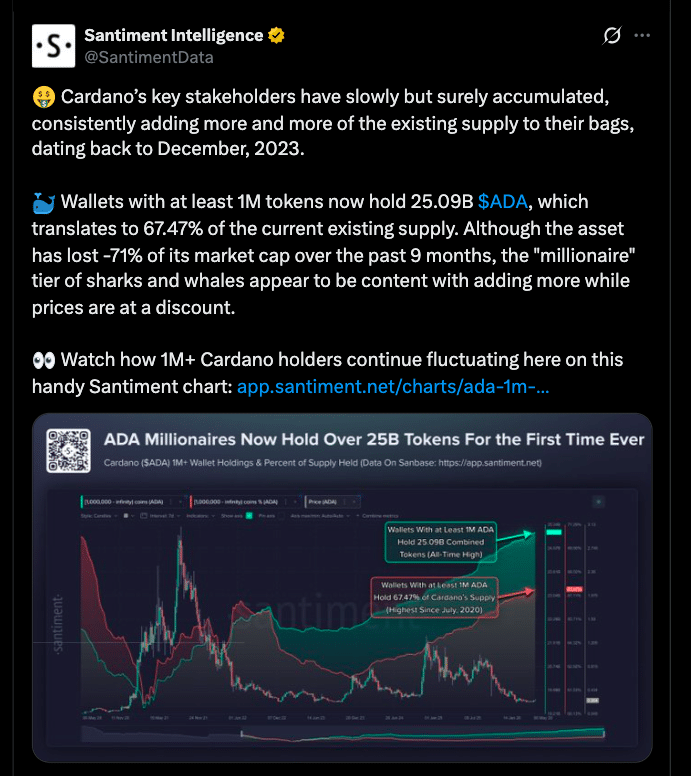
New on-chain data from Santiment is showing wallets that hold at least one million ADA now have control over about 25.09 billion tokens, which represents about 67.47% of the circulating supply.
This is the highest concentration level since July 2020 and it looks like these whales have been quietly accumulating a huge portion of ADA since late 2023 almost without a single break. This is really interesting because it’s happening at a time when ADA is not doing so well in the market.
In fact the token has lost more than 70% of its value since its late-2024 highs and has been sliding ever since. Yet big holders have been adding to their positions.
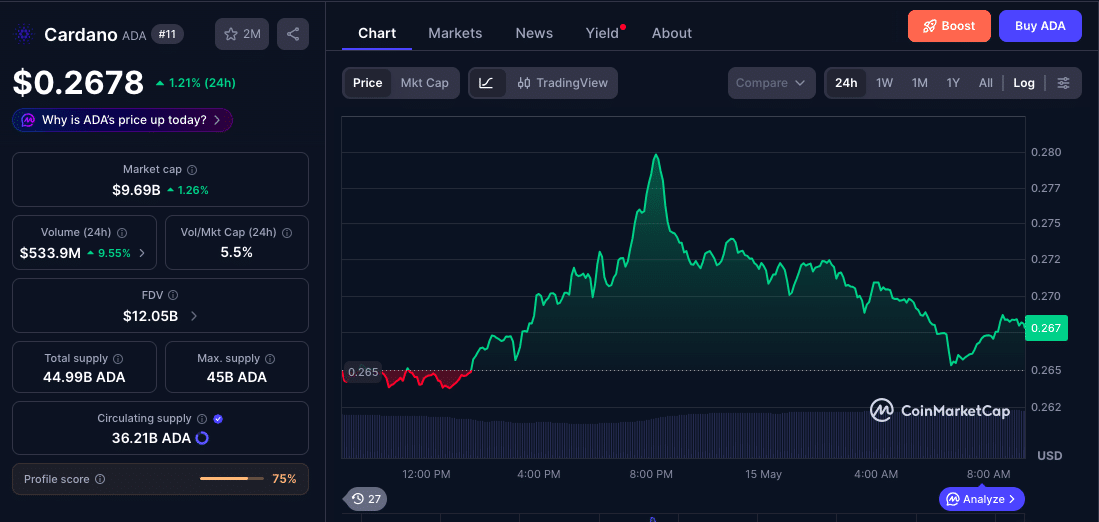
As at press time, ADA was trading at around $0.27 and that put the market capitalization at roughly $10 billion.
Cardano Whales are Buying the Dip
The latest Santiment figures make it clear that Cardano whales are viewing the prolonged decline as a buying opportunity and not a reason to get out.
There are now more tokens in these big wallets than at any time in recent history and experts are saying that the accumulation trend just kept getting bigger during this whole slump.
This goes against what is expected from retail investors who have been super cautious over the past few months as ADA just keeps plummeting.
Some analysts believe large holders may be positioning for a longer-term recovery tied to future Cardano upgrades and broader crypto market stabilization.
Others see it as a simple case of value accumulation after a big price drop.
The accumulation trend has also coincided with improving technical signals. Several analysts noted that ADA recently reclaimed short-term moving averages while momentum indicators started stabilizing after months of weakness.
Still, the Cardano whale accumulation alone has not translated into strong price recovery yet.
Cardano’s DeFi Ecosystem Keeps Shrinking Fast
While some Cardano whales are accumulating, the reality is that the ecosystem is not really thriving.
Data from DefiLlama is showing that Cardano’s total value locked has gone from $686 million in December 2024 to around $137 million today, that’s an 80% decline in DeFi capital on the network.
It’s not just the DeFi scene that is being affected, trading activity on Cardano is slacking off too. Daily decentralized exchange volume across Cardano sits below $2 million, far behind competing chains like Ethereum and Solana.
Network revenue also remains extremely low. The network is only bringing in a few hundred dollars a day whereas other big smart-contract ecosystems are making hundreds of thousands.
Active wallet usage is another indicator of the slowdown. Cardano is averaging fewer than 16,000 active daily addresses, which is a clear sign that not many users are active on the network, even though the whales are still accumulating ADA.
These numbers confirm that ADA is being treated more like a long term investment at the moment, instead of for immediate ecosystem usage.
What ADA Traders Are Watching Out For Next
The big question now is are the Cardano whales being early movers in anticipation of a full recovery or are they just grabbing up supply while the market is in a weak phase?
In past cycles, sustained whale accumulation has sometimes preceded stronger price reversals across crypto markets.
However, analysts are saying that, on its own, an accumulation doesn’t guarantee a bullish sign without quality improvements for the network.
For ADA, traders are watching the $0.25 region closely as major support. A sustained recovery above the $0.30-$0.33 range could improve momentum conditions after months of underperformance.
At the same time, the Cardano network is still facing pressure from its DeFi participation being weak, low transaction activity, and the fact that its ecosystem engagement continues to trail behind its competitors in the space.
Unless ADA starts to see some actual network usage along with the Cardano whale accumulation, ADA may continue struggling to match the performance of larger smart-contract competitors.
Conclusion
Cardano whales now hold their biggest share of ADA since 2020 continuing a buying trend that has persisted throughout the token’s long decline.
The accumulation suggests that large holders are still seeing the long-term potential in ADA even if the short-term performance hasn’t exactly been impressive. However, Cardano’s DeFi footprint is shrinking and on-chain activity is slowing thus raising questions about long-term growth.
For the time being though, the Cardano whale confidence is one of the few things that is still looking good for ADA.
Glossary
Cardano whales: The big ADA holders who are basically controlling a large portion of the token supply.
ADA: Native cryptocurrency of the Cardano blockchain.
TVL (Total Value Locked): Total capital deposited in decentralized finance protocols.
DEX – Decentralized exchange operating on blockchain networks.
On-chain activity – Blockchain-based transactions and user participation metrics.
Frequently Asked Questions About Cardano Whales Accumulation
How Much ADA Do Cardano Whales Hold?
Wallets that hold at least one million ADA now control about a total of 25.09 billion tokens, roughly 67% of the overall ADA circulating supply.
Why Are The Cardano Whales Accumulating ADA?
It seems like the big holders are buying in during price weakness, possibly positioning for a long-term recovery or for future ecosystem growth.
How Much Has Cardano’s TVL Dropped?
Cardano’s total value locked fell from around $686 million in December 2024 to roughly $137 million in May 2026.
Is ADA Still Underperforming?
Yes, it still is. ADA has remained one of the weaker major cryptocurrencies since the crypto market as a whole peaked in late 2024.
References