

Last updated: November 20, 2026
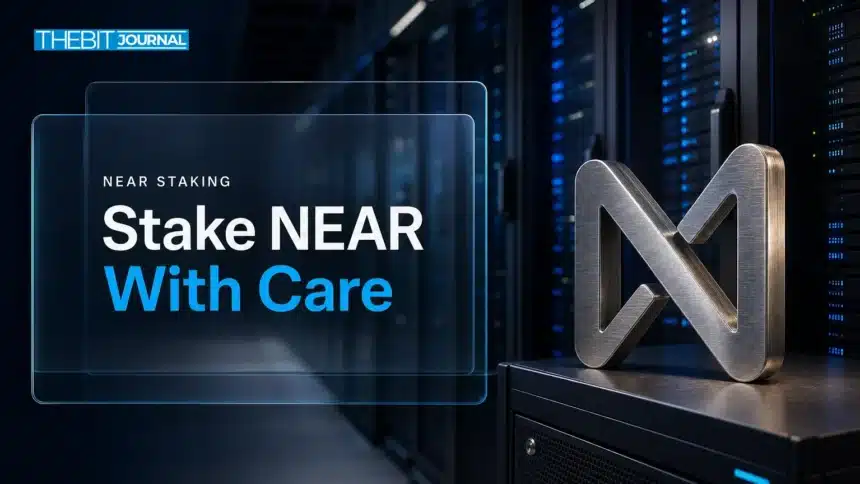
A NEAR staking guide needs to cover more than the advertised reward rate. Validator fees, changing protocol issuance and withdrawal timing matter too. Here’s how delegation works and what the available data says as of November 20, 2026.
Key Takeaways
- NEAR staking delegates tokens to a validator, with rewards affected by protocol issuance and the share of supply staked.
- Bitwise reported a 4.87% gross staking yield in Q3 2026. It’s a historical figure, and future yields can vary.
- MyNearWallet says unstaking can take up to 72 hours, followed by a separate withdrawal step.
- Validator fees, wallet security, token volatility and protocol changes can affect the result.
How NEAR staking works
NEAR staking delegates tokens to a validator that helps support the network. Tokens remain associated with the staking account, while validator performance and commission can affect rewards. Staking doesn’t remove NEAR’s market risk, and rewards aren’t fixed interest payments.
Wallet interfaces vary, but the basic process is to select a validator, choose an amount and authorize the transaction.
Rewards come from protocol issuance. Bitwise’s Q4 2026 staking report says an average of 596 million NEAR, about 46% of supply, was staked in Q3 2026. It reported a 4.87% gross staking yield in Q3 2026. Bitwise says yield depends on issuance and the share of supply staked; this historical figure does not predict future yields.

How to stake NEAR through a wallet
This NEAR staking guide uses MyNearWallet’s documented flow. Open the Staking tab, select a validator, enter an amount, then submit and authorize the stake. Follow the current wallet prompts, since labels and options can change.
- Choose a wallet. Confirm it supports NEAR staking and that you can access the account securely. Keep recovery information private. Never give a seed phrase to another person or a site claiming to stake for you.
- Review validators. MyNearWallet recommends comparing commission, reliability and total stake. Check the details and fee shown in the wallet. A low commission alone doesn’t establish that a validator is suitable.
- Enter an amount and confirm. Leave enough available for requirements shown in the interface. Check the validator and transaction details before approving.
- Check the staking position. After confirmation, review the delegation and any rewards displayed. Estimates may differ from the amount ultimately received.
Wallet and exchange terms differ. Coinbase Prime’s NEAR staking guide lists a 1 NEAR minimum wallet reserve that can’t be staked or withdrawn, and says its public validator charges a 10% fee. These are Coinbase Prime-specific terms, not universal NEAR network requirements.
What affects NEAR staking rewards?
Rewards vary with protocol issuance, the share of supply staked, validator commission and performance. Wallet estimates can change. Gross yield isn’t the user’s net outcome, and NEAR’s dollar value can rise or fall.
NEAR’s official post on HSP-029 says the House of Stake ratified a proposal after 99.96% of veNEAR votes cast supported it. The Security Council’s veto window closed without a veto on November 16, 2026. The proposal would gradually reduce maximum annual issuance from 2.5% to 1.6% over 24 months.
The change wouldn’t apply instantly to every staking account. NEAR says the reduction is planned to begin one quarter after ratification, with the 1.6% target at month 24. It depends on a grace period and validator adoption of a protocol upgrade. The official HSP-029 update gives the proposal details. Issuance changes can affect future rewards, but don’t set an individual delegator’s yield.
Unstaking and withdrawing NEAR
MyNearWallet treats unstaking and withdrawing as separate steps. Unstaking can take up to 72 hours, after which users must complete a separate withdrawal before NEAR appears as available in the account balance.
MyNearWallet warns that starting another unstake before the first finishes resets the clock. Check the wallet’s status rather than assuming tokens will be immediately spendable. Other services may use different processes or terms.
For wallet-specific instructions, MyNearWallet explains staking, unstaking and withdrawal. This guide describes the published flow, but timing may vary for an individual transaction or service.

Risks to weigh before delegating
Staking doesn’t protect against NEAR’s price volatility. Its value can fall while tokens are staked or waiting to be unstaked, and holders can lose some or all of the value put at risk. Rewards paid in NEAR can also be worth less in dollars if the token price declines.
Operational risks include a compromised wallet, mistaken transaction, unreliable validator or unexpected service terms. Review validator fees and wallet permissions, use official wallet channels, and avoid unsolicited offers or sites asking for recovery phrases.
Protocol rules and reward rates can change. Bitwise’s Q3 2026 yield is a dated observation, not a promise. Staking may have tax consequences that vary by country; consult a qualified tax professional about your situation. This information is educational, not personal financial advice.
NEAR staking guide FAQ
How long does it take to unstake NEAR?
MyNearWallet says up to 72 hours, followed by a separate withdrawal step. Other services may differ.
Are NEAR staking rewards fixed?
No. Bitwise reported a 4.87% gross staking yield in Q3 2026, but rewards vary with issuance, the share of supply staked and validator factors.
Can I choose a validator when staking NEAR?
MyNearWallet lets users choose. It advises considering commission, reliability and total stake.
Does unstaking remove NEAR’s price risk?
No. NEAR’s value can change while tokens are delegated or waiting to become available.
Sources
- NEAR Protocol Inflation Rate Reducing to 1.6% | HSP-029 (www.near.org)
- How do I stake, unstake, and withdraw my NEAR? (help.mynearwallet.com)
- NEAR Protocol price and market data (CoinGecko)
This article is for informational purposes only and does not constitute financial or investment advice. Cryptocurrencies are highly volatile; always do your own research before investing.