







As the crypto market faces its downward trajectory, Cardano whale accumulation is playing out surprisingly to determine ADA’s price behavior.
While ADA is down over 70% since its highs from late 2025, suggesting a deep correction has taken place, on-chain data indicates that large holders have been steadily accumulating more ADA.
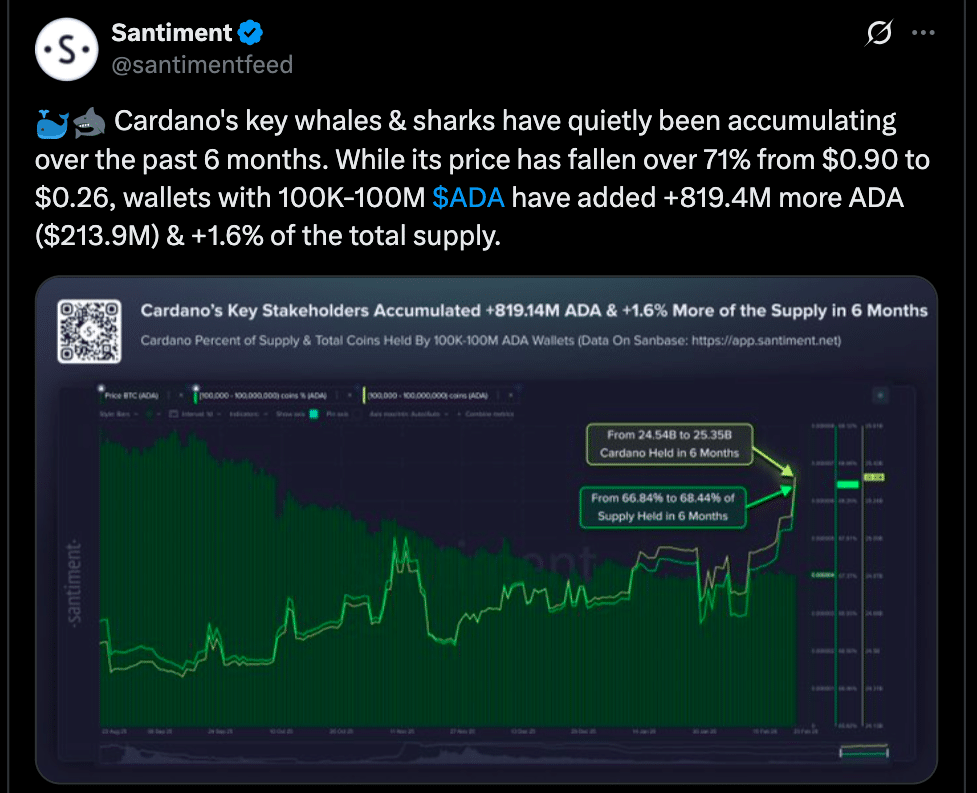
During the previous six months, wallets bearing between 100,000 and 100 million ADA have in aggregate, accumulated an estimated 819 million ADA, according to Santiment.
Cardano whale accumulation has also increased the proportion of total supply owned by larger holders, even as price struggled.
Whale Activity Amid Price Slump
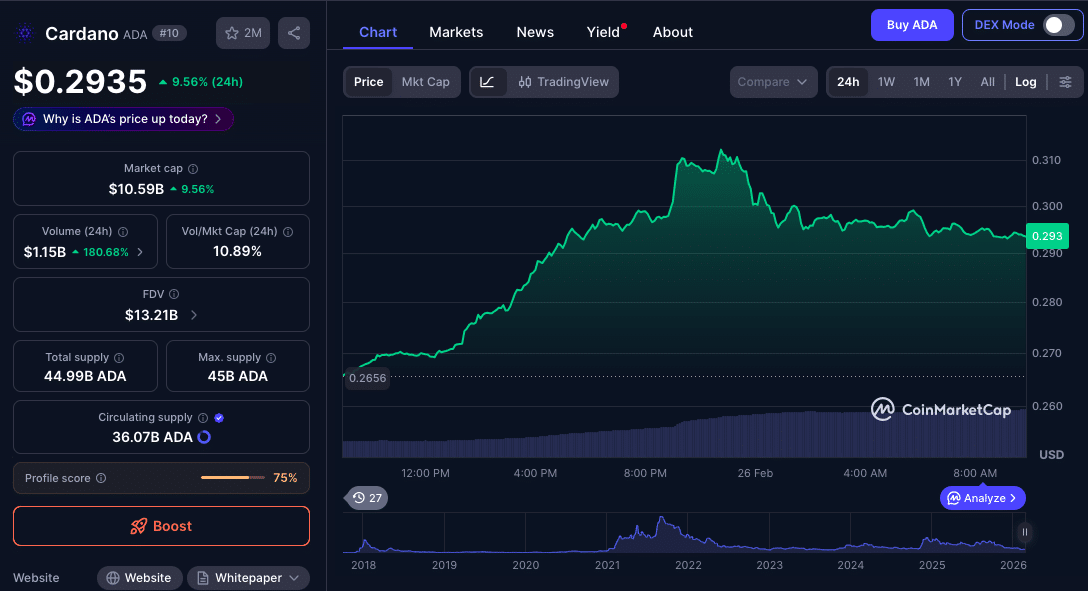
The price of Cardano has plunged from approximately $0.90 in October 2025 to close to $0.29 in 2026, a fall of about 70%. But amid this sell-off, on-chain analytics reveal something interesting; whales have been gradually accumulating ADA.
Wallets with between 100,000 and 100 million ADA holdings boosted their combined balance by 819.4 million tokens, worth about $213.9 million at current prices, over the past six months. This amounts to roughly 1.6% of Cardano’s total circulating supply presently in the hands of these large entities.
This Cardano whale accumulation trend was confirmed by a Santiment post on social media, despite a waning interest in the broader market and high volatility. This increased whale holdings took place under the context of a weakened retail sentiment, as smart money diverges from general trading activity.
Technical Picture and Market Dynamics
ADA is currently trading near the $0.29 level, backed by technical floors formed during previous bearish price action. In recent weeks, the token price has been trading range-bound, with sellers stepping in near the $0.30 area. Falling volume and a decline in derivatives open interest indicate speculative trading has declined, but accumulation by large holders continues.
On-chain metrics show how despite weak momentum in the entire market, large wallets are concentrated buyers and form supply support zones.
This dynamic often runs beneath the surface in crypto markets: as smaller traders leave out of fear, longer-term holders view discounted prices as accumulation opportunities. Data from Santiment illustrates exactly this trend, showing that whalelike entities had effectively increased their percentage of ADA even as prices tumbled hard the past six months.
Whales vs. Shorts: Interplay with Leverage
How large positions such as these would interact with short interest and leverage in the market is still being speculated, especially in light of the recent Cardano whale accumulation behaviors. When the large whales scooping at a slow pace build a long position during a negative session, it tends to create zones where short leverage builds up because traders expect more downside. This gets the “volatility loop” in which heavy short positions can get squeezed if price starts to stabilize or reverse.
In the case of ADA, the price is grazing areas where previous leverage was strong. Coupled with still-ongoing Cardano whale accumulation, this could see building volatility if the short positions fire off in rapid succession.
The net result is a battle between bearish sentiment and deeper pocket longer-term holders who are gradually adding exposure.
Interpreting Cardano Whale Accumulation
Although this Cardano whale accumulation does not indicate a bullish reversal, the concentration of supply among powerful hands coincides with two things in the current market:
First, it cuts the available circulating supply among retail traders, which could strengthen price floors if demand returns. Secondly, it is also a reflection of informed participants deploying capital at discounted valuations.
Many traders have capitulated, leaving only longer-term holders active as ADA languishes down more than 70% from recent highs.
Market analysts tend to regard such patterns as a cyclical accumulation behavior in which large holders target deeper pricing even as retail capitulation speeds up. There also seems to be structural support developing with this Cardano whale accumulation, hinted at by the recent trend in Cardano’s case, while the actual sentiment still appears weak.
Conclusion
Latest Cardano whale accumulation data shows that while the token’s price has suffered a steep drawdown, on-chain analytics point to what the large holders are doing under the price charts.
Whales have packed on 819 million ADA in six months despite broader weakness.
The larger wallets seem to be accumulating at discounted levels, a development that will definitely be worth monitoring in the coming days.
Glossary
Cardano whale accumulation: the increase in holdings by large wallets (100,000-100 million ADA).
Whale: The term for a holder of cryptocurrency with many assets, whose trading plan can affect the dynamics of the market.
Short leverage: The amount of leveraged short positions open within the market, typically building in areas that are due for more downside as far as traders are concerned
Frequently Asked Questions About Cardano Whale Accumulation
What is Cardano whales accumulation?
Big holders like whales are adding to their ADA holdings even though the price of the token has fallen significantly. This can indicate confidence from big investors.
Is price rally guaranteed with whale accumulation?
No. Actual price movement relies on wider market demand and sentiment, not just supply concentration; accumulation can provide some structural support.
Why is ADA’s price still low if whales are accumulating?
Whales may be stacking during these times of retail capitulation and little speculation. Price might lag until wider demand returns.
How significant is 819 million ADA?
Holding 819 million ADA, approximately 1.6% of total supply is suggestive of large holders conviction in a bear market.
References
HOKANEWS
cryptonews
Times Tabloid
Coincentral