
Last Updated; 16 July 2026
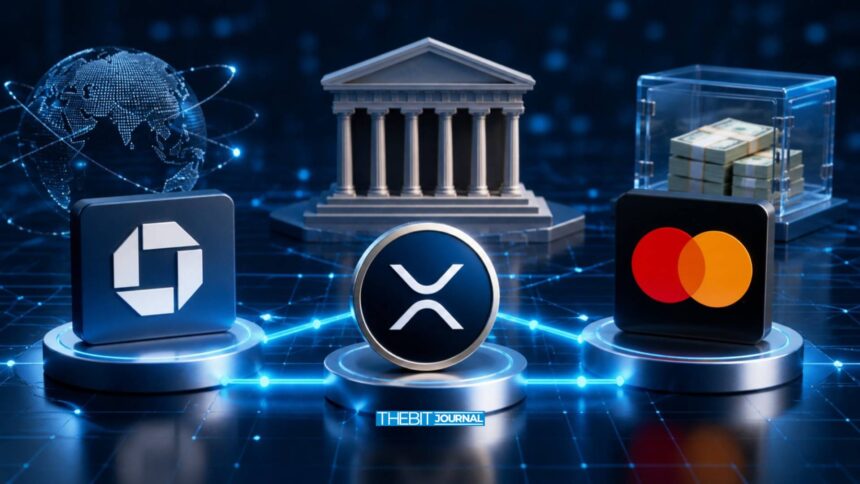
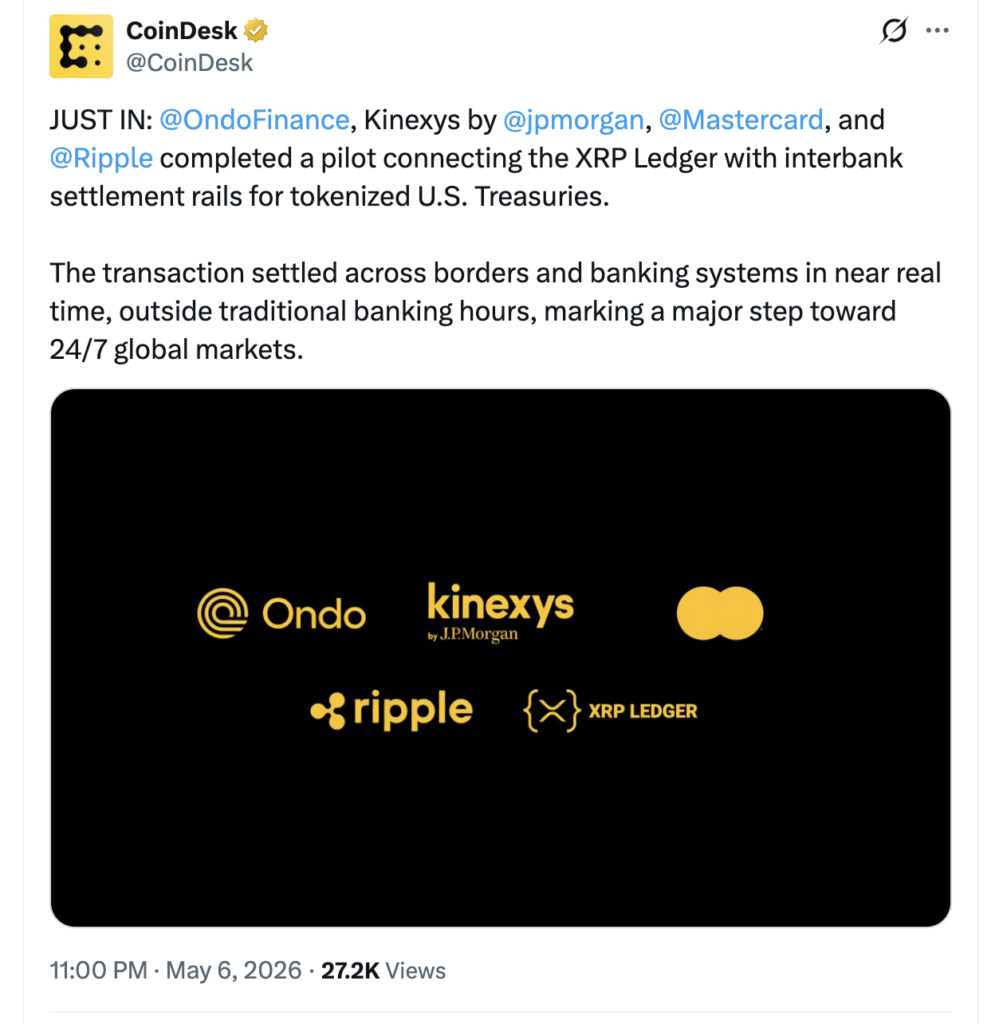
The latest JPMorgan XRP Ledger Settlement initiative has sparked major discussions across the blockchain industry as institutional finance moves deeper into tokenized assets. Ripple, Mastercard, Ondo Finance, and JPMorgan recently completed a high-profile pilot transaction involving tokenized U.S. Treasuries on the XRP Ledger.
The collaboration showed how traditional banks and blockchain networks can work together in near real-time. Analysts believe this development could reshape global finance by making cross-border treasury settlement faster, cheaper, and available around the clock for institutional investors worldwide.
XRP Price Overview as Ripple Advances Institutional Finance
Ripple’s latest institutional treasury settlement initiative has also kept XRP in focus, as investors monitor whether growing enterprise adoption will strengthen the digital asset’s long-term market outlook.
| Metric | Value |
|---|---|
| XRP Price | $1.11 |
| 24-Hour Change | -1.68% |
| Market Capitalization | $68.32 Billion |
| 24-Hour Trading Volume | $1.08 Billion |
| Circulating Supply | 62.47 Billion XRP |
| Market Rank | #6 |
Although XRP traded within a relatively stable range, Ripple’s participation in the JPMorgan, Mastercard, and Ondo Finance pilot underscored XRP Ledger’s expanding role in institutional finance and real-world asset tokenization.
JPMorgan XRP Ledger Settlement Signals a New Era for Blockchain Finance
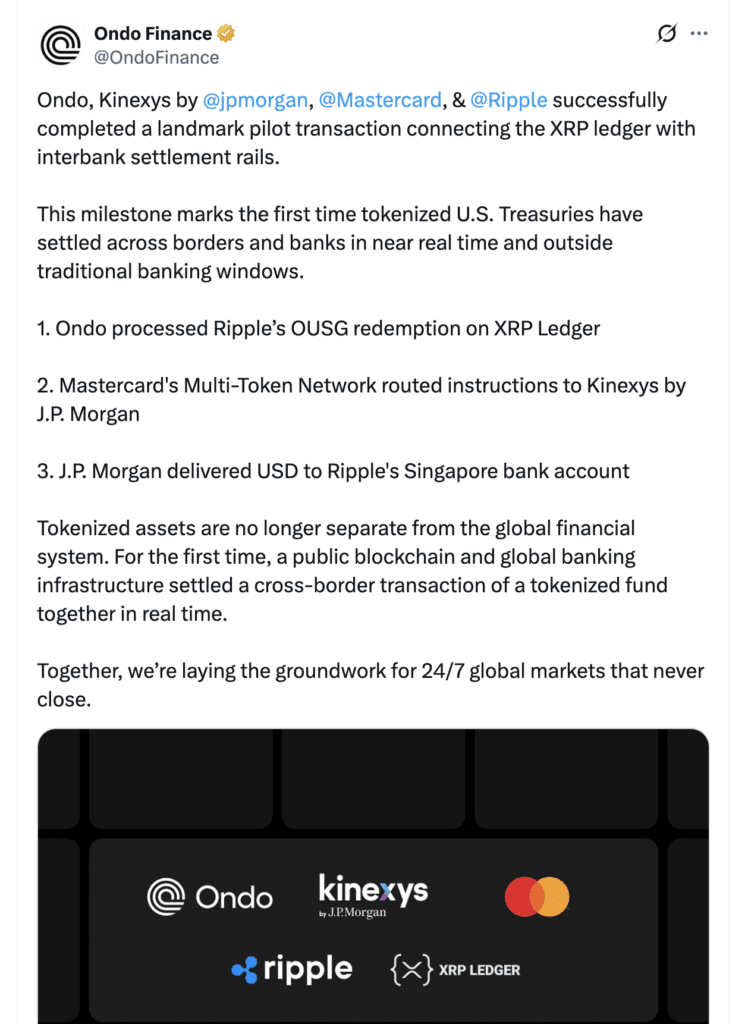
The JPMorgan XRP Ledger Settlement pilot demonstrated a major leap for institutional blockchain adoption in 2026. Traditional treasury settlements often move slowly due to banking hours, middlemen, and outdated infrastructure. This latest experiment used XRP Ledger tokenized treasury settlement technology to redeem Ondo Finance’s OUSG treasury product while routing payment instructions through Mastercard’s Multi-Token Network and Kinexys by JPMorgan.
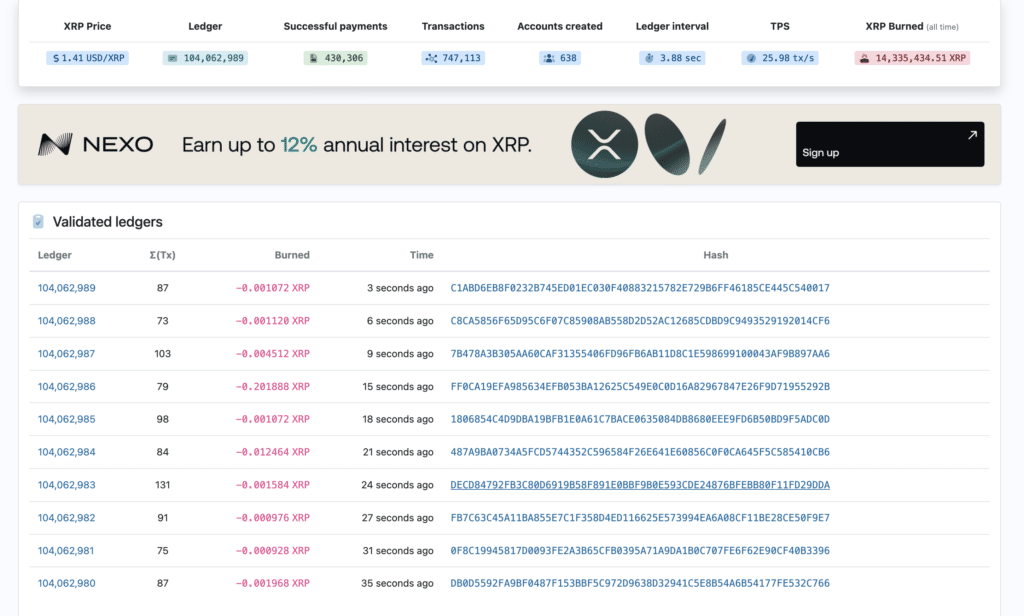
Settlement on XRPL reportedly finalized in seconds. Financial analysts now view this test as proof that tokenized finance is no longer theoretical. It is quickly becoming part of mainstream institutional banking operations.
Ripple XRPL Institutional Adoption Continues Expanding Across Global Markets
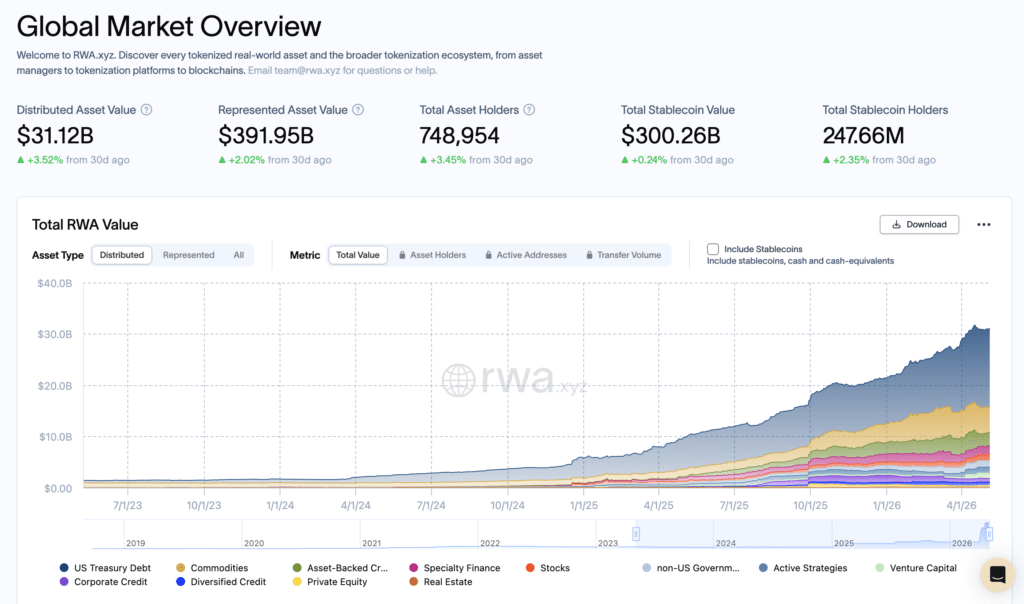
Ripple XRPL institutional adoption has accelerated steadily as financial institutions search for faster settlement solutions. The recent JPMorgan XRP Ledger Settlement pilot placed XRPL directly into conversations surrounding real-world asset tokenization and enterprise blockchain infrastructure. Ripple’s technology has long focused on improving international payments, but tokenized U.S. Treasuries now represent a much larger opportunity.
Market observers compare the current growth phase to the early days of stablecoin adoption. Back then, many banks dismissed blockchain payments entirely. Today, institutions are actively testing blockchain settlement systems to remain competitive in global finance markets.
Mastercard XRP Ledger Pilot Shows Institutions Want Faster Treasury Transfers
The Mastercard XRP Ledger pilot added another layer of credibility to blockchain-based settlements. Mastercard’s Multi-Token Network handled payment messaging while JPMorgan managed the banking infrastructure behind the scenes. This JPMorgan blockchain settlement model blended traditional finance with decentralized ledger technology in a practical way. Institutional investors constantly look for faster liquidity movement, especially during periods of market volatility.
Delays in treasury transfers can create costly inefficiencies. By combining tokenized assets with blockchain settlement rails, this pilot reduced operational friction and demonstrated how digital assets may support institutional treasury management in coming years.
Ondo Finance XRPL Integration Highlights Real-World Asset Tokenization Growth
Ondo Finance XRPL integration played a key role in the transaction because OUSG represents tokenized exposure to short-term U.S. Treasury assets. Tokenized U.S. Treasuries have become one of the fastest-growing sectors in crypto finance due to rising institutional demand for regulated yield-bearing products.
The JPMorgan XRP Ledger Settlement project showed how tokenized assets can move seamlessly between blockchain networks and traditional banking systems. Some analysts even compare this moment to the rise of exchange-traded funds years ago. Once institutional trust increases, adoption tends to spread rapidly across the financial sector.
How JPMorgan XRP Ledger Settlement Works in Institutional Finance
Many investors still wonder how JPMorgan XRP Ledger settlement works behind the scenes. The process involved Ripple redeeming Ondo Finance treasury tokens on XRPL while Mastercard transmitted settlement instructions through its institutional payment network. JPMorgan then transferred fiat proceeds directly into Ripple’s Singapore-based banking account.
This cross-border tokenized treasury settlement on XRP Ledger reduced delays tied to traditional international banking systems. Instead of waiting days for settlement confirmation, blockchain validation occurred almost instantly. That efficiency could eventually transform corporate treasury management, international banking, and liquidity operations for global institutions handling large asset transfers daily.
XRP Ledger Settlement Pilot for Institutional Finance Draws Market Attention
The XRP Ledger settlement pilot for institutional finance quickly attracted attention from crypto investors, asset managers, and banking executives worldwide. Institutional blockchain settlement using XRP Ledger offers a combination of transparency, transaction speed, and lower operational costs compared to traditional settlement infrastructure. Ripple tokenized assets may also benefit from rising demand for tokenized real-world assets across capital markets.
Some market analysts believe tokenization could eventually unlock trillions of dollars in traditionally illiquid financial products. If adoption continues at this pace, blockchain settlement systems may become standard tools for banks, payment processors, and multinational corporations.
Cross-Border Treasury Settlement on XRP Ledger May Reshape Global Banking
Cross-border treasury settlement remains one of the most expensive areas within global finance. Legacy systems rely heavily on intermediaries, creating delays and additional fees. The JPMorgan XRP Ledger Settlement pilot introduced a faster alternative capable of supporting twenty-four-hour institutional settlements. This development could be especially important for multinational firms operating across different time zones.
Financial institutions no longer want to pause transactions because a regional banking network closes overnight. Blockchain infrastructure solves that problem directly. As XRPL real-world asset tokenization expands, more institutions may begin integrating blockchain settlement solutions into everyday operations.
JPMorgan Blockchain Treasury Settlement With Ripple Strengthens XRPL Utility
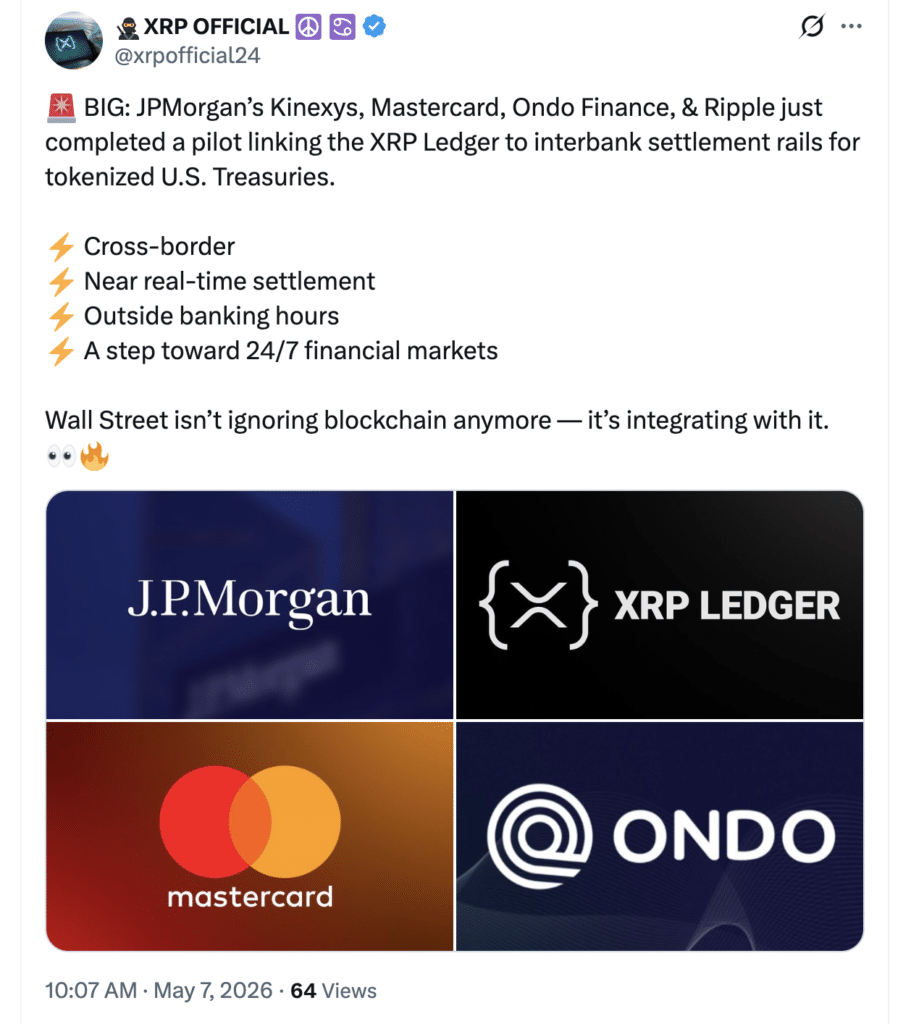
The JPMorgan blockchain treasury settlement with Ripple also strengthened confidence in XRPL’s long-term institutional utility. Ripple and JPMorgan complete XRP Ledger settlement pilot efforts at a time when governments and financial regulators are increasingly discussing tokenized securities and blockchain-based infrastructure. Institutional confidence often drives the next wave of financial innovation.
Once major firms begin testing blockchain systems publicly, smaller institutions typically follow the trend. That domino effect may already be unfolding within tokenized finance. The combination of banking giants, payment processors, and blockchain firms gives this initiative unusually strong credibility in financial markets.
Conclusion
The JPMorgan XRP Ledger Settlement initiative may become one of the defining institutional blockchain stories of 2026. Ripple, Mastercard, Ondo Finance, and JPMorgan successfully demonstrated that tokenized U.S. Treasuries can move efficiently across blockchain networks and traditional banking rails. The pilot highlighted how XRP Ledger tokenized treasury settlement systems could modernize global finance through faster liquidity movement and lower operational friction.
Institutional adoption of blockchain technology continues accelerating as real-world asset tokenization gains traction. Investors, analysts, and financial firms should closely monitor future developments because blockchain treasury settlement may soon become a core feature of modern banking infrastructure.
Appendix: Glossary of Key Terms
XRP Ledger (XRPL): A decentralized blockchain network designed for fast and low-cost transactions.
Tokenized U.S. Treasuries: Digital blockchain representations of U.S. Treasury-backed financial products.
Ondo Finance OUSG: A tokenized treasury product backed by short-term U.S. Treasury exposure.
Real-World Asset Tokenization: The process of converting traditional financial assets into blockchain-based digital tokens.
Cross-Border Treasury Settlement: The transfer and settlement of treasury assets between institutions located in different countries.
Mastercard Multi-Token Network: Mastercard’s blockchain-based infrastructure for digital asset and institutional payment transactions.
Frequently Asked Questions About JPMorgan XRP Ledger Settlement
What is the JPMorgan XRP Ledger Settlement pilot?
The pilot involved Ripple, Mastercard, Ondo Finance, and JPMorgan testing tokenized treasury settlement using XRPL and traditional banking infrastructure.
Why are tokenized U.S. Treasuries important?
Tokenized U.S. Treasuries provide blockchain-based exposure to government-backed financial assets while improving settlement speed and operational efficiency.
How fast was the XRP Ledger settlement?
Reports indicated that blockchain-side settlement finalized in under five seconds during the pilot transaction.
Why does institutional blockchain adoption matter?
Institutional adoption increases blockchain credibility, expands liquidity, and accelerates integration between traditional finance and digital assets.
What role did Mastercard play in the pilot?
Mastercard handled payment messaging through its Multi-Token Network during the cross-border treasury settlement process.
References
Disclaimer
This article is for informational purposes only and does not constitute financial or investment advice. Cryptocurrency and digital asset markets are highly volatile. Readers should conduct independent research before making financial decisions.