


The Bitcoin quantum fear has become one of the most controversial subjects in digital asset security over the past few years. With the progression of quantum technology, increasing numbers of financial institutions, blockchain developers and long-term investors have become increasingly anxious about Bitcoin cryptography risk. The most prevalent threat, which is exploit-based espionage had the least potential for breaches – only 10.200 BTC at risk in the current threat models, disputing previous claims that millions of coins could be put in danger.
That discovery has changed the conversation around bitcoin security and quantum-resistance, as well as long-term network security. Bitcoin is currently trading at $70,417.71 and a market cap of over $1.4 trillion so there has never been a more ripe time to understand Bitcoin quantum computing risk.
Is There a Bitcoin Quantum Threat? A look at the potential technology behind quantum resistant cryptocurrency protocols
The Bitcoin quantum threat focuses on the potential future susceptibility of cryptographic algorithms that secure blockchains to advanced quantum computers. Bitcoin uses Elliptic Curve Digital Signature Algorithm technology right now, which is safe from your grandmother’s classical computer. Yet, with big quantum computers it might be possible to find the private keys using Shor’s algorithm.
This calls into question the BTC-qRes of address generation, especially for older address formats. With alarming headlines, many modern wallets are still safe. The Bitcoin cryptography risk is primarily concentrated in dinosaur systems, so don’t expect immediate widespread compromises.
CoinShares Quantum Report: Why Only 10,200 BTC Are Considered at Risk
The CoinShares quantum briefing was a gamechanger in terms of reshaping the Bitcoin quantum threat narrative. The firm states that about 10,200 of at-risk BTC are held in Pay-to-Public-Key (P2PK) addresses made during Bitcoin’s infancy. These addresses reveal public keys forever exposing them to the risk.
But this is less than 0.06 per cent of the total amount in circulation. The report notes that the vast majority of Bitcoin holders have already transitioned to safer forms of the currency. This data shows that the legacy wallets Bitcoin risk is much lower than what people thought in the past, bringing back confidence and certainty to the future of Bitcoins security.
Bitcoin Quantum Computing Risk Versus Market Reality
The market clearly thinks differently, even though expert forums are filled with technical discussions. Even though Bitcoin quantum computing risk is becoming more well known, Bitcoin still stands. At present, the price sits at $70,417.71 demonstrating steady investor confidence against high trading volumes of more than $42 billion. Institutional investors are still buying BTC – which again suggests that there is not a strong worry about immediate risks.
Quantum computing vs Bitcoin is still mostly theoretical at this point. Attacks applicable in practice would necessitate machines highly unfeasible today. Thus, the botm Bitcoin quantum threat does not lead to mass BTS sell-offs or capital flight.
Media Validation: Mainstream Coverage
Leading crypto news outlets have also certified that the threat quantum poses to Bitcoin is indeed limited. Cointelegraph said that “Only 10,200BTC at risk from quantum threats”, which directly aligns with the CoinShares report. Situational awareness Other Site Identification CoinoMediaFollow-on The BlockFollow-on DecryptRegurgitation As sites such as these cover the news, it’s important to understand that the risk seems to be primarily applicable to wallets with weak RNG and not a direct threat to the greater Bitcoin network. This media coverage serves to demonstrate that while the Bitcoin quantum risk is real, it continues to be data-driven and without sensationalist.

Why Bitcoin Old Style Wallets Are More At Risk
Bitcoin legacy wallets were designed by developers who did not know in advance about many attack vectors. Pay-to-Public-Key outputs with public keys revealed forever were used by a large portion of users in the early 2010s. The susceptibility of these addresses to quantum attacks in the future is however much greater.
A lot of these wallets are held by early adopters who have been inactive for years. Some analysts suspect these funds will never move again. That said, even if quantum attacks were to become feasible, obtaining these coins might run into legal, technological, and ethical obstacles that would prevent their practical usage.
Is Bitcoin Safe From Quantum Computers?
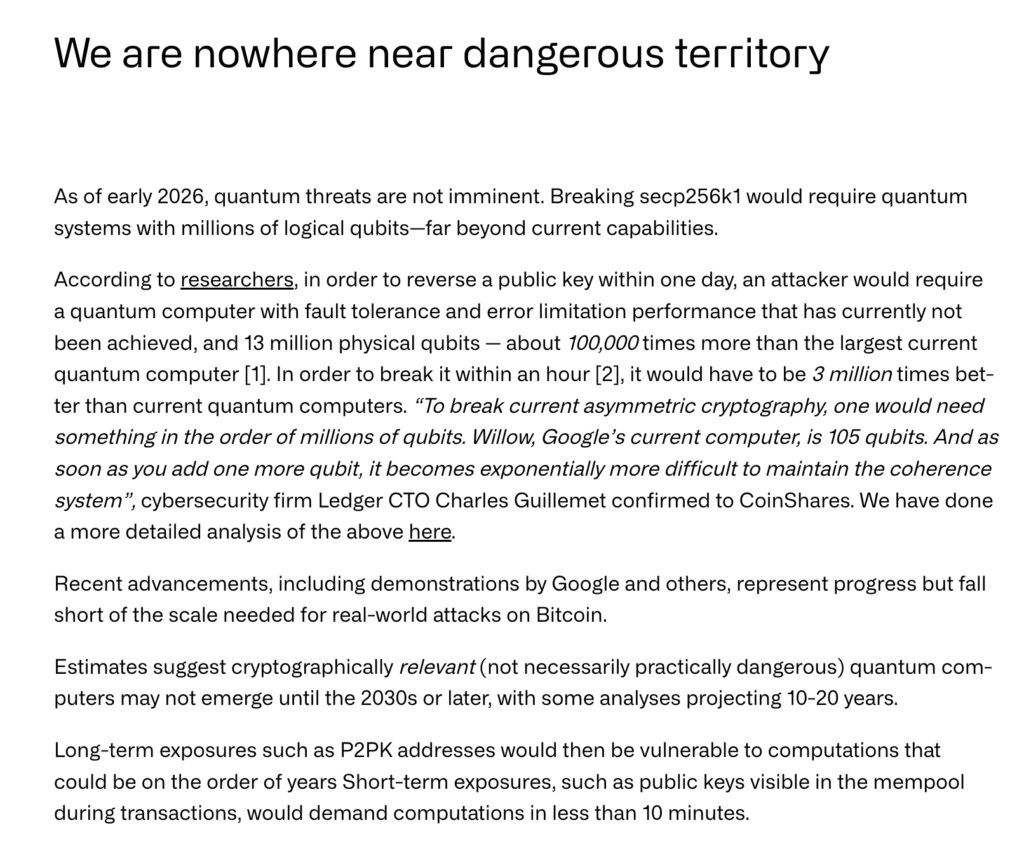
The Bitcoin quantum threat in early 2026 Currently the Bitcoin quantum threat is not here. To break the secp256k1 curve, millions of logical qubits would be required, well beyond what is available on existing quantum computers. According to estimates, reversing a public key in one day would require 13 million physical qubits, approximately 100,000 times as powerful as existing machines. Ledger CTO Charles Guillemet said: “Willow, Google’s current computer, is 105 qubits. And “every additional qubit is exponentially more difficult to keep coherent.”
Recent advances from Google and others are promising but still a long way off enabling real-world attacks on Bitcoin. We may not get cryptographically-relevant quantum computers until the 30s. Long-term P2PK addresses could be in danger for years, while short-term mempool exposures would require computations on the order of minutes.
Quantum Computing vs Bitcoin Network Flexibility There is another way to contrast the two.
Quantum computing and Bitcoin is often presented as a do or die competition. But in practice, Bitcoin’s flexibility is a boon. Unlike static ecosystems, Bitcoin changes by community agreement and technical development. Quantum resistant signatures can be added also by softforks or protocol upgrades if needed.
Adaptive security frames already are in place for financial institutions. This flexibility limits the long-run BTC quantum exposure. History has proven that Bitcoin would overcome numerous technological obstacles, giving believers confidence in its ability to thwart incoming threats.
How Many BTC Are at Risk From Quantum Attacks?
How many BTC are at risk from quantum attacks has been widely debated. Earlier reports claimed up to four million BTC could be exposed. The CoinShares quantum report corrected these figures, identifying only 10,200 BTC at risk under realistic scenarios. This difference highlights the importance of data-driven analysis. Many older estimates included reused addresses and minor exposures that are easily mitigated. The revised calculation has become a benchmark in evaluating Bitcoin quantum threat levels.
Can Quantum Computers Break Bitcoin in the Near Future?
Can quantum computers break Bitcoin remains a popular headline question. However, present-day quantum machines lack the scale and stability required to compromise cryptographic keys. Experts estimate that millions of error-corrected qubits would be necessary for effective attacks.
Current devices operate with only hundreds of unstable qubits. This technological gap suggests decades may pass before credible threats emerge. During this period, Bitcoin developers can deploy countermeasures, significantly reducing Bitcoin cryptography risk.
Bitcoin Quantum Risk 2026: What Experts Predict
Bitcoin quantum risk 2026 projections remain cautiously optimistic. Industry analysts agree that by 2026, quantum computing will still be in early commercial stages. Security agencies, financial regulators, and blockchain networks are already collaborating on post-quantum standards.
Bitcoin improvement proposals addressing cryptographic resilience are under review. This coordinated effort demonstrates preparedness rather than panic. As a result, Bitcoin quantum threat scenarios remain hypothetical rather than imminent over the next several years.
Investor Psychology and Perception of Bitcoin Security Quantum Issues
Investor behaviour often reflects emotional responses to technological narratives. The Bitcoin quantum threat has occasionally triggered short-term fear. However, long-term holders focus on fundamentals. Market data shows that major institutions continue allocating capital to BTC.
This indicates trust in Bitcoin security quantum architecture. Media coverage tends to exaggerate worst-case scenarios, while professional analysts prioritise probability-based risk models. This gap between perception and reality shapes market stability.
BTC Security Update Strategies for Future-Proofing
BTC security update initiatives focus on gradual migration toward quantum-resistant frameworks. Wallet providers are introducing enhanced key management systems. Exchanges now promote address rotation to minimise exposure. Developers are testing lattice-based and hash-based signatures.
These measures reduce Bitcoin cryptography risk over time. Continuous improvement ensures that Bitcoin remains competitive with traditional financial infrastructure in terms of cybersecurity standards. Such proactive upgrades strengthen Bitcoin future security prospects.
Bitcoin Quantum Threat Explained Through Historical Parallels
Bitcoin quantum threat explained through historical examples reveals important patterns. In the 1990s, encryption standards faced similar challenges from increasing computational power. Governments and corporations upgraded systems before breaches occurred. Bitcoin is following a comparable path.
Early recognition of vulnerabilities enables timely responses. The decentralised nature of Bitcoin accelerates innovation through open collaboration. This history suggests that catastrophic scenarios are unlikely if vigilance continues.
Market Implications of Only 10,200 BTC Vulnerable to Quantum Threat
Only 10200 BTC vulnerable to quantum threat represents a minimal fraction of circulating supply. Even in extreme scenarios, such losses would not destabilise the network. By comparison, daily trading volumes often exceed this amount. Liquidity buffers absorb potential shocks. This reinforces the view that Bitcoin quantum computing risk is manageable. Market structure and decentralisation provide natural safeguards against systemic collapse.
Regulatory and Institutional Views on Bitcoin Quantum Risk
Regulators and financial institutions monitor Bitcoin quantum threat developments closely. Central banks and cybersecurity agencies participate in post-quantum research programmes. Asset managers incorporate quantum risk assessments into portfolio models. These institutions recognise that blockchain security is evolving. Collaborative research reduces uncertainty and improves preparedness. This institutional involvement further enhances Bitcoin security quantum resilience.
Conclusion: Why the Bitcoin Quantum Threat Remains Manageable
The Bitcoin quantum threat represents a long-term technological challenge rather than an immediate crisis. Data from the CoinShares quantum report confirms that only 10,200 BTC at risk are realistically exposed. Continuous innovation, adaptive governance, and proactive research ensure Bitcoin future security.
Market confidence remains strong, supported by stable prices and institutional participation. Investors and developers are encouraged to stay informed, follow BTC security update developments, and adopt best practices. Monitoring emerging technologies and supporting secure wallet upgrades will strengthen the ecosystem for years to come.
Appendix: Glossary of Key Terms
Bitcoin Quantum Threat: Potential risks posed by quantum computers to Bitcoin’s cryptographic security.
Quantum Computing: Advanced computing using quantum mechanics principles.
Elliptic Curve Cryptography: Current cryptographic system used by Bitcoin.
Post-Quantum Cryptography: Algorithms designed to resist quantum attacks.
Legacy Wallets: Early Bitcoin addresses using outdated formats.
Public Key Exposure: Situation where cryptographic keys are permanently visible.
Frequently Asked Questions About Bitcoin Quantum Threat
Is Bitcoin safe from quantum computers?
Current systems remain secure, and post-quantum upgrades are in development.
How many BTC are at risk from quantum attacks?
Approximately 10,200 BTC according to recent research.
Can quantum computers break Bitcoin today?
No, existing machines lack sufficient power.
Will Bitcoin upgrade its security?
Yes, developers are working on quantum-resistant solutions.
Is Bitcoin quantum risk 2026 significant?
Experts consider the risk manageable in the medium term.
References
Disclaimer
This article is for informational purposes only and does not constitute financial, investment, or trading advice. Cryptocurrency investments are highly volatile and risky. Readers should conduct independent research and consult qualified financial professionals before making any investment decisions.