

The Ripple tokenization report brings the company into a Dubai Financial Services Authority (DFSA) paper alongside BlackRock, Standard Chartered and Robinhood. U.Today reported on November 7 that Ripple Middle East and Africa managing director Reece Merrick discussed using tokenized funds as collateral, not just issuing them on a blockchain.
The paper examines conditions that could support responsible growth in tokenized financial assets and related infrastructure, including in the Dubai International Financial Centre (DIFC). Merrick’s expectation that significant future growth could involve the XRP Ledger is his forecast, not a confirmed market outcome.
Key Takeaways
- U.Today reported that Ripple contributed to a DFSA-commissioned paper on scaling tokenized financial assets.
- Reece Merrick highlighted tokenized treasuries and money market funds as potential repo and margin collateral.
- The paper discusses potential benefits, while a separate UK report identifies settlement risks.
- XRP fell 1.97% over 24 hours as of November 7, 2026, at 15:13 UTC. The data does not show that the report caused the move.

What the Ripple tokenization report says
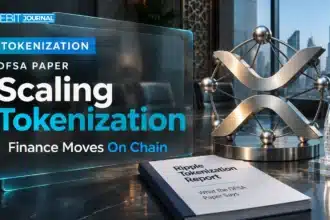
U.Today reported that Ripple contributed to the DFSA publication, “Scaling Tokenization: The Road Ahead.” The paper considers what responsible growth in tokenized assets and related infrastructure requires, including within the DIFC.
Other listed contributors include BlackRock’s Tony Ashraf, Standard Chartered’s René Michau, Robinhood’s Coy Garrison, Soter Insure founder Henson Orser and DFSA director Herman Schueller. The publication brings together perspectives from practitioners across the financial services ecosystem; it is not solely a Ripple position.
As summarized by U.Today, tokenization could widen investor access, improve efficiency for issuers and intermediaries, and reduce some risks, particularly around settlement. These are potential outcomes discussed in the report.
Merrick’s central point was that tokenized treasuries and money market funds (MMFs) could become more useful if institutions can use them in repo and margin arrangements without first redeeming them for cash. He expects significant growth over the next 12 months and predicts a significant proportion could involve the XRP Ledger. That remains his outlook.

Background and context for tokenized assets
The Ripple tokenization report comes amid wider efforts to connect conventional financial products with blockchain infrastructure. The City of London Corporation said its first Wholesale Digital Markets Champion report, published on July 13, 2026, set out actions to scale tokenization in UK financial markets, including secondary markets, tokenized collateral and the UK Digital Gilt instrument (DIGIT). Its page said 78 firms were then working with the initiative over the next 12 months.
The City’s report cites Ripple’s $1.25 billion purchase of prime broker Hidden Road and Santander UK’s use of Ripple’s blockchain for cross-border payments as examples of traditional finance and crypto converging. It lists Hidden Road/Ripple Prime as holding an FCA investment-firm licence and cryptoasset registration.
Ripple and Securitize announced in September 2025 that holders of BlackRock’s BUIDL could exchange fund shares for RLUSD through smart-contract functionality. Ripple said the BUIDL option was available then, with VanEck’s VBILL support to follow. Standard Chartered said on October 12, 2026, that institutional custody for RLUSD on the XRP Ledger was live through its DIFC branch. Its planned collateral-mirroring arrangement with Ripple and LMAX remained subject to documentation, testing, approvals and jurisdictional readiness, according to Standard Chartered’s announcement.
Forecasts for tokenized assets differ. U.Today cited Citi Institute’s base case of $5.5 trillion in tokenized financial assets by 2030, while a Standard Chartered and Synpulse paper estimated demand could reach $30.1 trillion by 2034. The estimates have different horizons and are not a single agreed forecast. The UK report also warns that chain reorganizations can reverse transactions that appeared confirmed, creating settlement-finality risk.
XRP market data alongside the Ripple tokenization report
The supplied market data does not show that the Ripple tokenization report moved XRP. CoinGecko’s snapshot for November 7, 2026, at 15:13 UTC showed XRP at $1.16, down 1.97% over 24 hours and 6.48% over seven days. Bitcoin and ether were higher over the 24-hour period. The Crypto Fear & Greed Index was in Extreme Fear.
| Asset or indicator | Reading | Period and timestamp |
|---|---|---|
| XRP | $1.16, down 1.97% | 24 hours, Nov. 7, 2026, 15:13 UTC |
| Bitcoin | $75,811, up 0.54% | 24 hours, Nov. 7, 2026, 15:13 UTC |
| Ether | $2,240.39, up 0.79% | 24 hours, Nov. 7, 2026, 15:13 UTC |
| Crypto Fear & Greed Index | 25, Extreme Fear | Nov. 7, 2026 |
The figures show a mixed market and do not establish why XRP moved. The snapshot is market context, not evidence of a connection between the paper and XRP’s price.
What to watch next
The next question is whether ideas in the paper become operating services. Issues to follow include which assets institutions can use as collateral, how they are valued, and how settlement works if a network reorganizes. These questions relate to the paper’s discussion of tokenization and the settlement-finality risk identified in the UK report.
For Ripple, the planned collateral arrangement with Standard Chartered and LMAX remains subject to the stated documentation, testing, approvals and jurisdictional readiness. Merrick’s forecast about potential XRP Ledger activity is not confirmation that this arrangement will proceed or that institutions will adopt the network.
Tokenized funds, custody services and proposed collateral arrangements are distinct developments. The evidence establishes that RLUSD custody through Standard Chartered’s DIFC branch was live, while the collateral-mirroring arrangement was still planned and conditional as of the bank’s October 12 announcement.
FAQ
What is the Ripple tokenization report?
It is U.Today’s coverage of Ripple’s contribution to the DFSA-commissioned paper “Scaling Tokenization: The Road Ahead,” which examines how tokenized financial assets and related infrastructure might scale responsibly.
Why did Ripple mention the XRP Ledger?
Ripple executive Reece Merrick said he expects a significant proportion of anticipated tokenization growth to involve the XRP Ledger. This is his forecast, not a DFSA commitment to adoption.
Does the report mean XRP’s price will rise?
The paper discusses financial infrastructure and potential use cases, not an XRP price forecast. The November 7 market snapshot showed XRP down over both 24 hours and seven days.
Sources
- Ripple Joins BlackRock, Standard Chartered in New Tokenization Report (U.Today)
- Wholesale Digital Markets Champion (www.theglobalcity.uk)
- Wholesale Digital Markets Champion – First report (www.theglobalcity.uk)
This article is for informational purposes only and does not constitute financial or investment advice. Cryptocurrencies are highly volatile; always do your own research before investing.