
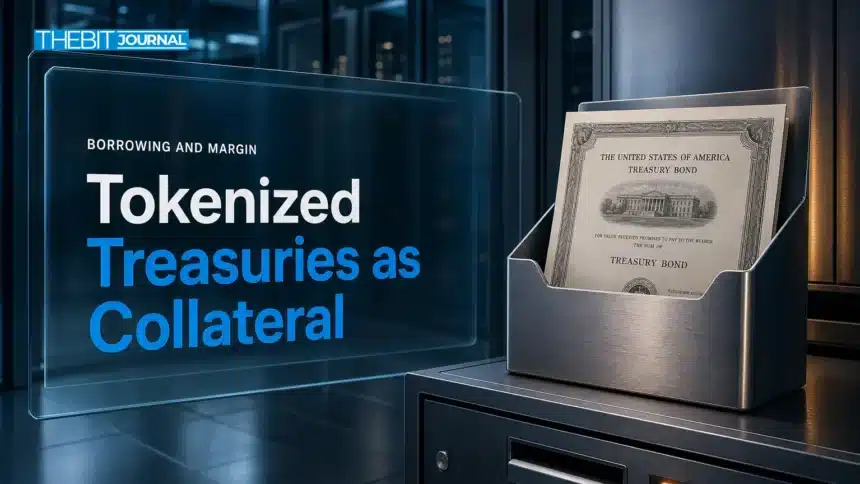

Tokenized treasury collateral is moving into institutional borrowing and digital-asset trading through a ZeroBeta and Lynq integration announced on October 27. The arrangement lets eligible tokenized Treasury holdings back loans or margin obligations while continuing to accrue interest, but the companies have not disclosed loan terms, thresholds or transaction volumes.
- ZeroBeta’s BlueShift provides risk terms and monitors margin, according to the companies’ announcement.
- Lynq holds the collateral and carries out pledge, top-up or release instructions against agreed thresholds.
- The integration covers secured borrowing and lending, plus margin for digital-asset positions and new orders.
- The assets may keep accruing interest while pledged, but that does not make them freely available for other uses.
- Lynq reported more than $89 million in platform assets and over 40 institutional firms onboarded as of October 27. Those figures are not collateral volumes for this integration.
Timeline of the tokenized treasury collateral integration
- February 25, 2026: Lynq announced EDX as its second exchange partner, supporting collateral posting and margin workflows between Lynq’s settlement layer and EDX exchange platforms.
- March 19, 2026: Lynq introduced Collateral Lock. Its stated function is to designate assets for a counterparty or exchange, prevent concurrent use while locked, and allow platform-held collateral to keep earning interest.
- October 13, 2026: Lynq and The Better Money Company reported a live proof of concept converting a client’s Lynq-held assets into RLUSD. That was a stablecoin settlement test, not a ZeroBeta collateral transaction.
- October 27, 2026: ZeroBeta and Lynq announced their integration for tokenized Treasury holdings used in secured borrowing and digital-asset margin.
- November 3, 2026: NewsBTC reported on the integration and its operational significance, while noting that evidence of actual use will matter.

Background: how tokenized treasury collateral works
Tokenization represents an asset in software, but a digital record alone does not establish that a lender or trading counterparty can rely on it. A collateral process also needs to establish that the asset has been committed to a specific obligation and cannot be spent or pledged elsewhere at the same time.
In this setup, BlueShift handles the risk layer, while Lynq holds the collateral and executes instructions. NewsBTC described the connection as using Lynq’s collateral-lock functionality on its Avalanche-based network. The practical point is the link between a margin calculation and control of the pledged holding, rather than tokenization by itself.
Interest accrual and access to an asset are separate matters. A Treasury holding may continue to earn interest while locked, but the borrower cannot assume that same holding is available for an unrelated payment. The eventual economics also depend on borrowing costs, collateral requirements and fees, none of which the announcement quantified.
Lynq announced Collateral Lock in March 2026. The feature allows participants to designate assets for counterparties or exchanges, prevents concurrent use while assets are locked, and allows platform-held collateral to continue earning interest. The October integration describes a use of collateral controls in borrowing and trading-margin workflows, but does not disclose transaction volumes or specific terms.

Reactions and market context
Lynq CEO Jerald David said in the October 27 announcement that eligible assets could remain on Lynq while backing a loan or trading position and continue earning interest. ZeroBeta CEO Varuna Wijesundera called collateral a compelling everyday use case for tokenized assets. These are the companies’ views on the product, not evidence of client demand or performance.
NewsBTC emphasized that an operational connection has to do more than display a balance. The system must determine when collateral is sufficient and ensure the right asset is pledged or released as exposures change. The announcement describes those responsibilities but does not publish valuation methods, response times, accepted asset details or exception procedures.
The supplied market snapshot does not establish a price reaction tied to the announcement. For broader context, CoinGecko data at 10:13 UTC on November 3 put Bitcoin at $76,936, down 1.28% over 24 hours, and Ether at $2,262.88, down 0.98%. The Crypto Fear & Greed Index was 26, classified as Fear, on November 3, according to Alternative.me. These figures describe wider market conditions, not a response to the integration.
| Asset or indicator | Reading | Reference time |
|---|---|---|
| Bitcoin | $76,936, down 1.28% in 24 hours | November 3, 2026, 10:13 UTC |
| Ether | $2,262.88, down 0.98% in 24 hours | November 3, 2026, 10:13 UTC |
| Crypto Fear & Greed Index | 26, Fear | November 3, 2026 |
Outlook: what to watch next
The test for tokenized treasury collateral is whether counterparties use it repeatedly in real financing and margin relationships. Useful disclosures would include which tokenized holdings qualify, how eligibility and valuation are determined, how quickly a top-up or release takes effect, and how the workflow handles exceptions.
Institutions will also need clarity on the rights attached to pledged assets. The available reporting does not detail how the parties handle a disagreement about valuation or eligibility, or what procedures apply when an exception arises. These are open operational and legal questions, not terms established by the announcement.
For now, the announcement establishes a capability, not a measured lending product or a universal return. Lynq’s previously reported platform totals and its earlier settlement test provide context for its network activity, but neither confirms use of this ZeroBeta workflow. More detail on transactions and terms would help show whether tokenized Treasury holdings can become routine collateral beyond a technical integration.

FAQ
What is tokenized treasury collateral?
It is an eligible Treasury holding represented in tokenized form and pledged to support a defined obligation, such as a secured loan or trading margin. A pledge can restrict the holder’s ability to use that asset elsewhere.
How does ZeroBeta and Lynq’s tokenized treasury collateral workflow work?
According to the October 27 announcement, ZeroBeta’s BlueShift sets risk terms and monitors margin, while Lynq holds collateral and executes pledge, top-up or release instructions against agreed thresholds.
Does pledged collateral keep earning interest?
The companies say eligible holdings can continue accruing interest while backing a loan or trading position. The announcement does not state rates, borrowing costs or net returns, and a pledged asset remains subject to the obligation it supports.
Sources
- ZeroBeta and Lynq Connect Tokenized Treasury Collateral to Lending and Margin (NewsBTC)
- ZeroBeta Integrates to the Lynq Platform Enabling Mutual Clients to use Tokenized Collateral (lynq.network)
- Lynq Announces Enhanced Functionality for Managing Digital Collateral and Margin Movement (lynq.network)
This article is for informational purposes only and does not constitute financial or investment advice. Cryptocurrencies are highly volatile; always do your own research before investing.