





Last Updated; 16 July 2026
Solana slowdown 2026 has become one of the most talked-about developments in the cryptocurrency industry after new testing revealed how post-quantum cryptography could dramatically reduce network throughput. While Solana has built its reputation on lightning-fast transactions and low fees, new security experiments suggest that preparing for future quantum computing threats comes at a significant cost.
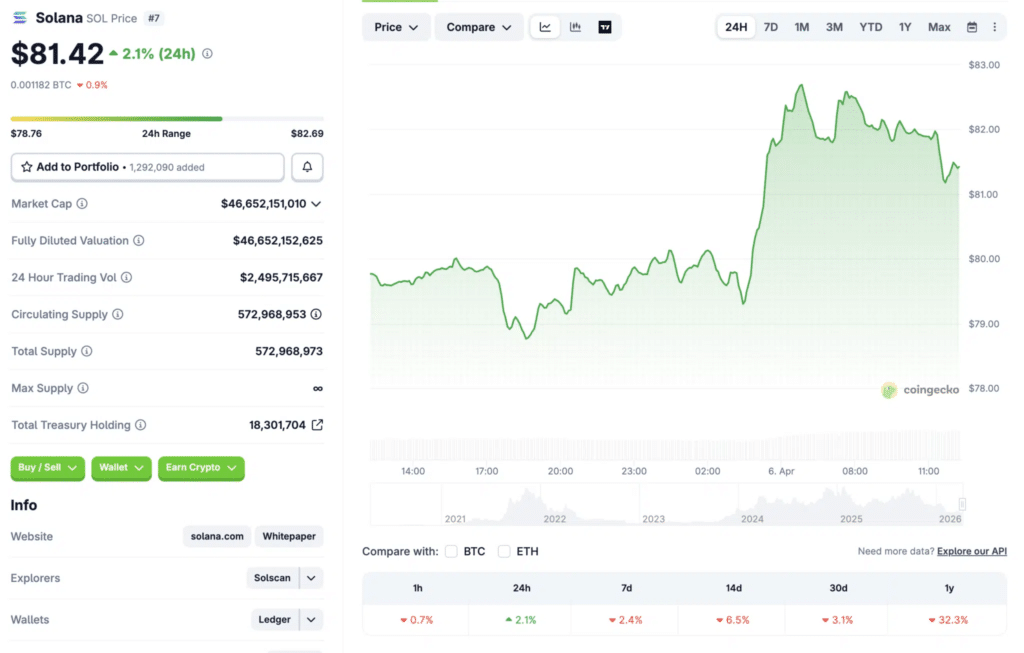
Solana currently trades at $82.01, with a 24-hour trading volume of $3,018,649,823, a market capitalization of $46,990,389,876, and a circulating supply of 572,969,015 SOL, while gaining 2.69% over the past 24 hours. The debate now centers on whether faster security can outweigh slower performance.
Why Is Solana Slowdown 2026 Making Headlines?
The Solana slowdown 2026 story revolves around a difficult engineering challenge. Solana has long promoted industry-leading transaction speeds that support decentralized finance, NFTs, gaming, and enterprise applications. However, testing with post-quantum cryptography revealed that quantum-resistant signatures significantly increase computational requirements, causing transaction throughput to fall by nearly 90%. The findings have triggered widespread discussion across the crypto sector because Solana’s competitive advantage has always depended on exceptional processing speed and network efficiency.

Solana TPS Slowdown Versus Ethereum Performance
For years, Solana has outperformed Ethereum in raw transaction processing, allowing developers to build applications without the congestion commonly seen on competing blockchains. The Solana slowdown 2026 discussion raises an important comparison because reducing TPS by such a large margin narrows that performance gap. Even with slower processing under quantum-safe testing, Solana still benefits from an efficient architecture, although maintaining that lead may require significant protocol optimization before any future security upgrade reaches production.
Why Quantum Security Changes Everything
The biggest reason behind Solana slowdown 2026 is the transition toward stronger cryptographic protection against future quantum computers. Traditional digital signatures that secure blockchain transactions could eventually become vulnerable as quantum computing advances. Solana’s research into post-quantum cryptography demonstrates a proactive approach to long-term security. Unfortunately, larger signatures require additional bandwidth, storage, and verification time, creating a direct trade-off between security and transaction processing efficiency across the network.

Solana Scalability Faces Its Biggest Test
Scalability has always been central to Solana’s identity. High throughput enables decentralized exchanges, payment systems, and blockchain games to process thousands of transactions without major delays. The Solana slowdown 2026 challenge forces developers to reconsider how scalability should evolve alongside stronger cryptographic standards. Instead of focusing only on maximum TPS, future development may prioritize smarter optimization, validator efficiency, and improved software engineering to preserve user experience without sacrificing long-term network protection.
How Markets Are Reacting to Solana Performance
Despite concerns surrounding Solana slowdown 2026, investor sentiment has remained relatively stable. SOL continues trading near $82.01, reflecting confidence that current testing represents research rather than an immediate network upgrade. Many analysts believe early experimentation allows developers to solve performance bottlenecks before quantum-resistant cryptography becomes essential. Rather than signaling weakness, the research demonstrates that Solana is planning for technological changes that could reshape blockchain infrastructure over the coming decade.
Security Versus Speed: Can Solana Balance Both?
The central question surrounding Solana slowdown 2026 is whether blockchain networks can maintain industry-leading speed while strengthening security for the future. Speed alone may no longer define blockchain success as institutional investors increasingly prioritize resilience, reliability, and infrastructure readiness. Solana developers now face the difficult task of improving validator software, optimizing signature verification, and reducing computational overhead. Achieving both security and scalability could reinforce Solana’s position as one of the industry’s leading Layer-1 ecosystems.
Future Outlook for Solana Network Performance
Looking ahead, Solana slowdown 2026 may represent an important milestone rather than a permanent limitation. Every emerging technology experiences periods where innovation introduces temporary trade-offs before optimization restores efficiency. Blockchain history offers several examples where early technical constraints eventually disappeared through protocol improvements. If developers successfully optimize post-quantum cryptography, Solana could strengthen security without permanently sacrificing the high transaction throughput that has become one of its strongest competitive advantages.
Conclusion
Solana slowdown 2026 highlights one of the blockchain industry’s biggest engineering challenges: balancing security with performance. Although quantum-resistant cryptography currently reduces transaction throughput by approximately 90%, the research reflects long-term planning rather than immediate network weakness. Solana continues to maintain strong market fundamentals, active developer participation, and significant ecosystem growth.
As blockchain technology evolves, projects capable of combining scalability, security, and innovation will likely remain industry leaders. Investors and developers should continue monitoring protocol upgrades because they could determine how Solana competes throughout the next generation of blockchain infrastructure.
Appendix: Glossary of Key Terms
Solana TPS: The number of transactions Solana processes every second.
Post-Quantum Cryptography: Cryptographic algorithms designed to remain secure against future quantum computers.
Quantum Security: Security measures intended to protect blockchain networks from quantum computing attacks.
Scalability: A blockchain’s ability to process increasing transaction volumes efficiently.
Validator: A network participant responsible for verifying and confirming blockchain transactions.
Layer-1 Blockchain: A base blockchain network that operates independently without relying on another blockchain.
Frequently Asked Questions About Solana Slowdown 2026
What is Solana slowdown 2026?
Solana slowdown 2026 refers to performance testing that showed post-quantum cryptography could reduce Solana’s transaction throughput by nearly 90%.
Why is Solana slowing down in 2026?
Testing with quantum-resistant cryptographic signatures increases computational workload, resulting in slower transaction processing.
Does Solana slowdown 2026 affect the live network?
The reported slowdown comes from testing scenarios and research into future security upgrades rather than current production performance.
Why is quantum security important for Solana?
Quantum-resistant cryptography prepares blockchain networks for future computing technologies that may eventually break today’s encryption standards.
Can Solana recover its transaction speed?
Many blockchain researchers believe future software optimization and protocol improvements can significantly improve performance while maintaining stronger security.
Reference