

The Bitcoin price climbed to $64,335.50 even as South Korea’s semiconductor giants triggered one of Asia’s biggest equity sell-offs this year. Instead of following AI-driven technology stocks lower, Bitcoin remained resilient, suggesting investors are increasingly separating cryptocurrency fundamentals from the volatility affecting traditional equity markets.
Key Takeaways
- The Bitcoin price increased 1.33% over the past 24 hours to $64,335.50.
- South Korea’s semiconductor sector experienced one of its largest two-day declines after investors sold AI chip stocks despite strong earnings.
- Bitcoin continued attracting buyers while the Kospi index weakened, highlighting a possible shift in market correlations.
- The steep decline in SK Hynix and Samsung Electronics reflected growing investor concerns that AI-driven demand may no longer justify the elevated valuations of semiconductor stocks after months of rapid gains.
Bitcoin Holds Firm While Global Markets Turn Cautious
The Bitcoin price demonstrated remarkable resilience on Tuesday, climbing toward $64,000 even as South Korea’s technology sector suffered heavy losses. The contrast immediately caught investors’ attention because Bitcoin had often traded alongside high-growth technology stocks throughout the past year. Instead of mirroring the decline in semiconductor shares, Bitcoin moved higher as institutional demand and macroeconomic expectations continued supporting the cryptocurrency market.
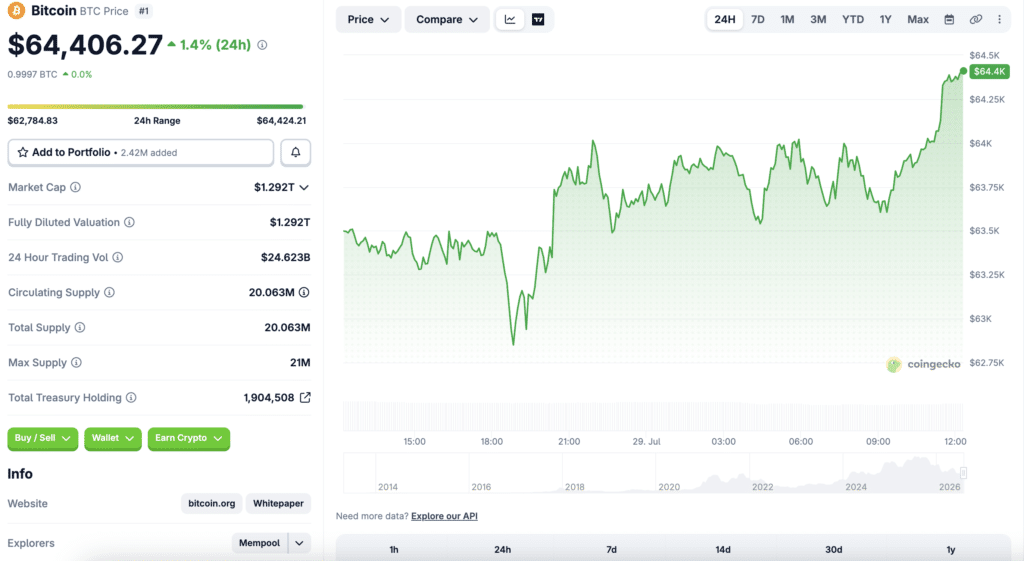
At the time of writing, the Bitcoin price stood at $64,335.50, up 1.33% during the previous 24 hours. Daily trading volume reached $24.27 billion, while Bitcoin’s market capitalization climbed above $1.29 trillion, reinforcing its position as the world’s largest digital asset. The latest rally also comes just hours before investors shift their focus to the Federal Reserve’s upcoming monetary policy decision, an event expected to influence both cryptocurrency and traditional financial markets.
Why Is Bitcoin Price Rising Today?
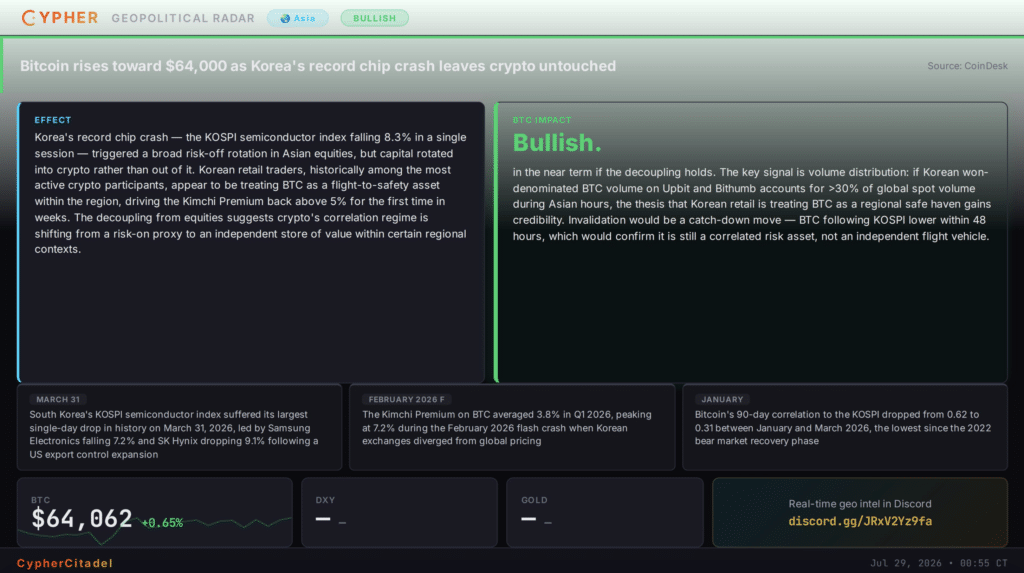
Several factors are helping explain why the Bitcoin price advanced despite broad weakness across Asian stock markets. Market participants largely ignored the semiconductor sell-off and instead focused on improving crypto sentiment, steady institutional participation, and expectations surrounding the Federal Reserve. Those factors created enough buying pressure to offset concerns generated by declining technology shares.The latest market data also reflects Bitcoin’s strong position compared with traditional financial assets.
| Metric | Value |
|---|---|
| Bitcoin Price | $64,335.50 |
| 24-Hour Change | +1.33% |
| Market Capitalization | $1.29 Trillion |
| 24-Hour Trading Volume | $24.27 Billion |
| Circulating Supply | 20,062,687 BTC |
| Maximum Supply | 21 Million BTC |
The numbers above highlight that the recent rally wasn’t driven by thin trading activity. Healthy volume accompanied the price increase, suggesting genuine market participation rather than a temporary spike caused by low liquidity. Continued institutional interest and steady spot demand have helped strengthen confidence even as uncertainty remains across global equity markets.
Bitcoin Price Shows Strength While Korea’s Chip Stocks Struggle
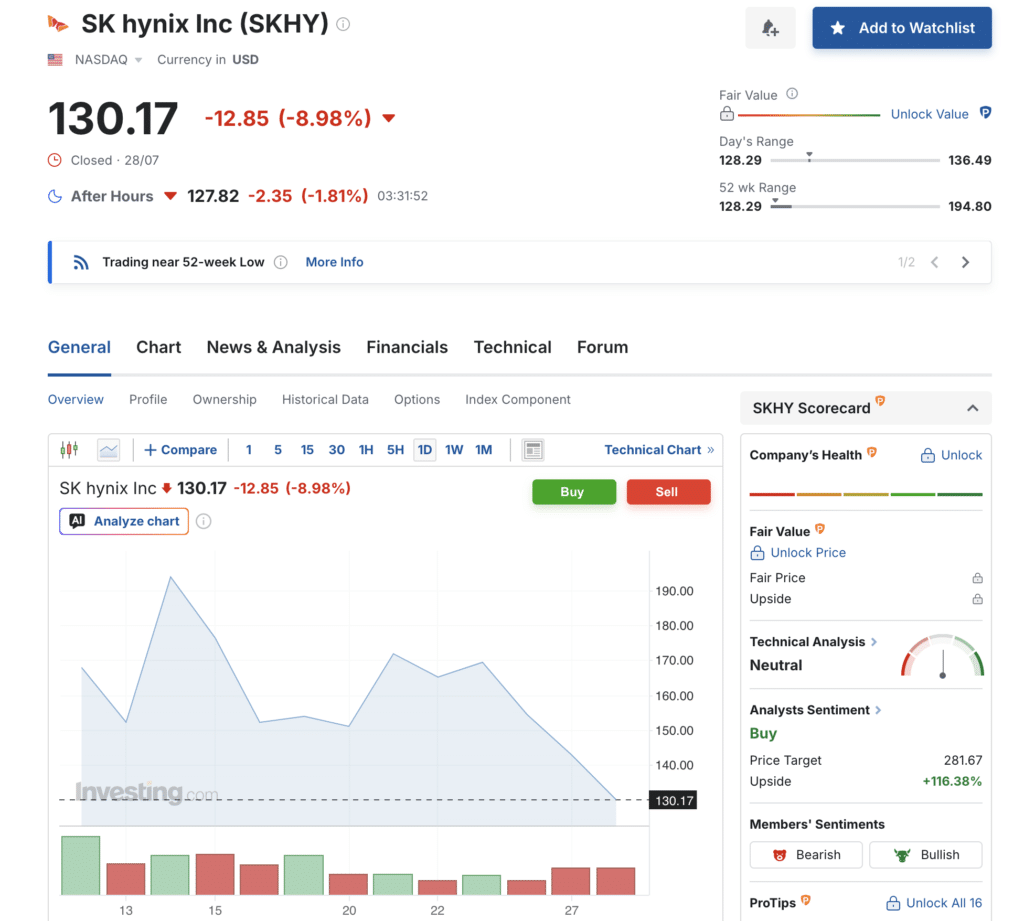
The latest Bitcoin price rally became even more notable because it unfolded during one of South Korea’s sharpest semiconductor sell-offs of the year. SK Hynix reported exceptionally strong quarterly earnings, yet investors still rushed to lock in profits after months of extraordinary gains fueled by artificial intelligence demand. Samsung Electronics also traded lower ahead of its earnings announcement, extending losses across the country’s technology sector. The difference between cryptocurrency and semiconductor performance paints a clearer picture of changing market behavior.
| Bitcoin Market | Korea Semiconductor Market |
|---|---|
| Bitcoin price gained 1.33% | SK Hynix shares fell sharply despite record earnings |
| Institutional demand remained stable | Investors aggressively booked profits |
| Crypto sentiment stayed positive | AI valuation concerns weighed on sentiment |
| Focus shifted toward the Federal Reserve | Focus remained on semiconductor earnings |
This comparison suggests investors evaluated each market using entirely different catalysts. While semiconductor stocks struggled with lofty earnings expectations, Bitcoin benefited from optimism surrounding macroeconomic conditions and continued institutional participation. That divergence is becoming one of the most closely watched developments in today’s crypto market and may signal a broader shift in how investors value digital assets relative to traditional technology stocks.
Sky-High AI Valuations Face a Reality Check
The sharp decline in SK Hynix and Samsung Electronics shares highlighted a growing shift in investor sentiment toward AI-driven technology stocks. After months of exceptional gains fueled by optimism surrounding artificial intelligence, many investors began questioning whether future AI demand could continue justifying premium valuations.
As a result, even strong earnings failed to sustain buying momentum, triggering widespread profit-taking across South Korea’s semiconductor sector. The move signals that markets are entering a more disciplined phase, where sustainable earnings growth and realistic expectations matter more than AI hype alone.
What Triggered Korea’s Record Chip Stock Crash?
South Korea’s semiconductor sector entered the trading session under intense pressure despite posting fundamentally strong earnings. SK Hynix, one of the world’s largest memory-chip manufacturers, reported another quarter of impressive profit growth driven by robust demand for high-bandwidth memory used in artificial intelligence infrastructure. Under normal market conditions, those results would have supported a rally. Instead, investors focused on elevated valuations and chose to secure profits after months of exceptional gains, dragging the broader Kospi index lower.The sequence of events below explains how the market shifted throughout the trading day.
| Time | Market Event |
|---|---|
| Pre-market | SK Hynix releases stronger-than-expected quarterly earnings. |
| Market Open | Investors begin taking profits across AI chip stocks. |
| Mid-Session | Samsung Electronics extends sector-wide selling pressure. |
| Afternoon | Kospi records one of its sharpest declines of the year. |
| Crypto Session | Bitcoin price continues climbing toward $64,000. |
| Market Close | Investor attention shifts to the upcoming Federal Reserve meeting. |
Rather than signaling weakness in the semiconductor industry itself, the sell-off reflected changing investor expectations. After months of extraordinary gains, even record earnings failed to justify increasingly expensive valuations, triggering widespread profit-taking across South Korea’s technology sector.
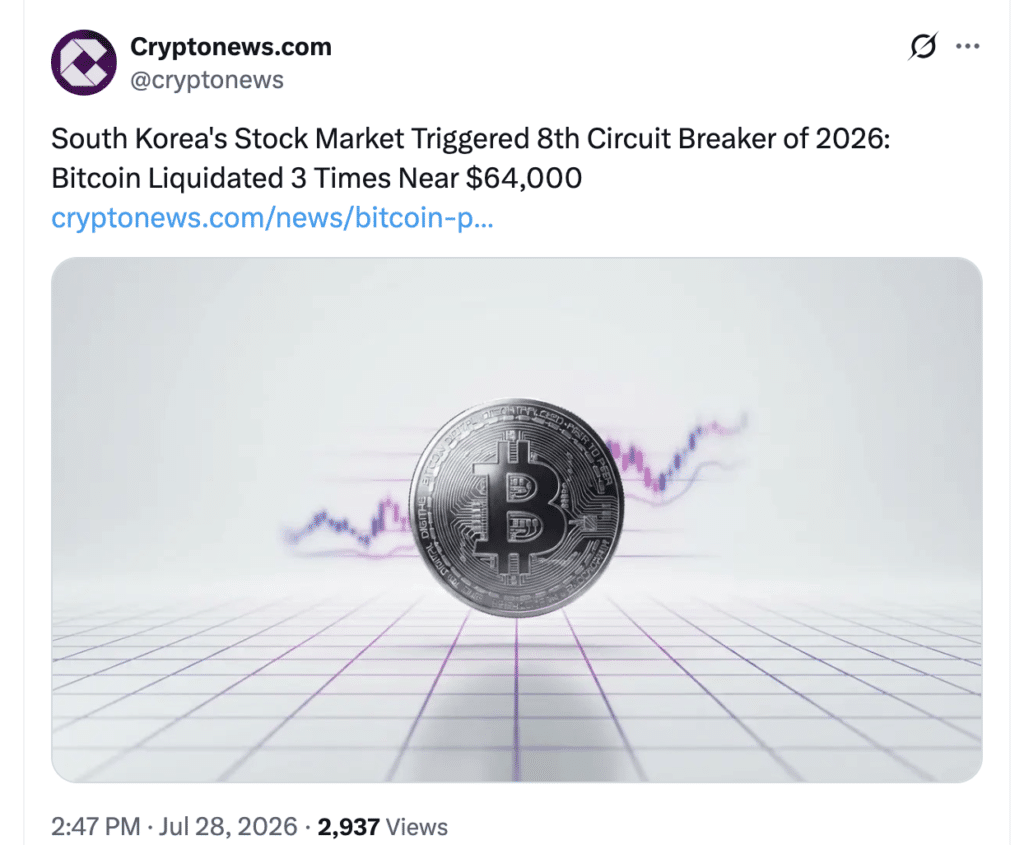
Is Bitcoin Decoupling From AI Chip Stocks?
The latest market action suggests the Bitcoin price may be becoming less tied to AI-related technology stocks. While semiconductor companies fell on valuation concerns, Bitcoin continued attracting buyers, driven by institutional demand and strong market fundamentals rather than tech-sector sentiment.
Although one trading session does not confirm a lasting trend, Bitcoin’s resilience during consecutive technology-led sell-offs indicates it may be developing a more independent market identity.
Expert Analysis: Why Bitcoin Stayed Resilient
The Bitcoin price remained resilient because investors focused on crypto-specific fundamentals rather than the semiconductor sell-off. Continued institutional demand, ETF participation, and expectations surrounding the Federal Reserve supported buying interest even as technology stocks weakened.
Unlike AI chip companies, which depend heavily on earnings and growth expectations, Bitcoin is increasingly driven by macroeconomic conditions, capital flows, and long-term adoption. While more data is needed to confirm a lasting trend, its recent resilience suggests Bitcoin is gradually establishing a more independent market identity.
How the Federal Reserve Could Shape Bitcoin’s Next Move
Despite the recent rally, the Bitcoin price now faces its next major test as investors await the Federal Reserve’s latest policy announcement. Interest-rate decisions remain one of the strongest macroeconomic drivers for both cryptocurrencies and global financial markets because they directly influence liquidity, borrowing costs, and investor appetite for risk assets.
If policymakers signal that inflation is easing and future monetary policy may become more accommodative, Bitcoin could receive additional support as investors increase exposure to growth-oriented assets. On the other hand, a more cautious stance could temporarily increase volatility across both cryptocurrencies and equities. The market indicators below summarize Bitcoin’s current position ahead of the Federal Reserve meeting.
| Federal Reserve Outcome | Potential Impact on Bitcoin |
|---|---|
| Interest rates unchanged | Neutral to slightly bullish as markets gain clarity |
| Rate cut | Bullish, as lower borrowing costs may increase demand for risk assets |
| Hawkish guidance | Short-term bearish due to reduced liquidity expectations |
| Dovish guidance | Positive for Bitcoin as investors anticipate easier financial conditions |
These figures illustrate that Bitcoin enters a critical macroeconomic event from a position of relative strength. Stable trading volume, a positive daily performance, and sustained institutional participation suggest investors remain cautiously optimistic despite uncertainty across broader financial markets.
Conclusion
The Bitcoin price continued climbing toward $64,000 despite South Korea’s record chip stock sell-off, highlighting growing resilience in the cryptocurrency market. While AI-related equities struggled under profit-taking pressure, Bitcoin remained supported by institutional demand and expectations surrounding the Federal Reserve’s upcoming policy decision. Investors should continue monitoring macroeconomic developments, ETF flows, and market sentiment to determine whether Bitcoin can maintain its upward momentum.
Frequently Asked Questions About Bitcoin Price
Why is the Bitcoin price rising today?
The Bitcoin price gained as investors focused on institutional demand and the upcoming Federal Reserve meeting rather than the Korea stock market decline.
Did the Korea chip stock crash affect Bitcoin?
No. Bitcoin remained resilient despite sharp losses in South Korea’s semiconductor sector.
What is Bitcoin’s current price?
Based on the market data used in this article, the Bitcoin price is $64,335.50, up 1.33% over the last 24 hours.
What should investors watch next?
The Federal Reserve’s policy decision, ETF inflows, and macroeconomic data are expected to be the next major drivers of Bitcoin.
Appendix: Glossary of Key Terms
Bitcoin (BTC): The world’s largest cryptocurrency by market capitalization.
Market Cap: The total value of all circulating Bitcoin.
Kospi: South Korea’s benchmark stock index.
Federal Reserve: The U.S. central bank responsible for monetary policy.
AI Chip Stocks: Semiconductor companies benefiting from artificial intelligence demand.
References