



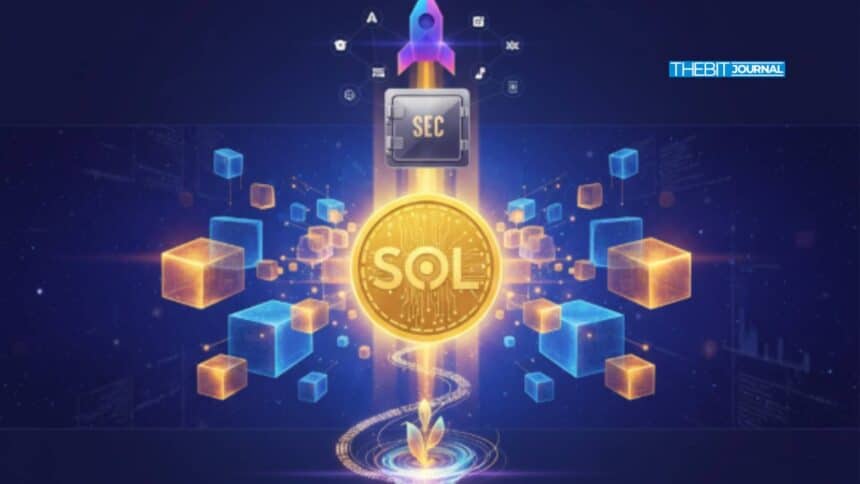

This article was first published on The Bit Journal. After a fresh Form 8-A filing with the United States securities regulator, the VanEck Solana ETF now appears to be in the last phase before trading begins, giving traditional investors a regulated doorway into one of the fastest-growing smart contract networks.
This move arrives at a time when digital asset funds are evolving from niche products into mainstream portfolio tools. Solana has moved from being a high beta alternative to Bitcoin to a core altcoin exposure for funds that want speed, low fees, and a thriving DeFi and NFT ecosystem. The launch timing of the VanEck Solana ETF is therefore not a coincidence. It aligns with rising institutional interest in blockchains that can support real throughput, rather than only narratives.
A regulatory step that signals a near term launch
The latest Form 8-A filing is not a casual update. In the exchange-traded fund world, this document typically appears just before a product lists on an exchange. For the VanEck Solana ETF, the filing follows an earlier registration statement that laid out the structure, risks, and operational details of the trust. Together, these documents show a product that has moved from concept to execution and now waits only for the final green light.
According to the public filing, the trust is expected to list under the ticker symbol VSOL on a major United States exchange. It is structured as a grantor trust that holds Solana directly rather than through futures or swaps. That design is meant to track the underlying market more closely and reduce complexity for regulators and investors alike.
Inside the structure of the ETF
At its core, the VanEck SOL ETF is designed to reflect the price of Solana while also capturing rewards from staking a portion of the holdings, when this is possible within legal and tax constraints. The fund will reference the MarketVector Solana Benchmark Rate, an index that aggregates prices from several leading trading venues in order to smooth out idiosyncratic order book moves.
Unlike leveraged exchange products or complex derivatives based strategies, the VanEck Solana ETF will not use margin or futures contracts as part of its mandate. It aims to be a straightforward spot exposure vehicle that holds SOL, publishes a daily net asset value, and allows investors to trade shares on a stock exchange in the same way they trade shares of equity or commodity funds. For institutions that must operate inside strict risk frameworks, this type of design is often a prerequisite for allocation.
Inflows show growing appetite for Solana exposure
The VanEck Solana ETF is not arriving in a vacuum. Several other Solana based funds have already attracted strong inflows, with hundreds of millions of dollars entering Solana focused products over recent weeks. Net inflows into existing Solana ETFs have climbed into the high hundreds of millions, even as some Bitcoin and Ethereum funds reported modest outflows in the same period.
This pattern suggests that professional investors are using Solana as a way to express a higher growth thesis inside a regulated wrapper. The VanEck SOL ETF enters that landscape as a recognisable name with a long track record in commodity and digital asset products. For allocators that care about operational history and brand, that combination matters almost as much as the underlying asset itself.
Market impact on SOL and the wider crypto landscape
Short term, the launch of the VanEck Solana ETF may not guarantee a one way price move for SOL. In recent sessions, Solana has experienced notable volatility, including double-digit intraday declines that mirrored weakness across the broader crypto market after large-cap coins pulled back from recent highs. ETF flows can soften this volatility at the margin, but they cannot eliminate the risk profile of a high growth blockchain asset.
Over a longer horizon, however, the presence of the VanEck Solana ETF could deepen liquidity, tighten spreads, and attract a wider mix of market participants. Regulated access through brokerage accounts lowers friction for pensions, family offices, and advisory platforms that are not prepared to manage private keys or direct exchange relationships. That deeper pool of capital can influence how the market responds to network upgrades, fee changes, and new application flows on Solana.
Conclusion
The VanEck Solana ETF represents another step in the steady migration of crypto assets from specialist venues into the center of the capital markets. By pairing spot Solana exposure with a transparent index methodology and the potential for staking rewards, it offers a product that speaks the language of institutional investors while still tracking an innovative, high-throughput blockchain.
If inflow trends into Solana funds continue, and regulatory conditions remain stable, the VanEck SOL ETF may become a reference point for how altcoin exposure is delivered in traditional portfolios. The next phase will depend on how investors balance Solana’s growth potential against its volatility, but the gateway is now almost open.
Follow us on Twitter and LinkedIn, and join our Telegram channel to be instantly informed about breaking news!
Frequently Asked Questions
What is the VanEck Solana ETF and how does it work?
The VanEck Solana ETF is an exchange traded fund that holds Solana directly in a trust structure and issues shares that trade on a stock exchange. Its objective is to mirror the price of SOL, using a benchmark index, while also seeking to capture staking rewards when possible under regulatory and tax guidelines.
Why does the Form 8-A filing matter for the VanEck Solana ETF?
The Form 8-A filing is a technical step that usually occurs just before an ETF begins trading. For the VanEck Solana ETF, this filing indicates that the product has cleared most of the regulatory process and is close to listing, subject to final exchange procedures and any remaining approvals.
How could the VanEck Solana ETF affect Solana’s market performance?
The VanEck Solana ETF could increase access to SOL for investors who prefer regulated brokerage channels. Greater access may support liquidity and tighten spreads over time, although Solana will still react to broader crypto cycles, macro conditions, and network specific developments such as upgrades or outages.
Glossary of Key Terms
Form 8-A
A registration document filed with the United States securities regulator to register a class of securities for trading on a national securities exchange. In the context of new ETFs, it is often one of the final steps before listing.
Grantor Trust
A legal structure in which a trust holds underlying assets and investors own shares that represent a direct interest in those assets for tax purposes. Many spot crypto products use this model to hold coins directly.
Staking
A process used by proof-of-stake blockchains in which holders lock tokens to help secure the network and, in return, receive rewards that resemble a yield in token form.
Benchmark Index
A rules-based measure of market prices used to value an ETF portfolio. For the VanEck Solana ETF, the benchmark reflects Solana prices across several major trading venues.