

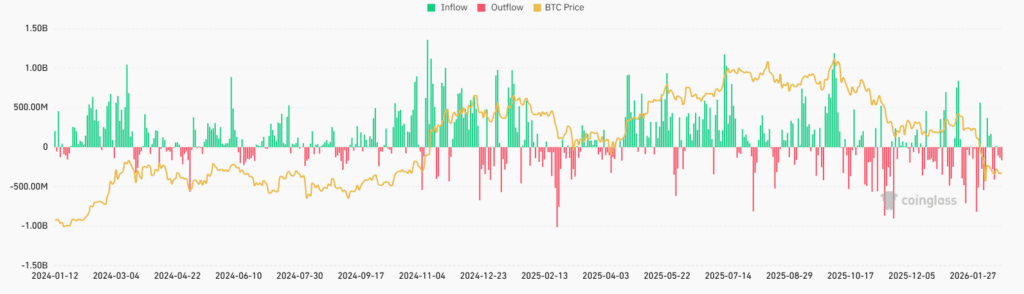
Bitcoin ETF outflows have become a clear pressure point for the U.S. spot ETF market, with ongoing redemptions putting institutional commitment under closer scrutiny. Market data shows that this selling has not been limited to short bursts, as roughly $8.6 billion has moved out over recent months, pointing to a sustained trend rather than a temporary response to price swings.
This matters because spot ETFs were designed as long-term entry routes for traditional investors seeking Bitcoin exposure. As negative flows appear more often, the focus has shifted away from daily mood swings and toward deeper questions about how durable ETF demand really is over time.
How did Bitcoin ETF outflows become a defining market signal?
Bitcoin ETF outflows describe what happens when investors pull more money out of U.S.-listed spot Bitcoin ETFs than they put in. After Bitcoin topped out near $126,000 last October, this pattern became hard to ignore, with outflows recorded on 55 of the last 89 trading days.

In total, about $8.66 billion has left these ETFs during that time, showing that selling pressure has been steady rather than occasional. That consistency has prompted traders and analysts to take a closer look at whether ETF demand is truly long-lasting when prices stay under pressure for months.
Why are cumulative inflows still being watched closely?
Even with the recent wave of selling, overall net inflows into U.S. spot Bitcoin ETFs remain significant. Data tracked by Bloomberg Intelligence show that total net inflows climbed to around $63 billion in October and have since slipped to about $53 billion.
ETF analyst Eric Balchunas has noted that this longer-term total matters more than daily flow movements. His view reflects the fact that while Bitcoin ETF outflows have increased, a large portion of early investment has remained in the market through the downturn.
How severe has the recent drawdown been?
Since October, Bitcoin has fallen by more than 40 percent from its peak near $126,000 and is now trading around $67,826.73, while roughly $8.66 billion has been withdrawn from spot Bitcoin ETFs. During this period, Bitcoin ETF outflows have averaged close to $90 million per trading day.
Even with this pressure, cumulative net inflows still sit near $54.31 billion. Taken together, these figures point to a market where long-term holders remain invested while shorter-term participants continue to sell.
What do futures markets say about institutional risk?
ETF flow data captures only one side of market activity. Futures positions on the Chicago Mercantile Exchange add another layer of insight. Bitcoin futures exposure on the CME has fallen by around two-thirds from its late-2024 high to roughly $8 billion.
This pullback matches the pattern seen in Bitcoin ETF outflows. Because authorized participants commonly use futures to manage risk linked to ETF share creation and redemptions, lower futures activity suggests that major institutions are currently holding less exposure.
Why does U.S. trading activity look heavier than offshore markets?
Trading activity across major platforms supports what the flow data is showing. Coinbase, which is widely used by U.S. institutions, has regularly priced below Binance, pointing to ongoing selling from the U.S. side of the market.
There have been moments of relief. In mid-January, spot Bitcoin ETFs pulled in about $760 million in one day, the largest single-session inflow since October, with Fidelity’s FBTC accounting for a large share. Even so, these positive sessions have been fewer than the days marked by continued Bitcoin ETF outflows.
How is capital distributed across spot Bitcoin ETFs?
Data shows that combined assets held across spot Bitcoin ETFs amount to $98.33 billion. IBIT remains the largest fund with $57.01 billion, followed by FBTC at $13.94 billion and GBTC at $12.58 billion. BITB holds $5.79 billion, while ARKB stands at $5.36 billion. Beyond these, assets decline more sharply.
HODL holds $1.37 billion, EZBC stands at $728.57 million, BTCO at $696.58 million, BTCW at $462.49 million, and BRRR at $398.00 million. This distribution illustrates how liquidity remains concentrated in a handful of funds, even as Bitcoin ETF outflows continue to affect the broader category.
What happens if current outflows persist?
If Bitcoin ETF outflows were to continue at an average pace of about $90 million per trading day, the long-term picture starts to look uneasy. With total ETF assets near $98 billion, maintaining that rate would suggest around 1,011 trading days before holdings are largely depleted, placing that point in early January 2030 if nothing changes.

Using the next Bitcoin halving as a closer reference, expected around 11 April 2028 or roughly 558 trading days from now, the same rate of withdrawals would reduce ETF assets to about $44 billion. At a mid-$60k Bitcoin price level, this would still represent roughly 662,000 BTC held inside ETF structures. However, if cumulative net inflows were to decline all the way to zero instead, that scenario could unfold sooner, potentially just after the halving, around the middle of 2028.
Conclusion
Bitcoin ETF outflows have made ETF flow numbers a daily measure of how institutions are responding to market conditions. Higher redemptions tend to raise questions, while steady inflows can just as quickly rebuild confidence.
For now, cumulative inflows are still large by historical standards, yet recent activity shows how fast sentiment can change when prices come under pressure. How these outflows evolve from here, whether they slow, turn positive, or continue, will play a key role in defining Bitcoin’s next stage of interaction with traditional finance.
Disclaimer: The content provided is intended solely for general information and market analysis. It should not be interpreted as a recommendation to buy, sell, or hold any asset. Market conditions can change rapidly, and readers are responsible for their own investment decisions.
Glossary
Cumulative Net Inflows: Net money added to ETFs over time.
Bitcoin Halving: Event that halves new Bitcoin supply from mining.
Spot Bitcoin ETF: Fund that holds real Bitcoin to track its price.
CME Bitcoin Futures: Regulated Bitcoin contracts traded on CME.
Liquidity Concentration: Most capital gathered in a few dominant funds.
Frequently Asked Questions About Bitcoin ETF Outflows
How much money has left Bitcoin ETFs since October?
Around $8.6 billion has been withdrawn from U.S. spot Bitcoin ETFs since October.
How much has Bitcoin’s price fallen since October?
Bitcoin’s price has fallen by more than 40 percent since its October peak.
What could this mean for the 2028 Bitcoin halving?
If outflows continue at the same pace, ETF holdings could be much lower by the 2028 halving.
What do CME Bitcoin futures suggest about institutions?
CME Bitcoin futures data suggests that many institutions have reduced their market exposure.
Are institutions completely leaving Bitcoin ETFs?
Institutions are not completely leaving Bitcoin ETFs, but they have reduced their exposure in recent months.
Sources