


Last updated: November 18, 2026
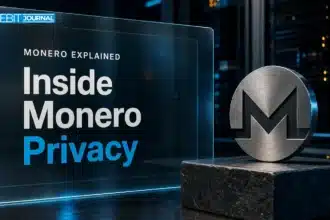
What is Monero? It’s a cryptocurrency built to keep the sender, recipient and amount in a transaction private by default. Its native asset is XMR, and understanding how that privacy works also means understanding Monero’s mining, supply design and regulatory risks.
TL;DR
- Monero uses stealth addresses, ring signatures and RingCT to obscure transaction details by default, according to the official Monero website.
- XMR uses proof-of-work mining and a continuing block reward, so the network has no fixed maximum supply.
- Privacy features can affect exchange access and regulation. XMR is volatile, and using it does not remove the risks of loss, scams or custody problems.
What is Monero and how does it work?
Monero launched in April 2014. Unlike a cryptocurrency whose public ledger displays transaction details openly, Monero’s protocol is designed to hide key information on-chain. The official Monero introduction describes three core tools: stealth addresses, ring signatures and RingCT.
What is Monero’s privacy technology?
A stealth address creates a one-time destination for a payment, rather than exposing the recipient’s reusable public address in the transaction. Ring signatures combine a real spend with other possible outputs, making it harder to tell which one was actually spent. RingCT, short for Ring Confidential Transactions, conceals the transaction amount.
These tools provide transaction privacy by default, but they shouldn’t be confused with complete personal anonymity. They don’t make the use of an exchange, a compromised device or a person’s own disclosures private. Wallet security and how someone obtains or uses XMR still matter.

How XMR is mined and issued
Monero uses RandomX proof of work. Miners compete to add blocks, and the network targets a new block about every two minutes, according to Monero’s official information. Mining helps secure the ledger, but it also requires computing resources and can involve costs and technical risks.
Monero has no fixed maximum supply. After its main emission, the protocol pays a tail emission of 0.6 XMR per block, according to the official Monero site. After the main emission, the 0.6 XMR tail emission continues as a block reward. It also means XMR supply continues to grow rather than stopping at a preset cap.
For context, CoinGecko reported a circulating supply of about 18.83 million XMR on November 18, 2026. Circulating supply is a snapshot, not a supply limit, and it can change as new coins are issued.
Monero network and development
Monero’s roadmap listed Full-Chain Membership Proofs (FCMP), CARROT addressing and Cuprate, a Rust node implementation, as in progress on November 18, 2026. The roadmap gave no activation date for FCMP. These are development efforts, not features users should assume are already active.
The project’s FCMP++ description says the design aims to let a transaction prove that its input is valid without revealing which output was spent. Its intended anonymity set is the full history of eligible Monero outputs, rather than the current ring of 16. That describes a design goal; the roadmap lists no FCMP activation date.
For a dated activity snapshot, XMRList counted 33,391 on-chain transactions on November 17, 2026, 14% above its cited 30-day average. The source says its total comes from synced public Monero nodes and excludes miner-reward transactions. One day of activity doesn’t establish a longer-term trend.

XMR market data and exchange access
CoinGecko listed the following Monero market figures at 12:22 UTC on November 18, 2026. Crypto prices and trading conditions can change quickly, so this table is a dated snapshot, not a forecast.
| Measure | Reported value |
|---|---|
| XMR price | $504.58 |
| Market capitalization | $9.50 billion |
| 24-hour trading volume | $153.44 million |
| 24-hour price change | -1.69% |
| Circulating supply | About 18.83 million XMR |
Exchange access can vary by platform and jurisdiction. MEXC announced that it suspended XMR spot trading and closed deposits on November 17, 2026, while saying withdrawals would remain available for 30 days after delisting. Availability differs by platform and jurisdiction. Readers comparing access can review our guide to Monero exchanges, wallets and risks, but should check current platform terms directly.
Monero regulation and practical risks
Privacy-focused design has regulatory consequences. EU Regulation 2024/1624 is scheduled to apply from July 10, 2027. Article 79 restricts covered crypto-asset service providers from keeping accounts that anonymize customers or anonymize or further obscure transactions, including through anonymity-enhancing coins. The EU regulation text is the primary source; rules and practical effects vary by location and service.
Other risks are familiar across crypto. XMR’s market price can fall sharply, and a holder can lose some or all of the value. Sending funds to the wrong address, losing wallet access or trusting a scammer can also lead to permanent loss. Privacy features do not prevent mistakes, fraud or platform failure.

Monero pros and cons
| Potential advantages | Trade-offs and risks |
|---|---|
| Transaction details are private by default. | Privacy features can limit exchange availability or draw regulatory restrictions. |
| Proof-of-work and continuing rewards support ongoing mining incentives. | Mining uses computing resources, and supply has no fixed maximum. |
| Open development includes published roadmaps and software releases. | Roadmap items may change and should not be treated as completed upgrades. |
Who Monero may or may not be for
Monero may interest people researching transaction privacy, proof-of-work networks or how digital cash can work without displaying payment details by default. The technology is also relevant to developers and researchers assessing privacy systems.
It may be a poor fit for someone who needs broad exchange access, transparent transaction records or a capped supply. People who cannot tolerate sharp price swings, custody mistakes or changing regulations should account for those risks before interacting with XMR. Our overview of Monero privacy and investment risks discusses those considerations without making a return promise.
Bottom line
Monero is a privacy-focused cryptocurrency whose protocol obscures transaction senders, recipients and amounts by default. Its RandomX mining and ongoing tail emission distinguish its security and supply design from networks with fixed caps. But privacy does not erase market, wallet, exchange or legal risks. What is Monero, then? It’s a tool for private on-chain transfers, with trade-offs that are as important as its central feature.
Sources
- What is Monero (XMR)? (www.getmonero.org)
- Regulation (EU) 2024/1624 (eur-lex.europa.eu)
- Monero price and market data (CoinGecko)
This article is for informational purposes only and does not constitute financial or investment advice. Cryptocurrencies are highly volatile; always do your own research before investing.