






HYPE ETF inflows are gaining attention as investors evaluate Hyperliquid through the perspective of an on-chain exchange business rather than viewing HYPE only as a digital asset. The recent fund activity reflects a growing focus on crypto investment products connected with measurable business activity, including trading volume, revenue generation, and token economic structures.
The development comes as market participants examine whether blockchain platforms with transparent financial metrics can attract sustained institutional interest. One month after THYP started trading on Nasdaq, three US-listed spot HYPE ETFs recorded $161 million in net inflows. The steady demand has increased focus on Hyperliquid’s exchange model, its fee structure, and whether its current growth metrics can continue supporting investor confidence.
What does the HYPE ETF inflows trend reveal about investor demand?
HYPE ETF inflows show that investors are using regulated market products to gain exposure to Hyperliquid while assessing the platform’s underlying performance. One month after THYP’s Nasdaq debut, the three US spot HYPE ETFs attracted $161 million in total net inflows.

June 5 was the only trading session that recorded an outflow, with BHYP seeing a $2.9 million redemption. Every other trading day closed in the green, creating a consistent flow pattern during the first month of trading. The access structure has also influenced demand.
Hyperliquid restricts US users from directly accessing its platform, making brokerage-listed ETFs one of the main options for American investors who want exposure to HYPE without using a non-custodial wallet. Beyond accessibility, investors are focusing on Hyperliquid’s trading activity, revenue generation, and token buyback mechanism connected to platform fees.
What is Hyperliquid’s business model behind the ETF demand?
Hyperliquid’s investment case is based on its position as an on-chain derivatives exchange with measurable usage, fee generation, and trading activity. DefiLlama data shows the platform recorded $240.5 billion in 30-day perpetual contract volume, $72.4 billion in seven-day volume, and $9.4 billion in 24-hour volume. Its cumulative perpetual contract volume stands at $4.663 trillion.
The platform currently has $8.6 billion in open interest. Annualized fees exceed $1 billion, while annualized revenue is close to $886 million. Other market data has also highlighted the scale of activity. CoinGlass reported nearly $493 billion in derivatives trading volume during the first quarter, while DefiLlama’s cumulative figure reached approximately $443 billion.
At the time of THYP’s mid-May launch, 21Shares cited cumulative trading volume of $4.22 trillion. Hyperliquid’s fee structure remains a key part of the investment discussion. Its methodology states that 99% of perpetual contract fees flow into the Assistance Fund for HYPE token buybacks, excluding builder fees.
Bitwise, the issuer behind BHYP, describes this as nearly all trading revenue being recycled into open-market buybacks. This creates a model where increased trading activity can generate more fees, which can support buybacks and influence token supply dynamics.
How does HYPE’s price and valuation shape investor expectations?
HYPE’s market performance has become another factor influencing how investors assess the protocol’s growth potential. HYPE reached an all-time high of $75.48 on June 2. The token has gained around 160% year-to-date and is currently trading around $65.11, up 8.12% over the past 24 hours.
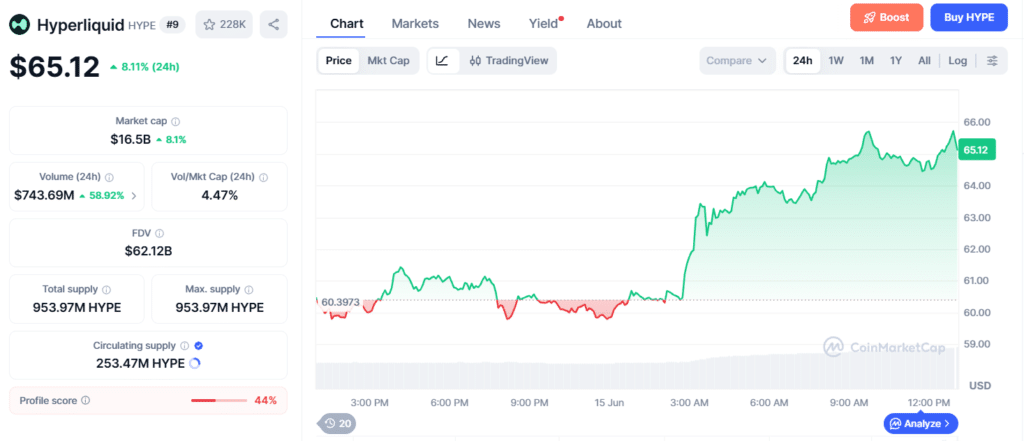
The protocol’s fully diluted valuation is approaching $69 billion, placing the asset among the larger crypto projects by market valuation. The protocol’s fully diluted valuation is approaching $69 billion, placing the asset among the larger crypto projects by market valuation. These figures provide context for ETF demand as investors consider whether Hyperliquid’s exchange-style revenue model can justify its current market position.
BHYP’s own fund data shows $93.53 million in assets under management as of June 10. The fund held 1.587 million HYPE tokens, reported a 2.25% gross staking reward rate, a 1.18% net staking reward rate, and had 70% of assets currently staked.
Bitwise Chief Investment Officer Matt Hougan said the market is “1% penetrated its potential” and noted that many investors are still unfamiliar with Hyperliquid. Presto Research Head of Research Peter Chung observed that early institutional demand for HYPE ETFs was stronger than Bitcoin ETFs when adjusted for market capitalization.
Why is HYPE being compared with exchange stocks?
HYPE is being compared with exchange businesses because investors are focusing on measurable financial activity rather than only crypto market narratives. Bitcoin ETFs are generally associated with digital asset exposure, liquidity, and supply characteristics.
Solana ETFs are linked with blockchain ecosystem growth, developer activity, staking, and applications. XRP ETFs are focused more on payment utility, settlement activity, and regulatory developments. HYPE ETFs represent a different approach because the underlying asset is connected to an on-chain derivatives exchange.
Investors are monitoring trading volume, open interest, fees, revenue, and buybacks in a way that resembles how traditional exchange companies are evaluated. Another factor supporting this comparison is HIP-3, Hyperliquid’s permissionless framework that allows perpetual futures markets for assets with price feeds.
HIP-3 has expanded beyond crypto trading. The share of cryptocurrency in total trading volume has fallen from roughly 90% to around 65%. On some days, five of the top ten traded assets include traditional markets such as the S&P 500, silver, Nasdaq-100, WTI crude oil, and Brent crude oil through licensed contracts.
HIP-3 open interest reached $1.7 billion in mid-May, increasing more than 150% from February. Trade.xyz, the largest HIP-3 deployer and a product of Hyperunit, Hyperliquid’s tokenization division, accounts for $1.58 billion of that total and has processed more than $100 billion in trading volume since October 2025.
What risks could affect HYPE ETF inflows and future growth?
The sustainability of HYPE ETF inflows depends on whether Hyperliquid can maintain trading activity, revenue growth, and demand for token buybacks. The positive scenario depends on 30-day perpetual volume staying above $200 billion, with HIP-3 open interest moving beyond $3 billion.
In this situation, investors would continue monitoring HYPE ETF inflows, buyback activity, and HIP-3 volume growth. A base scenario would involve strong trading activity without further acceleration. Investors would focus on 30-day volume, staking rates, and ETF asset growth. The downside scenario could emerge if monthly volume falls below $150 billion.
In that case, annualized revenue could move toward the $350 million to $450 million range modeled by 21Shares, with a possible HYPE price range between $15 and $19. A shock scenario could develop if regulatory action affects commodity perpetual contracts or tokenized markets.
Investors would watch enforcement headlines, possible market restrictions, delistings, and validator risks. The only sustained outflow session so far did not create observable price damage. However, the impact could look different if outflows increased by ten times the current scale, especially because HYPE has a concentrated circulating supply.
Bitwise’s BHYP documentation identifies risks including staking-related slashing risk, reward-loss risk, and redemption timing risk. 21Shares has also highlighted centralization risks, validator attack risks, and regulatory uncertainty.
The platform also faces competition from centralized exchanges with deeper liquidity and established compliance infrastructure. Hyperliquid’s growth depends on continued developer participation and the ability of HIP-3 markets to expand.
What could determine the next stage for Hyperliquid’s market position?
The future direction of Hyperliquid will depend on whether the platform can continue producing the activity levels that support its exchange-based valuation approach. Hyperliquid expanded its presence as a 24/7 macro trading platform partly after traders sought oil exposure during the US-Iran conflict last summer when traditional futures markets were closed.

The development increased regulatory attention toward commodity perpetual contracts and tokenized markets. Bitwise has committed 10% of BHYP management fees toward purchasing and staking HYPE on its own balance sheet.
This creates a demand mechanism connected to the fund’s assets under management. Whether ETF demand and protocol buybacks can absorb future token unlock pressure will depend on the continued performance of trading volume and revenue metrics.
Conclusion
HYPE ETF inflows of $161 million highlight a changing approach toward crypto investments, where investors are increasingly examining operational performance alongside token value. The Hyperliquid discussion now centers on exchange-style metrics such as trading volume, fees, revenue, and buyback mechanisms.
At the same time, risks related to regulation, competition, token supply, and market cycles remain important considerations. The next phase for HYPE will depend on whether Hyperliquid can maintain the economic activity behind its investment thesis while managing the challenges faced by emerging on-chain financial platforms.
Glossary
HYPE ETF Inflows: Money flowing into HYPE exchange-traded funds.
HYPE Token: The native token of the Hyperliquid platform.
Perpetual Futures: Futures contracts with no expiration date.
Buyback Mechanism: Revenue used to purchase HYPE tokens from the market.
Annualized Revenue: Projected yearly revenue based on current performance.
Frequently Asked Questions About HYPE ETF Inflows
How much money entered HYPE ETFs in the first month?
HYPE ETF inflows attracted $161 million in net during their first month of trading.
Why are investors interested in HYPE ETFs?
Investors are interested because HYPE ETFs offer regulated access to Hyperliquid.
What supports demand for HYPE tokens?
Demand is supported by Hyperliquid’s token buyback program funded by trading fees.
How does Hyperliquid generate revenue?
Hyperliquid generates revenue from fees paid by traders on its platform.
What risk could affect HYPE ETF inflows?
Falling trading volume and slower revenue growth could weaken investor demand.
Sources –