

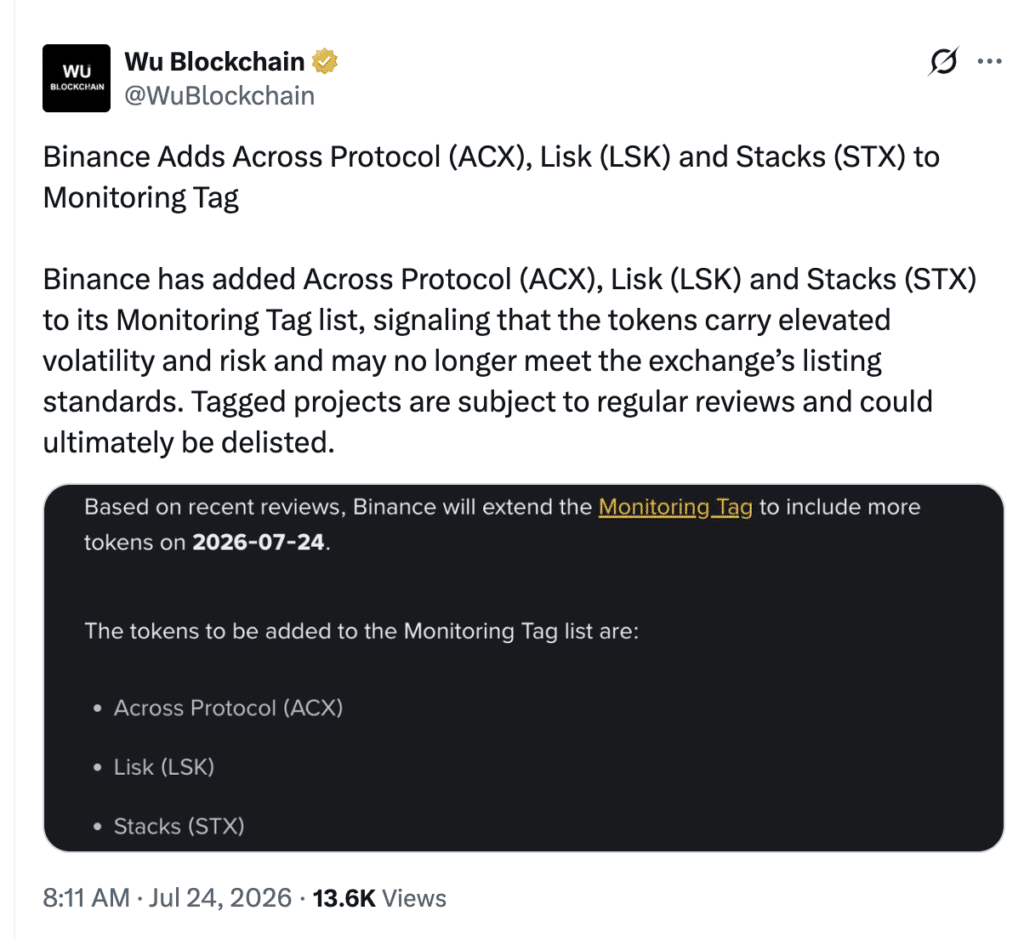
The latest Binance delisting risk update has placed three well-known altcoins under the spotlight. Across Protocol (ACX), Lisk (LSK), and Stacks (STX) have officially received Binance’s Monitoring Tag, signaling that the exchange will conduct ongoing evaluations to determine whether these projects continue to meet its listing standards. While the move does not mean an immediate removal from the exchange, it raises fresh questions about each project’s long-term position on the world’s largest cryptocurrency trading platform.
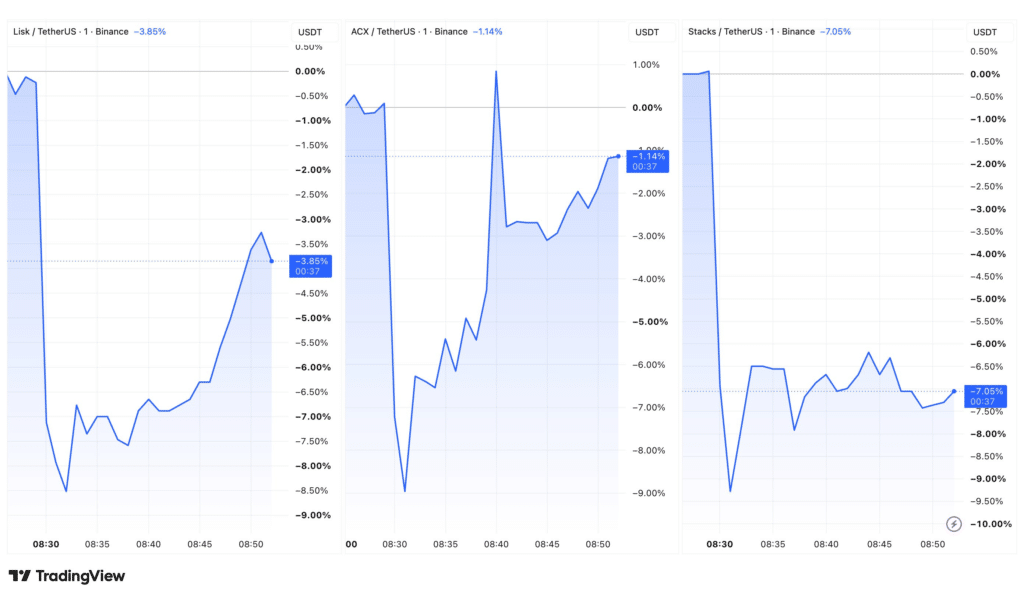
The announcement has already affected market sentiment. STX experienced the sharpest decline following the news, while ACX posted a smaller daily loss on Binance. LSK also attracted increased investor attention as traders weighed the potential impact of future Binance listing decisions. As Binance delisting risk becomes a growing concern across the cryptocurrency market, investors are paying closer attention to how exchanges evaluate digital assets.
Binance Monitoring Tag Signals Higher Listing Scrutiny
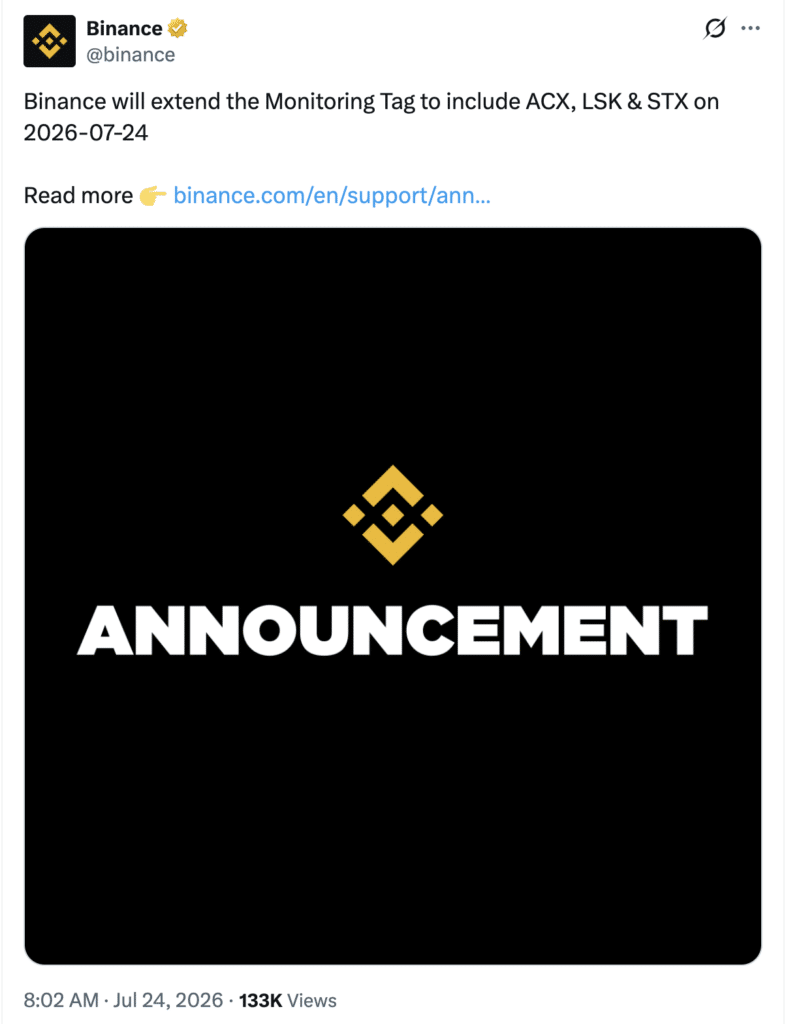
The addition of ACX, LSK, and STX to the Binance Monitoring Tag represents an important step in Binance’s ongoing Binance listing review process. The Monitoring Tag is reserved for cryptocurrencies that require closer oversight because they may no longer meet the exchange’s evolving listing requirements. Although trading remains available, tokens carrying this designation face regular evaluations that could eventually result in removal if performance or compliance standards deteriorate.
For many investors, understanding the Binance Monitoring Tag meaning has become increasingly important. The tag serves as an early warning rather than a final decision. Projects placed under review must continue demonstrating active development, transparent communication, healthy liquidity, and strong ecosystem growth to reduce their Binance delisting risk over time.
Why Did Binance Add ACX, LSK, and STX to the Monitoring Tag?
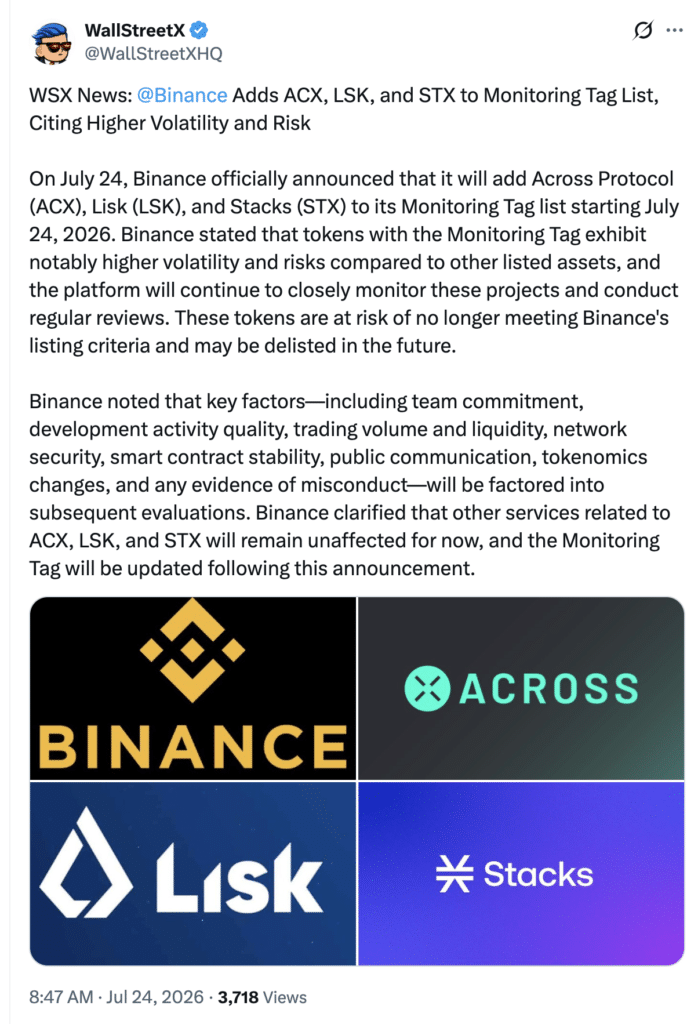
One of the biggest questions circulating throughout Binance crypto news is, Why did Binance add ACX to Monitoring Tag? The exchange has not cited a single reason for each project individually. Instead, Binance explained that every asset carrying the Monitoring Tag will undergo regular reviews based on multiple operational and technical factors rather than a single event or announcement.
According to Binance, each review examines market liquidity, daily trading activity, development progress, community communication, token supply changes, governance updates, and blockchain security. These evaluation standards help determine whether Binance ACX, Binance LSK, and Binance STX continue meeting listing expectations. As a result, the current Binance delisting risk reflects ongoing monitoring instead of an immediate decision to remove any of the three cryptocurrencies.
Market Reaction Shows STX Facing Strongest Selling Pressure
Market reactions like these are common whenever investors perceive elevated Binance delisting risk. Even though listing reviews do not guarantee removal, uncertainty often encourages short-term traders to reduce exposure while longer-term investors evaluate project fundamentals. This pattern has appeared repeatedly across previous Binance delisting announcements, where sentiment changes frequently outweigh immediate fundamental developments.
What Binance Will Review Before Making Any Final Decision
The current Binance delisting risk does not automatically lead to a delisting. Instead, Binance has confirmed that ACX, LSK, and STX will continue facing periodic reviews before any future listing decision is made. These evaluations allow projects to demonstrate ongoing improvements while giving the exchange flexibility to reassess changing market conditions.
During each Binance token listing review process, Binance will evaluate liquidity, trading volume, developer activity, network security, responsiveness from project teams, regulatory considerations, public communication, and token supply changes. Investors asking Will Binance delist Stacks (STX)?, Will Binance delist Across Protocol (ACX)?, or Will Binance delist Lisk (LSK)? should recognize that no final outcome has been announced. The Monitoring Tag simply increases scrutiny while keeping all three tokens available for trading until further notice.
How ACX, LSK, and STX Compare Under Binance’s Review Process
Although ACX, LSK, and STX now share the same Monitoring Tag, each project brings a different value proposition to the blockchain ecosystem. Across Protocol focuses on cross-chain interoperability, enabling faster and more efficient asset transfers between networks. Lisk continues developing its Layer 2 infrastructure on Ethereum to simplify decentralized application development. Stacks expands Bitcoin’s functionality through smart contracts and decentralized applications. Even with distinct use cases, all three now face elevated Binance delisting risk, making future project execution and community confidence increasingly important.
What Happens When Binance Adds a Monitoring Tag?
Many investors continue asking, What happens when Binance adds a Monitoring Tag? The designation does not suspend trading or freeze deposits. Instead, it signals that a project will undergo more frequent evaluations under Binance’s internal listing framework. Users may also need to acknowledge the additional trading risks before accessing affected tokens on the exchange.
This approach gives projects an opportunity to improve before any permanent action is taken. At the same time, the process protects traders by increasing transparency around higher-risk assets. As Binance reviews ACX LSK and STX, investors should expect future announcements to depend on measurable project performance rather than short-term market volatility alone.
What Investors Should Watch in the Coming Months
The latest Binance delisting risk announcement shifts attention away from daily price swings and toward long-term project fundamentals. Investors should closely monitor developer activity, protocol upgrades, ecosystem adoption, liquidity, and official updates from each project’s leadership team. Consistent technical progress often strengthens confidence during exchange reviews.
Equally important is Binance’s own communication. Future review outcomes could include maintaining the Monitoring Tag, removing it if improvement is demonstrated, or proceeding with a delisting if listing standards are no longer satisfied. Until another update is released, speculation alone should not replace careful research or sound portfolio management.
Conclusion
The latest Binance delisting risk update serves as another reminder that exchange listings are continuously evaluated rather than permanently guaranteed. ACX, LSK, and STX remain available for trading, but their addition to the Monitoring Tag places each project under increased scrutiny. Binance will continue assessing liquidity, development activity, security, communication, governance, and token supply before determining whether any future action is necessary.
For investors, the most effective strategy is to focus on verified project developments instead of reacting solely to headlines. Monitoring official Binance announcements, blockchain progress, and broader market conditions can provide a clearer picture of each token’s long-term outlook. As the review process continues, informed decision-making remains the strongest tool for navigating changing cryptocurrency markets.
Appendix: Glossary of Key Terms
Binance Delisting Risk: The possibility that a cryptocurrency could be removed from Binance if it no longer meets the exchange’s listing requirements.
Binance Monitoring Tag: A label assigned to selected cryptocurrencies that require additional monitoring because they face increased listing review.
Liquidity: The ease with which a cryptocurrency can be bought or sold without significantly affecting its market price.
Trading Volume: The total amount of a cryptocurrency traded during a specific period.
Token Supply: The number of cryptocurrency tokens currently in circulation or available under a project’s tokenomics.
Listing Review: Binance’s ongoing evaluation process that measures whether listed assets continue meeting exchange standards.
Frequently Asked Questions About Binance Delisting Risk
What is Binance delisting risk?
Binance delisting risk refers to the possibility that a cryptocurrency may be removed from Binance if it fails to meet the exchange’s ongoing listing standards.
Why did Binance add ACX, LSK, and STX to the Monitoring Tag?
Binance stated that these assets will undergo regular reviews based on factors such as liquidity, development activity, security, communication, and token supply.
Will Binance delist ACX, LSK, or STX?
No final decision has been announced. The Monitoring Tag indicates increased review rather than a confirmed delisting.
Does the Monitoring Tag stop trading?
No. ACX, LSK, and STX remain available for trading while Binance completes future listing evaluations.
How often does Binance review monitored tokens?
Binance performs periodic reviews but does not publish a fixed timetable. Each project is evaluated according to its ongoing performance and compliance with listing standards.
References