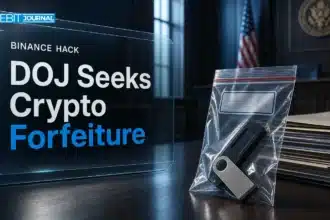




The Binance hack recovery effort entered federal court on November 23, when the US Department of Justice filed a civil forfeiture action seeking more than $1.1 billion in cryptocurrency. The USDC is allegedly linked to the October theft and North Korean actors. The filing starts a legal process, but it is not a final judgment transferring ownership.
Key Takeaways
- The DOJ seeks forfeiture of more than $1.1 billion in USDC allegedly linked to the October 29 Binance theft.
- The complaint says the funds were restrained on November 12 and identifies 36 addresses across 18 blockchain networks.
- US authorities say they have helped freeze, seize or return more than $2.9 billion, but have not said how much reached Binance.
- Binance said it covered $6 billion of an approximately $6.3 billion impact by buying replacement tokens.
What happened in the Binance hack recovery case
The DOJ announced its civil forfeiture complaint on November 23. Its announcement says the cryptocurrency was allegedly stolen from Binance and laundered by North Korean cyber actors. The government is asking the court to forfeit the targeted property. The complaint does not determine the case’s outcome.
Filed in the US District Court for the District of Columbia as 1:26-cv-04150, the DOJ’s verified complaint links the USDC to 36 virtual-currency addresses across 18 blockchain networks. It says the funds were restrained under a temporary restraining order on November 12, served on Circle that day.
The complaint alleges that about $780 million in USDC moved from Binance to one address at approximately 20:41 UTC on October 29, followed by roughly $43 million to the same address at 20:59 UTC.
The DOJ says US authorities have helped freeze, seize and/or return more than $2.9 billion in cryptocurrency since the theft. That combined figure is not the amount recovered by Binance, and the department has not specified how much was returned to the exchange.
Background and context behind the Binance hack
The theft took place on or about October 29. According to the court complaint, someone posing as a recruiter allegedly persuaded a Binance employee to download malware during a job interview. According to Binance’s account in the filing, the compromised device was used to install an EIP-7702 injection, which attackers exploited to take control of hot wallets. These are allegations, not court findings.
The complaint says the Secret Service, FBI and IRS Criminal Investigation assessed that the military-linked Lazarus Group, also known as APT38, carried out the incident. CoinDesk reported that on October 31 the FBI publicly attributed the theft to North Korea’s TraderTraitor group and urged virtual-asset firms and DeFi services to block transactions tied to identified laundering addresses. The notice listed more than 600 Ethereum addresses, just under 20 Bitcoin addresses and one Solana address.
The case also highlights the coordination required among investigators, exchanges and issuers when assets move across networks.
On October 31, Binance said it had covered $6 billion of an approximately $6.3 billion impact by buying replacement tokens. MarketScreener reported the exchange put the remaining amount below 10%, involving less-liquid assets that could take longer to source. Binance said it would use SAFU, its Futures Insurance Fund and corporate funds. That response is separate from the DOJ case: replacing losses does not mean the stolen assets have been returned.
Reuters reported on November 5 that Federal Reserve and Office of the Comptroller of the Currency supervisors contacted banks about unusual activity or service disruptions after the incident. A bank source told Reuters its institution experienced no disruption.

Market reaction to the Binance hack recovery filing
The listed crypto assets were higher over 24 hours and lower over 30 days on November 23. CoinGecko’s figures below were timestamped 22:13 UTC and do not show that the DOJ announcement caused the market moves.
| Asset | Price | 24-hour change | 30-day change |
|---|---|---|---|
| Bitcoin (BTC) | $61,206 | +0.59% | -23.88% |
| Ethereum (ETH) | $1,718.69 | +0.22% | -26.58% |
| BNB | $556.66 | +0.09% | -23.89% |
Bitcoin and BNB were slightly higher over 24 hours but down over 30 days. Alternative.me’s Crypto Fear & Greed Index registered 11, classified as Extreme Fear, on November 23. The reading provides broader sentiment context, not evidence of a market response to the case.
What to watch next in the Binance hack recovery
The next key development is how the forfeiture case proceeds. The complaint asks the court to forfeit the targeted USDC, but it is not a final judgment. The complaint seeks forfeiture, but the court has not issued a final judgment on the claim.
Further disclosures may clarify how the alleged laundering trail crossed 18 networks and whether more assets can be frozen or returned. The DOJ’s $2.9 billion figure combines assets frozen, seized and/or returned. A breakdown would show more clearly how much has actually been recovered.
Binance’s reported replacement of losses should be distinguished from the legal case. The exchange described its funding response, while the court case concerns ownership and recovery of specific assets. Court filings and official statements will determine the status of the claim.
The case underscores the role of coordination between authorities and crypto firms in tracing and restricting assets. Identifying, freezing, seizing and returning cryptocurrency are separate steps.
FAQ
How much is the DOJ seeking in the Binance hack recovery case?
The DOJ seeks forfeiture of more than $1.1 billion in USDC allegedly linked to the October 2026 theft. The complaint targets assets associated with 36 addresses across 18 blockchain networks.
Have the stolen Binance funds been returned?
The DOJ said authorities helped freeze, seize and/or return more than $2.9 billion in cryptocurrency, but did not specify how much was returned to Binance. Separately, Binance said it had covered $6 billion of an estimated $6.3 billion impact through replacement tokens.
Does the DOJ filing mean the government now owns the USDC?
No. The civil forfeiture complaint asks the court to order forfeiture. Filing the case is not a final judgment transferring the assets to the government.
Sources
- United States Files Action to Recover More Than $1 Billion in Cryptocurrency Assets Stolen by North Korean Cyber Actors in Binance Hack (www.justice.gov)
- United States’ Verified Complaint for Forfeiture In Rem (www.justice.gov)
- US Strikes Back After $6 Billion Binance Hack (U.Today)
This article is for informational purposes only and does not constitute financial or investment advice. Cryptocurrencies are highly volatile; always do your own research before investing.