

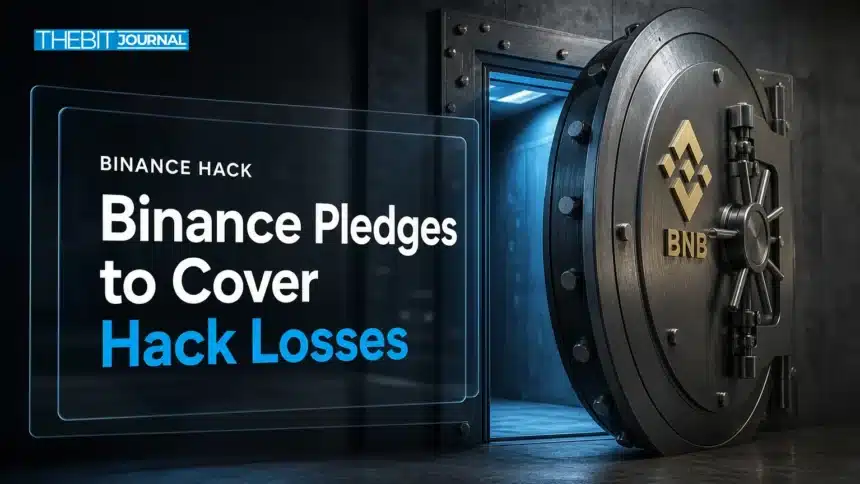

Binance says it has set aside $6.34 billion of its own money to cover every dollar lost in the Binance hack that drained its hot wallets late on Thursday, October 29, 2026. The Block reported the pledge on Friday. Blockchain analysts have called the theft the largest on record and pointed at North Korea.
Why it matters
The theft tests whether a major crypto exchange can absorb a multibillion-dollar loss without passing it on to users. Binance says its reserve covers customer balances. Withdrawals are still paused, though, and key questions about the attack remain open.
What we know about the Binance hack
According to the exchange’s Friday statement, about $5 billion of the committed funds is already held in the same digital assets that were affected. Binance says it is buying the remaining roughly $1.3 billion in tokens through market and over-the-counter channels.
CEO Richard Teng repeated the pledge in a video address. As Decrypt reported, he said customer funds were never touched. He also said $5 billion of the reserve is held in the exact tokens taken, among them USDC, USDT, BTC, ETH and BNB.
How the Binance hack unfolded
Blockchain analytics firm TRM Labs said an attacker moved about $6.36 billion out of Binance wallets across ten blockchains. Most of it left in roughly 20 minutes starting at 20:05 UTC on October 29, with a second wave around 23:05 UTC, Securities.io noted. TRM called it the largest crypto theft on record, about four times the $1.5 billion Bybit hack of February 2025.
Binance said late Thursday that an initial investigation suggested the hack went through an engineer’s laptop, “which allowed an attacker to gain access to a service container and submit unauthorized withdrawal transactions,” according to CNN. Teng added that the attacker used a self-destruct mechanism and an EIP-7702 delegation that bypassed the exchange’s normal approval controls. Our explainer on how the EIP-7702 upgrade was abused in the Binance hot wallet hack covers that mechanism.
Frozen funds and law enforcement
Binance credited industry partners with freezing roughly $3 billion of the stolen assets, CoinDesk wrote. Tether CEO Paolo Ardoino said his company froze more than $1.56 billion “related to a potential Binance exchange hack,” per Forbes.
Reuters, in a report carried by Yahoo Finance, said stablecoin issuers including Tether and the Trump-backed World Liberty Financial froze about half of the stolen assets. A person familiar with the matter told Reuters that Binance is working with the FBI and the U.S. Secret Service. According to its website, the exchange also has a $1 billion bitcoin reserve fund designed to protect customer assets in the event of security breaches. Founder Changpeng Zhao said on X that the company owned SpaceX shares worth more than $1 billion.

What is still unclear
The biggest gap is the money that wasn’t frozen. Reuters noted that Binance didn’t mention the status of the remaining $3.3 billion. The reports cited here don’t say how much of it can still be traced or recovered.
Attribution isn’t settled either. NPR reported that TRM tied the attack to TraderTraitor, which it described as North Korea’s elite hacking unit. A Chainalysis spokesperson told CNN the firm had “high confidence” North Korea was behind the hack. Binance hasn’t confirmed who did it. Asked about the North Korea link, a spokesperson said only that the company is “working closely with our law enforcement partners to confirm the identity of the criminals and bring them to justice.” We’ve covered the TraderTraitor link to the theft in more detail.
Then there’s the timeline. FinanceFeeds pointed out that on October 27, Binance said it had fended off several North Korea-linked cyberattacks over the previous week, with no systems compromised and no assets lost. The same outlet reported that small Tornado Cash withdrawals had funded the operator wallet from October 28, at least 36 hours before the theft. Whether those earlier attempts are connected to this week’s breach has not been established in the available reports.
Even the headline figure varies slightly. Most reports cite an estimated $6.3 billion, TRM puts the outflow at $6.36 billion, and Binance’s reserve stands at $6.34 billion.
How markets and analysts reacted
All five major assets in the data below were lower over the past 24 hours. BNB, the token most closely tied to the exchange, fell more than bitcoin. The Crypto Fear & Greed Index stood at 30 (“Fear”) on October 30. For more on derivatives positioning, see our report on the Binance hack market impact and liquidations.
| Asset | Price (USD) | 24h change | 7d change |
|---|---|---|---|
| Bitcoin (BTC) | $77,209 | -4.69% | -5.32% |
| Ethereum (ETH) | $2,240.87 | -4.73% | -7.39% |
| BNB | $699.89 | -6.40% | -6.42% |
| XRP | $1.25 | -3.98% | -5.13% |
| Solana (SOL) | $94.77 | -6.79% | -9.43% |
Data: CoinGecko, October 30, 2026, 17:13 UTC.
Zhao struck a confident tone early. He wrote on X that “it does look like a hack on Binance” and noted he no longer manages the platform. He added that as a shareholder, “I expect all user funds will be fully recovered.” That is a personal expectation, not a formal commitment.

What the Binance hack means for investors
The reserve figures come from Binance’s own statements and haven’t been independently verified in the reports cited here. Teng’s assurance that client balances are covered is notable. It still depends on the exchange completing its token purchases and restoring withdrawals, which Binance expects by Sunday morning, according to CNN.
The episode is a reminder of custodial risk. Funds held on any exchange depend on that firm’s security and solvency, and large thefts can hit even the biggest platforms. Prices remain volatile, and losses from hacks or market moves can be substantial.
Users should also be wary of fake support accounts and phishing links that may try to exploit the incident. A legitimate exchange or recovery service should never ask for a seed phrase or private keys.
Bottom line
Binance has committed $6.34 billion of its own funds to cover customer losses from what TRM calls the largest crypto theft on record. How this plays out depends on the withdrawal restart, the status of the unfrozen $3.3 billion and what investigators find.
Sources
- Binance says it has $6.34 billion ready to cover hack losses (The Block)
- Binance Sets Aside $6.34B to Cover Hack Losses, CEO Says 'Your Assets Are Safe' – Decrypt (decrypt.co)
- Binance arranges $6.34 billion to cover losses from biggest crypto hack ever (www.coindesk.com)
- Binance Reserves Over $6.34 Billion in Company Funds for Hack Losses (www.securities.io)
- Hackers steal $6.3 billion from Binance in record heist blamed on North Korea (finance.yahoo.com)
- Binance Says $6.3 Billion Impacted In Record Crypto Hack, Suspends Withdrawals (www.forbes.com)
- Binance crypto hack: North Korea suspected to be behind biggest-ever heist (www.cnn.com)
- Blockchain intelligence firms link North Korea to $6.3B hack on Binance : NPR (www.npr.org)
- Did Lazarus Hack Binance? North Korea Blamed for $6.3B Theft (financefeeds.com)
This article is for informational purposes only and does not constitute financial or investment advice. Cryptocurrencies are highly volatile; always do your own research before investing.