






Bitcoin price remained below the crucial $60,000 mark on Tuesday as Ethereum, XRP, Dogecoin, BNB, Solana, and Hyperliquid (HYPE) posted mixed performances across the crypto market. A stronger U.S. dollar, weakening on-chain demand, and Strategy’s plan to potentially sell more than $1 billion worth of Bitcoin combined to keep investors on edge. While several major cryptocurrencies extended their weekly losses, Solana and HYPE managed to resist the broader market weakness.
According to the source, the latest downturn is not the result of one major event. Instead, it reflects three powerful forces working together. The Japanese yen has fallen to its weakest level in four decades, lifting the U.S. dollar, while on-chain demand remains subdued and Strategy’s new financing plan has introduced fresh uncertainty into an already cautious crypto market.
Bitcoin Price Stays Below $60K as Three Headwinds Build

The Bitcoin price traded around $59,500, slipping 0.3% over the past 24 hours and 7% during the previous week. More importantly, Bitcoin continued to trade below its 200-week moving average, one of the market’s most closely watched long-term technical indicators.
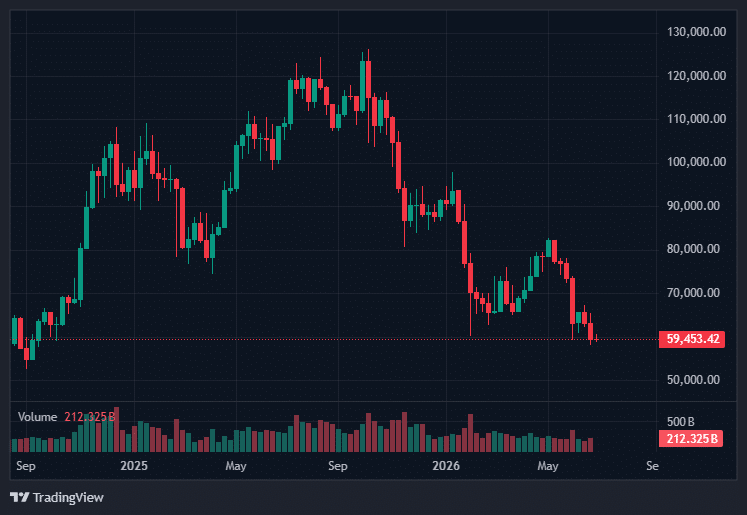
This is not a short-lived development. Bitcoin has struggled to reclaim its 200-week moving average throughout June, showing that buyers have repeatedly failed to rebuild long-term momentum despite several attempts to defend key support levels. Many analysts view this indicator as a line separating stronger bull markets from prolonged periods of weakness.
The biggest macroeconomic pressure came from the currency market. The Japanese yen weakened beyond 162 per U.S. dollar, reaching its lowest level since 1986. That move strengthened the U.S. dollar across global markets. As a result, Bitcoin price came under pressure because dollar-priced assets become more expensive for overseas investors, often driving capital away from higher-risk investments such as cryptocurrencies.
Another major concern emerged after Strategy, the world’s largest corporate Bitcoin holder, announced a financing program that may allow the company to sell more than $1 billion worth of Bitcoin to strengthen its balance sheet. The announcement surprised many investors because Executive Chairman Michael Saylor has spent years promoting a long-term “never sell Bitcoin” philosophy. Although no immediate sale has been announced, the possibility of future selling has changed market psychology during a period of already fragile sentiment.
Ethereum and XRP Extend Weekly Losses
Ethereum ranked among the weakest large-cap cryptocurrencies during the week, reflecting continued caution across the altcoin market. ETH declined 8.2% over the past seven days to trade near $1,587, as buyers remained reluctant to return despite lower prices.
The weakness also mirrors broader blockchain activity. Recent network data suggests that declining prices alone have not been enough to attract significant buying interest. Investors continue to wait for stronger economic signals before committing fresh capital to digital assets.
XRP also moved lower, falling 7.1% during the week to around $1.04. Although Ripple’s ecosystem continues to develop, the token struggled alongside the broader crypto market as investors reduced exposure to risk assets.
Both Ethereum and XRP illustrate how macroeconomic conditions are currently driving price action more than project-specific developments. Until overall market confidence improves, many leading altcoins may continue following Bitcoin’s direction.
Dogecoin Leads the Decline While BNB Struggles
Dogecoin recorded the steepest weekly decline among the major cryptocurrencies discussed in the report. The meme coin fell 11.9% over the past seven days, dropping to around $0.072 as speculative assets faced stronger selling pressure.
Large price swings are common for Dogecoin because sentiment often plays a bigger role than fundamentals. During uncertain market conditions, investors typically reduce exposure to more volatile assets first, making meme coins especially vulnerable.
BNB also remained under pressure, losing 6.5% over the week. Although the decline was smaller than Dogecoin’s, it reflected the same cautious investor behavior affecting most large-cap cryptocurrencies. The latest losses suggest that even well-established blockchain ecosystems are struggling to attract fresh buying while broader economic uncertainty continues to dominate market sentiment.
Solana and HYPE Defy the Market
While most leading cryptocurrencies extended their losses, Solana stood out as one of the few major assets to post gains. SOL climbed 3% over the past 24 hours and 2.9% during the week to trade near $74. Solana was one of the few major cryptocurrencies to advance despite widespread selling pressure, making it the market’s clear outlier during the session. Its resilience suggests that investors continue to value its active developer ecosystem and growing blockchain adoption, even as broader market conditions remain challenging.
Hyperliquid’s native token, HYPE, also performed better than most large-cap cryptocurrencies. The token gained 7% during the day, helping erase earlier losses and leaving it roughly flat for the week. Although HYPE avoided the sharp declines seen across much of the market, analysts believe the move reflects selective buying rather than a broad return of bullish sentiment.

Why the Crypto Market Still Lacks a Bullish Catalyst
The latest selloff reflects several pressures rather than a single event. A stronger U.S. dollar, weak on-chain demand, Strategy’s potential Bitcoin sales, and concerns over Japan’s currency outlook have all weighed on the crypto market, keeping the Bitcoin price under pressure.
The Japanese yen fell to its weakest level since 1986, strengthening the U.S. dollar and making dollar-priced assets like Bitcoin more expensive for overseas investors. As a result, many traders have reduced exposure to risk assets, including cryptocurrencies.
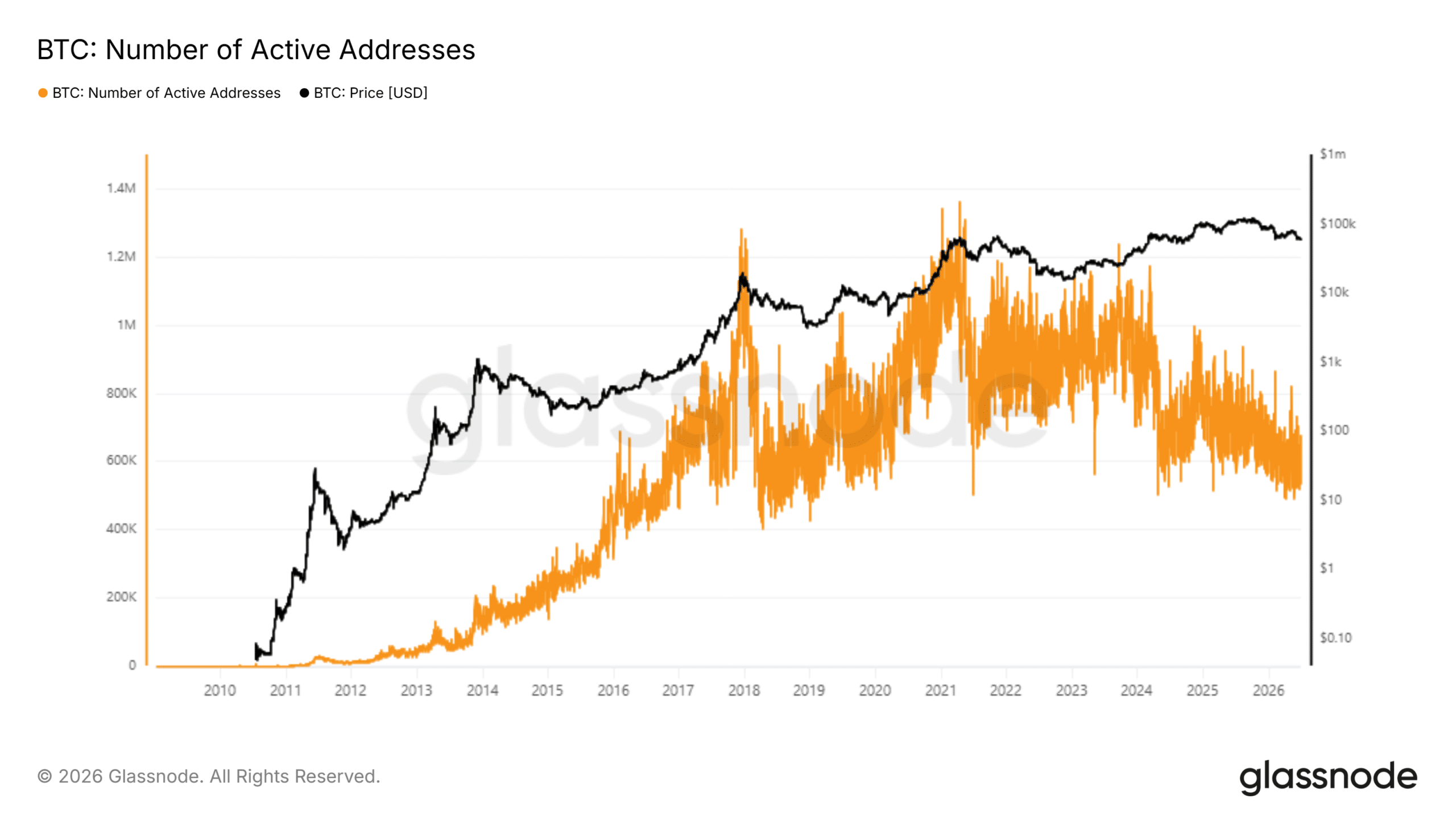
On-chain data also points to subdued demand. Glassnode reported that active Bitcoin addresses remained around 618,000, transferred value stayed near $4.2 billion, just above the recent low of $3.6 billion, and transaction fees continued to decline. Together, these indicators suggest that lower prices have failed to attract meaningful new buyers, keeping the Bitcoin price under pressure.
Market sentiment weakened further after Strategy revealed it could sell more than $1 billion worth of Bitcoin under a new financing program. Although no sale has been announced, the move marks a notable shift from Michael Saylor’s long-held “never sell” stance. In an already thin market, the prospect of additional supply has added to investor caution.
Investors are also watching whether Japan intervenes to support the yen. Such a move could unwind the global yen carry trade, where investors borrow low-cost yen to buy higher-yielding assets, potentially increasing volatility across cryptocurrencies and other financial markets.
Conclusion
The latest decline shows that the Bitcoin price remains closely linked to global economic conditions rather than crypto-specific developments alone. Bitcoin continues trading below its 200-week moving average, while Ethereum, XRP, Dogecoin, and BNB remain under selling pressure. In contrast, Solana and HYPE have demonstrated relative strength despite the broader downturn.
For now, the crypto market has little to lift sentiment. Weak on-chain demand, a stronger U.S. dollar, thin market liquidity, and uncertainty surrounding Strategy’s potential Bitcoin sales continue to weigh on investors. Until on-chain activity strengthens, the dollar eases, or a fresh catalyst emerges, Bitcoin, Ethereum, XRP, Dogecoin, BNB, Solana, and HYPE may continue trading in a cautious market with limited upside momentum.
Glossary of Key Terms
200-Week Moving Average: A long-term indicator used to identify key support and resistance levels.
On-Chain Activity: Blockchain data that shows network usage and transaction activity.
Market Liquidity: How easily an asset can be bought or sold without affecting its price.
Yen Carry Trade: Borrowing low-interest yen to invest in higher-return assets.
Risk Assets: Investments like cryptocurrencies and stocks that are more sensitive to market uncertainty.
FAQs About Bitcoin Price
Why is Bitcoin trading below $60,000?
A stronger U.S. dollar, weak on-chain demand, and Strategy’s potential Bitcoin sales have pressured the market.
Why did Dogecoin post the biggest weekly loss?
Dogecoin’s higher volatility makes it more vulnerable during market selloffs.
Why did Solana outperform?
Strong investor confidence and ecosystem growth helped Solana outperform the broader market.
Why is Japan’s currency being watched?
A possible yen intervention could disrupt the carry trade and increase volatility across crypto markets.
Sources/References