






This article was first published on The Bit Journal.
BitMine Immersion Technologies’ quarterly Form 10-Q has revealed that Ethereum staking and validator operations generated $45.74 million during the quarter which ended May 31, accounting for 98.3% of total revenue.
BitMine’s financial performance now appears tied to Ethereum’s proof-of-stake ecosystem and the continued success of its MAVAN validator platform.
The filing also reveals that a long-term management agreement with Ethereum Tower LLC gives the operator an irrevocable 2% ownership stake in MAVAN and economic rights that could survive an early termination, potentially making any future restructuring more expensive than investors might expect.
Bitmine Ethereum Staking Has Become the Firm’s Core Business
BitMine’s business has changed over the past year. The company previously generated revenue from Bitcoin mining, equipment leasing and consulting, but staking now dominates its income statement.
During the latest quarter, staking and validator services contributed 98.3% of total revenue, leaving only a small portion from previous operations.
Since launching the Made in America Validator Network (MAVAN) in March, the company has become an institutionally capable of serving custodians, asset managers and other enterprise clients in addition to supporting its own Ethereum treasury.
By the end of the reporting period, BitMine held more than 5.4 million ETH, with roughly 87% already staked through MAVAN. The company has also reiterated its long-term ambition of accumulating approximately 5% of Ethereum’s total circulating supply.
This is one difference between BitMine and many corporate crypto treasury firms because Ethereum generates staking rewards that create recurring operating revenue instead of relying mainly on appreciation in the asset.
A Long-Term Operator Agreement Creates Hidden Switching Costs
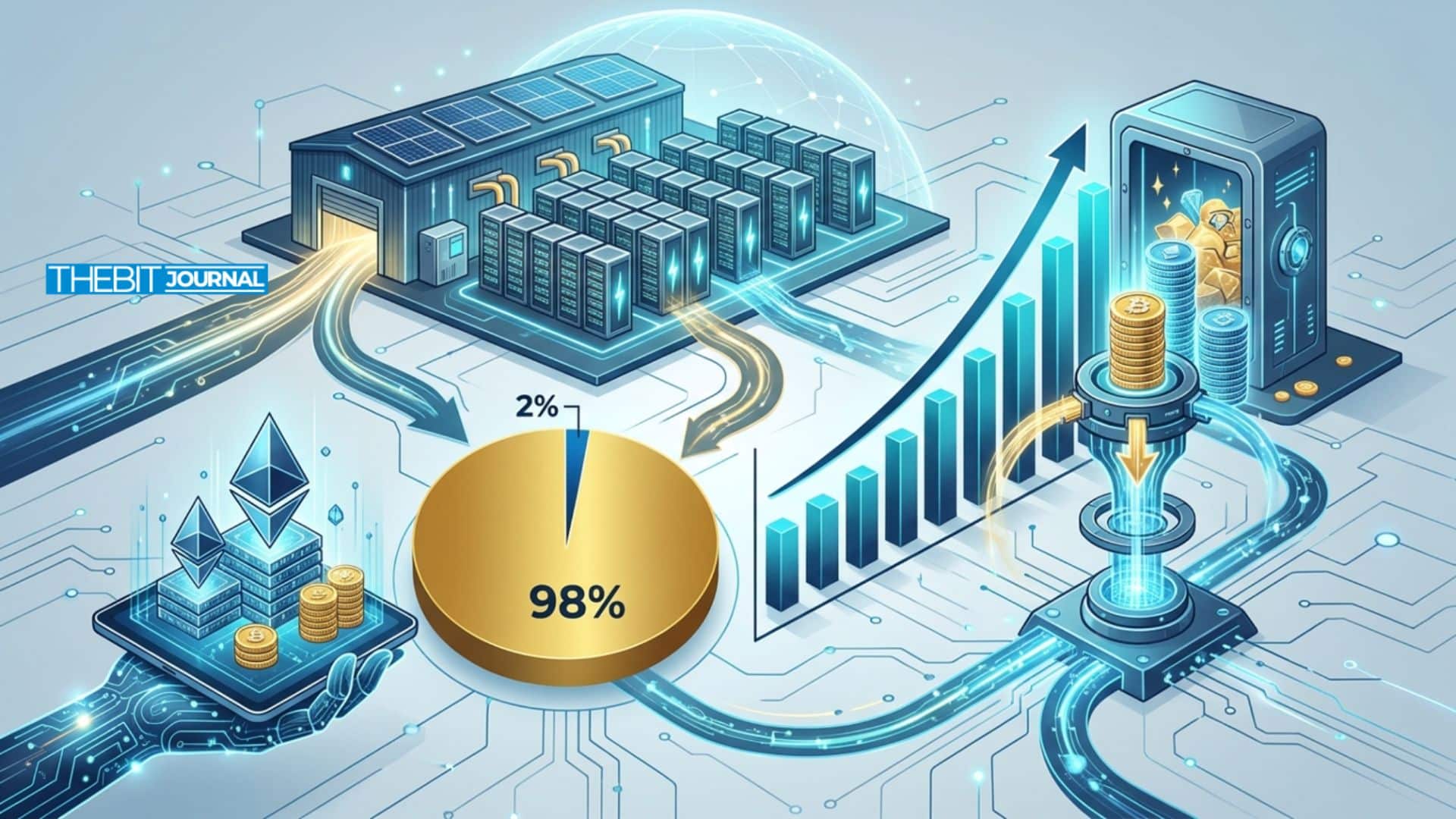
BitMine owns 98% of MAVAN Holdings, while Ethereum Tower retains the remaining 2% through a non-controlling interest established under a Management Services Agreement signed in March 2026. Under that agreement, Ethereum Tower oversees planning, validator operations and technology management while BitMine subsidiary BMNR retains ultimate managerial authority.
Although the agreement allows termination for convenience with 180 days’ notice, Ethereum Tower’s ownership interest does not disappear. If BitMine exits the agreement without qualifying cause, Ethereum Tower can either continue receiving revenue participation for the remaining contract term or elect a formula-based payment tied to its highest monthly compensation.
Because portions of the revenue-sharing schedule remain redacted in SEC filings, investors cannot calculate the exact financial impact of an early exit.
This structure effectively creates switching costs beyond the technical challenge of migrating validator infrastructure, making the relationship more durable than a standard service contract.
Scaling Ethereum Brings Revenue Opportunities and Concentration Risk
Management acknowledged that validator downtime, slashing penalties, lower network yields or adverse protocol changes could materially reduce revenue and operating cash flow because staking now contributes nearly all reported income.
Unlike diversified digital asset firms that generate revenue across trading, custody or software services, BitMine’s earnings are tied to one activity on one blockchain.
The concentration is not necessarily negative. Ethereum’s transition to proof-of-stake created an environment where institutional staking has become a source of recurring yield, encouraging large treasury holders to deploy dormant assets instead of leaving them idle. This has helped institutional validators become an important segment of Ethereum’s infrastructure while generating predictable staking rewards.
Still, concentration means operational issues could have an outsized effect on financial performance.
If staking rewards decline or validator performance weakens, BitMine has relatively few alternative revenue streams capable of offsetting the impact.
Institutional Expansion Depends on More Than ETH Holdings
BitMine’s recent filings suggest management sees MAVAN evolving beyond an internal staking platform.
The company says the validator network is intended to attract institutional investors, custodians and ecosystem partners seeking enterprise-grade staking infrastructure. If successful, that expansion could diversify revenue sources within staking itself rather than relying exclusively on BitMine’s treasury assets.
Additionally, the Ethereum Tower agreement demonstrates that scaling validator infrastructure often requires long-term partnerships with specialist operators.
As far as institutional investors evaluating BitMine are concerned, this extends beyond the company’s growing ETH balance. The economics of its staking platform will be a factor of Ethereum yields and contractual relationships governing how that infrastructure is managed over the next decade.
As institutional participation in Ethereum staking continues to grow, those governance arrangements may become just as important as the number of coins held on a balance sheet.
Conclusion
BitMine Ethereum staking has evolved from a supporting business into the company’s primary source of revenue, accounting for more than 98% of quarterly sales. The latest SEC filing also reveals that the strategy is closely linked to a decade-long management agreement with Ethereum Tower, whose ownership stake and contractual rights could survive an early separation.
As BitMine pursues its ambition of becoming one of Ethereum’s largest long-term holders, investors will likely monitor not only staking yields but the operational agreements that hold up the business model.
Glossary
Ethereum Staking: Locking ETH to help secure the Ethereum network in exchange for staking rewards.
Validator: A participant that verifies transactions and proposes new blocks on a proof-of-stake blockchain.
MAVAN: BitMine’s Made in America Validator Network, launched to provide institutional Ethereum staking infrastructure.
Slashing: A penalty imposed on validators for malicious behavior or prolonged downtime.
Non-Controlling Interest: An ownership stake held by another party that does not provide overall control of the business.
Frequently Asked Questions About Bitmine Ethereum Staking
Why is BitMine Ethereum staking revenue notable?
The company generated approximately 98.3% of its quarterly revenue from Ethereum staking and validator operations, making staking the foundation of its current business model.
Why does the Ethereum Tower agreement matter?
The agreement grants Ethereum Tower a permanent 2% interest in MAVAN and allows it to retain economic rights or receive a formula-based payout if BitMine terminates the contract early.
What is BitMine’s long-term Ethereum strategy?
BitMine aims to expand its institutional staking platform while pursuing a long-term objective of holding roughly 5% of Ethereum’s circulating supply, although management describes that goal as forward-looking.
References