
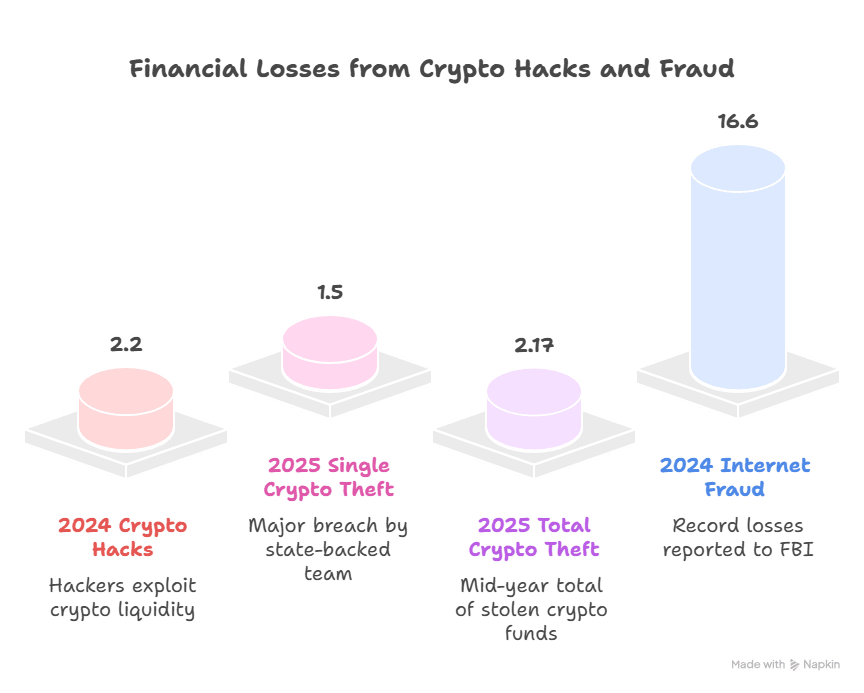
Crypto is open, fast, and global. It also attracts thieves and frauds. Losses are real and rising. In 2024, hackers stole about $2.2 billion from crypto services. That was a 21% jump from the year before. The trend did not slow in 2025.
By mid-year, stolen funds had already passed the entire 2024 total. Analysts tied the surge to one record breach worth about $1.5 billion. Strong Crypto Security is not optional. A single mistake can drain a wallet. This guide shows how to build a simple, layered plan that protects funds without turning life into a full-time job.
What Crypto Security Means
Crypto security is the set of habits, tools, and checks that keep private keys and funds safe. It covers how wallets store keys, how people log in, and how devices connect to the internet.
Good practice starts with control of private keys. If someone else controls the keys, they control the coins. It also covers risk on exchanges, phishing, malware, and fake apps. A plan should match the size of holdings and the level of activity.
The goal is simple. Reduce the chance of loss. Make attacks costly for criminals and easy to spot.
The Cost Of Weak Security
Hacks and scams keep growing because crypto is liquid and global. In 2024, hackers took about $2.2 billion from platforms. Key theft and weak controls made most cases possible.
In 2025, a single theft of about $1.5 billion showed how one breach can change the picture for the year. It was linked to a state-backed team known for advanced methods. By mid-2025, total stolen funds reached about $2.17 billion.
Fraud hurts the wider public too. The FBI’s Internet Crime Complaint Center logged a record $16.6 billion in reported losses across fraud types in 2024. Investment scams were a top category.
Core Principles Of Wallet Safety
There are three pillars of safe self-custody. Protect keys. Control access. Secure devices.
First, choose the right wallet. A hardware wallet keeps keys offline. It reduces attack paths from the web or infected apps. Keep most funds in cold storage. Move only what is needed for daily use.
Second, control access. Use a unique password for each wallet and exchange. Use an authenticator app for two-factor codes. Avoid text-message codes when possible.
Third, secure devices. Keep systems updated. Use a reputable antivirus. Avoid unknown browser extensions. Do not install wallet apps from links in messages.
Setup Checklist For Everyday Users
A clear checklist helps turn good advice into action. Start with these steps.
- Pick a hardware wallet from a trusted maker. Update its firmware before use.
- Create a recovery seed on paper or steel. Store it in a safe place. Do not photograph it.
- Set a long, unique password. Store passwords in a reputable manager.
- Turn on two-factor authentication for exchanges and email. Use an app, not SMS.
- Bookmark exchange and wallet URLs. Visit from bookmarks, not from links.
- Keep a clean device for finance tasks. No games or unknown extensions.
- Use a VPN on public Wi-Fi or avoid public Wi-Fi for any transaction.
- These steps stop most common attacks. They also build habits that last.
Threats Every Holder Should Know
Phishing
Phishing tricks users into giving up secrets. Fake emails and sites copy real brands. Attackers now also spoof government sites that collect crime reports. Recent alerts warned the public about fake complaint portals that steal sensitive data.
Defense is simple. Never enter a seed phrase online. Check the URL. Use bookmarks. Treat urgent, fear-based messages as red flags.
Exchange Breaches
Centralized platforms face constant pressure. Weak key management and poor change control lead to large losses. In 2024, hacked volumes reached about $2.2 billion. In 2025, one breach alone reached about $1.5 billion.
Hold only what is needed for trading on any exchange. Withdraw to a hardware wallet after trades settle.
Malware And Keyloggers
Malware steals passwords and clipboard data. Some strains swap a real address for an attacker’s address when users paste it. Others record keystrokes.
Use an antivirus and a locked-down browser. Verify the first and last characters of every address before sending. Send a small test first when moving large sums.
Social Engineering
Scammers pose as support staff or friends. They ask for help to unlock funds or to test a tool. They try to rush decisions.
Slow the process. Use official tickets and verified channels. Never share a screen or seed phrase.
Common Threats And Simple Defenses
| Threat | How It Works | First Defense | Second Defense |
| Phishing | Fake sites and emails steal logins | Bookmark real URLs | Use app 2FA |
| Exchange Breach | Keys or systems get compromised | Keep funds in cold storage | Split holdings across providers |
| Malware | Keyloggers and clipboard swaps | Antivirus and updates | Address checks before send |
| Fake Support | Impersonation in chats | Verify through official portal | Never share seed or screen |
| Airdrop Lures | Malicious tokens prompt clicks | Ignore unknown tokens | Turn off auto approvals |
| SIM Swap | Attackers take over phone line | Use app 2FA | Carrier PIN and port-out lock |
Building A Layered Security Stack
Hardware Wallets
A hardware wallet is the anchor of any plan. It keeps private keys offline. It signs transactions on the device. Even if a computer is infected, the keys stay safe.
Choose a device with strong supply chain checks. Buy from the maker. Set a PIN and a passphrase if supported. Learn how to verify receiving addresses on the device screen.
Password Managers
Reused passwords lead to account takeovers. A password manager creates unique, random passwords. It stores them in an encrypted vault. This makes phishing less effective since each site has a different login. Enable two-factor for the manager itself. Store recovery codes in a safe place.
Two-Factor Authentication
Two-factor codes stop many attacks. Authenticator apps are better than SMS. SMS can be hijacked through SIM swaps. Use a backup method like secure one-time codes. Store backups offline.
Clean Devices And Networks
Keep the operating system and browser updated. Remove unused extensions. Use a VPN on risky networks. Consider a separate device for finance.
Smart Moves For Active Traders
Cold And Hot Split
Keep most value in cold storage. Keep a small hot wallet for daily trades. Sweep profits back to cold storage on a schedule.
Withdraw And Re-Deposit
After a trade, withdraw. Do not treat an exchange as a vault. Exchanges are targets and can freeze accounts during incidents.
Address Books And Allow Lists
Use whitelists on exchanges that support them. This restricts withdrawals to pre-approved addresses. Review the list often.
On-Chain Security Tools
Multi-Signature Wallets
A multi-signature wallet needs two or more keys to move funds. One key can live on a hardware wallet. Another can live with a trusted partner or device. This reduces the chance that one stolen key drains everything.
Spending Limits And Time Locks
Some smart wallets support daily limits and delays. A time lock gives a window to react if a key is stolen. These tools add friction for thieves without slowing normal use.
Contract Approvals
Review token approvals in wallet dashboards. Revoke old approvals. Attackers exploit unlimited approvals to pull funds without consent.
How To Spot A Scam Before It Starts
Signals In Social Posts
Scams push urgency. They promise guaranteed yields. They ask for up-front fees. They claim a special access link. Ignore and report.
Project Red Flags
Anonymous teams, no audits, copied whitepapers, and complex tokenomics are danger signs. If the use case is vague, step back. If price action depends only on new buyers, avoid.
Verify With Multiple Sources
Use official sites and reputable media. Look for hard data, not hype. If numbers seem too perfect, they likely are.
Security And Regulatory Context
Policy can raise the floor for safety. In the European Union, MiCA took effect for stablecoins on June 30, 2024. Rules for most other tokens and providers began on December 30, 2024. Supervisors expect non-compliant stablecoins to be fixed or removed by the end of the first quarter of 2025.
Crime data shows why rules matter. In 2024, hacked funds reached about $2.2 billion. In 2025, stolen crypto crossed $2.17 billion by mid-year, driven by a single record breach. Analysts tied much of the damage to a known state-backed threat group.)
Consumer fraud also rose. The FTC reported $5.7 billion in losses to investment scams in 2024.
The takeaway is simple. Policy can add guardrails. Personal habits still decide most outcomes.
Case Study Snapshot: Large-Scale Breaches
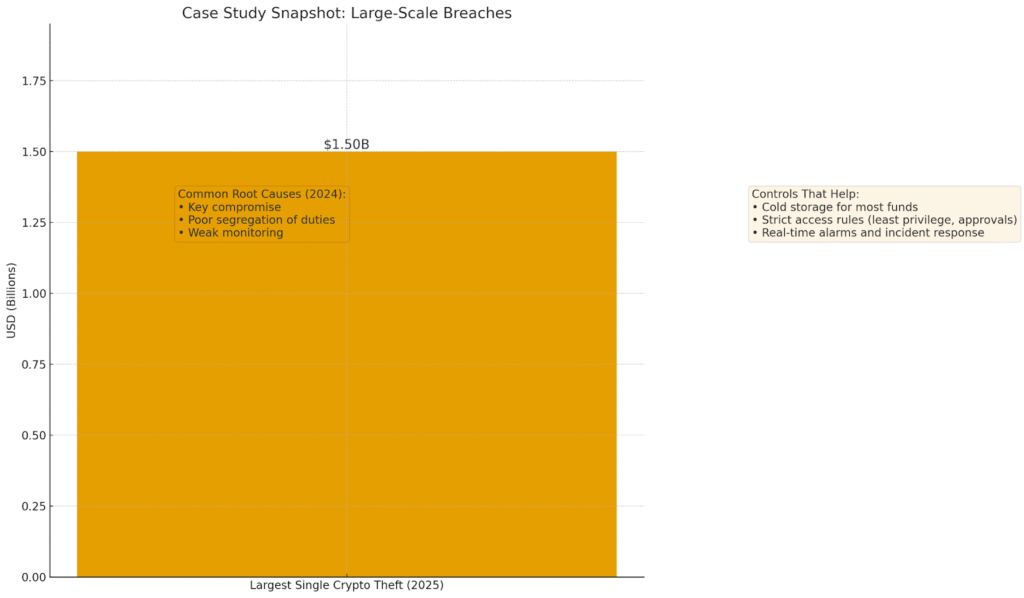
One 2025 breach led to about $1.5 billion in losses at a major exchange, which is the largest single crypto theft to date. It highlights the danger of concentrated keys and weak operational controls.
The 2024 figures also show a pattern. Most large hacks link back to key compromise and lapses in basic hygiene. That includes poor segregation of duties and weak monitoring.
A clear lesson stands out. Cold storage, strict access rules, and real-time alarms are not luxuries. They are table stakes for any platform that holds client funds.
Practical Playbooks
Personal Cold Storage
Set up a hardware wallet. Write down the seed on paper or steel. Store it in two places. Add a passphrase if supported. Practice a small mock recovery with a spare device before real funds move.
Exchange Safety
Use app 2FA and withdrawal allow lists. Lock a unique email to the exchange. Turn on security alerts. Review session history and linked devices. Log out after each session.
Safe Sending
Verify the full address on the hardware wallet screen. Send a small test first. Wait for confirmations. Then send the rest.
Travel Mode
When on the move, keep seed backups at home. Carry only a small hot wallet. Use a VPN on hotel networks. Avoid public computers.
Simple Chart: Risk And Matching Controls
| Holding Size | Main Risks | Controls That Fit |
| Under $1,000 | Phishing, fake apps | Password manager, app 2FA, bookmarks |
| $1,000 to $25,000 | Malware, exchange breach | Hardware wallet, antivirus, cold and hot split |
| $25,000 to $250,000 | Targeted scams, SIM swap | Multi-sig or passphrase, allow lists, carrier PIN |
| Over $250,000 | Key compromise, extortion | Distributed multi-sig, time locks, safe storage of backups |
Education And Ongoing Care
Security is a habit. Review settings every quarter. Rotate passwords if a breach hits a service you use. Revoke old token approvals. Audit exchange activity logs.
Follow reliable sources. Read incident write-ups from respected labs and analytics firms. Watch for alerts about spoofed websites and fake apps.
Backups matter. Test a recovery on a spare device at least once a year. Store backups where fire and water cannot reach them.
Crypto Security For Families And Teams
Families and small teams need shared rules. Write a one-page plan. List where keys live, who holds them, and how to act in an emergency.
Use multi-sig to split control among two or three people. Record a recovery process that a trusted person could follow. Store copies in sealed envelopes in secure locations.
Run a short drill. Pretend a phone is lost. Walk through recovery. Fix gaps.
Future Trends To Watch
Attackers use AI to write better lures and fake support chats. That makes phishing more convincing. Defense is also using AI for anomaly detection. Expect this duel to continue.
Quantum threats are not here yet. Work on quantum-safe standards is under way. Long term holders should watch for wallet upgrades that support new schemes.
Regulation will broaden. MiCA set a baseline for stablecoins and service providers in the EU. Other regions will keep adding rules on custody, disclosures, and incident reporting.
Conclusion
Crypto Security is a daily habit, not a one-time setup. The numbers show real risk. In 2024, hacked funds neared $2.2 billion. By mid-2025, losses had already passed that mark due to a single record breach.
A layered plan protects against most threats. Use a hardware wallet. Turn on app 2FA. Keep devices clean. Verify every message. Rehearse recovery. With simple steps and steady care, holders can keep control of their digital assets and sleep well.
FAQs About Crypto Security
What Is The Most Important Crypto Security Step?
Control the private keys with a hardware wallet. It cuts most attack paths.
Should Funds Stay On An Exchange?
Only what is needed for trading should stay there. Move the rest to cold storage.
Is SMS Two-Factor Safe Enough?
It helps, but an app is better. SIM swaps can hijack SMS codes.
How Often Should Security Be Reviewed?
Quarterly is a good rhythm. Also review after any major breach in the news.
What If A Seed Phrase Is Lost?
If there is no backup, funds cannot be recovered. Create and protect backups today.
Glossary Of Key Terms
- Address Allow List: A set of approved withdrawal addresses on an exchange.
- Cold Storage: Wallets kept offline to protect private keys.
- Hardware Wallet: A small device that stores keys and signs transactions offline.
- Hot Wallet: A wallet connected to the internet for daily use.
- Multi-Signature Wallet: A wallet that needs two or more keys to send funds.
- Private Key: The secret that proves control over a wallet.
- Seed Phrase: A set of words that can restore a wallet.
- SIM Swap: An attack where thieves take over a phone number.
- Time Lock: A delay on spending that gives time to react.
- Two-Factor Authentication: A second login step, often from an app.
Summary
Crypto security is about control of keys, strong access rules, and clean devices. Losses remain high. Hackers stole about $2.2 billion in 2024, and by mid-2025 thefts had already passed that total after a record $1.5 billion breach. Policy steps like MiCA set new rules for stablecoins and service providers in the EU, while U.S. data shows rising investment fraud. A layered plan works best. Keep most funds in cold storage on a hardware wallet. Use app-based two-factor codes, password managers, and allow lists. Check addresses on the device screen and send small tests first. Review settings each quarter. Revoke old approvals. Practice recovery. These habits lower risk and keep assets safe.