
This article was first published on The Bit Journal.
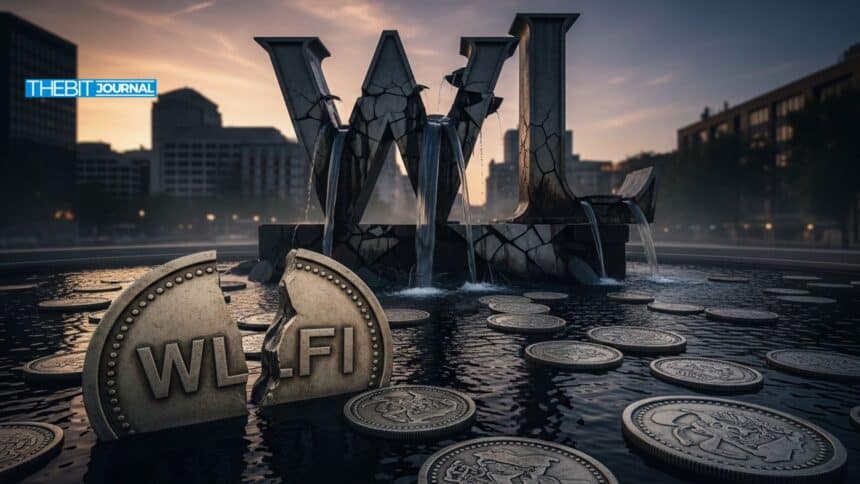
The WLFI token crisis has gotten worse following a massive crash that erased over $700 million from the market and placed the token at all-time lows while leaving most of the crypto market to panic.
As controversies over the project continue to escalate, the token itself has plummeted, with reports confirming it hit an all-time low in the latest selloff.
Meanwhile, investor sentiment has soured sharply as governance issues, liquidity risks and legal threats come together into one crisis event. The speed of the drop has revealed just how fragile sentiment can be when structural weaknesses come up at once.
Justin Sun Accuses WLFI of “Backdoor” Controls and Asset Freezes
One of the main reasons behind the WLFI token crisis is an ongoing dispute with Justin Sun, one of the project’s biggest early investors.
Sun, who poured at least $75 million into WLFI, publicly accused the platform of secretly incorporating an internal blacklist mechanism into its smart contracts. Based on reports, he accused the system of providing the team with “unilateral ability to freeze, restrict and ultimately confiscate the property rights” of token holders.
He allegedly accused the feature of being deployed to his own wallet, which has been unable to move funds since September 2025 with over tens of millions in unrealized losses.
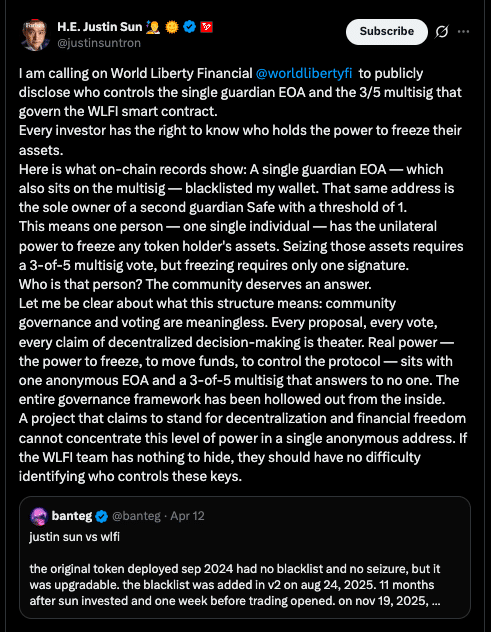
Reports suggest that such blacklist controls may not have been implemented at launch but created later through updates to the smart contract, causing investors to question the transparency and disclosure.
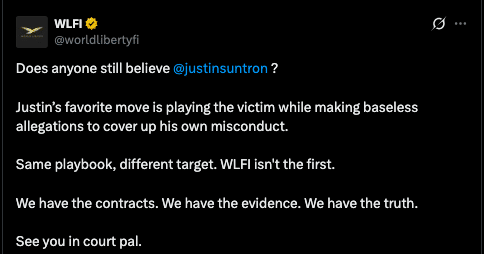
WLFI responded by holding firm and threatening legal action, saying publicly:
“See you in court pal.”
The fight is now out of the technical weeds and into a full-on legal battle.
$150M Borrowing Strategy Poses Systemic Liquidity Risks
While the legal battle dominates headlines, the WLFI token crisis is also being driven by concerns over the project’s financial structure.
Based on reports, WLFI used its own token as collateral in order to borrow tens of millions of dollars worth of stablecoins, increasing system leverage.
According to blockchain data, the World Liberty team has deployed approximately 5 billion WLFI tokens, valued at roughly $400 million and representing nearly 98% of the asset’s supply on Dolomite, across two multisignature wallets. According to Arkham Intelligence data, the team has also borrowed approximately $150 million in stablecoins, .
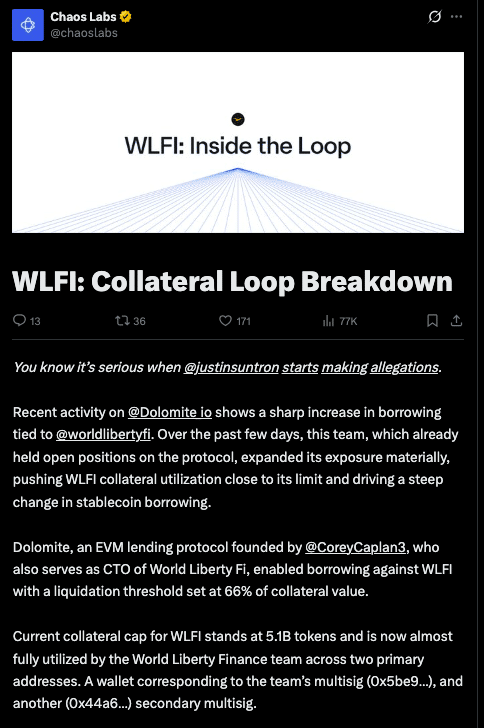
This technique, known as looping, enables borrowers to roll over collateral multiple times to increase exposure. While it works great in bullish markets but introduces substantial downside risk when prices dip.
The scale of WLFI’s position has caused alarm because of its volume. A large amount of the token’s supply has become tied to collateralized positions, so any forced liquidation could cause enough selling pressure to saturate available liquidity.
Critics say this structure creates a dangerous feedback loop where falling prices raise liquidation risk, which could in turn fuel further price drops.
Another concern is the overlap between project insiders and the platforms used for these loans, raising questions about governance independence and risk management practices.
Market Fallout Hits Investors as Confidence Breaks Down
The WLFI token crisis has spread fear to both spot and derivatives markets. The general price falls have been accompanied by continuous sharp volatility, resulting in a large amount of leveraged traders liquidating. As confidence faltered, many investors fled positions, creating a downward spiral.
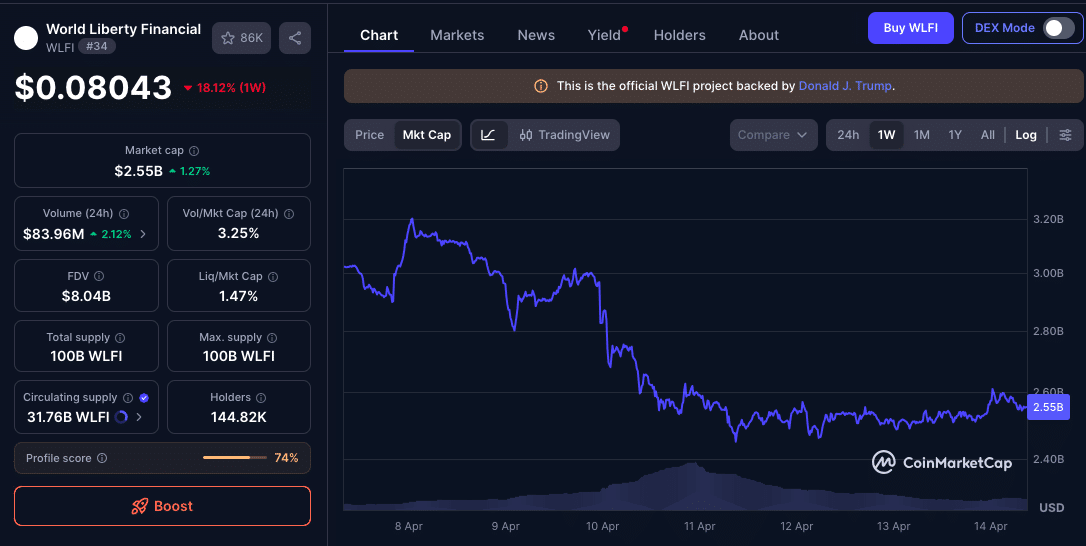
The market panic erased more than $700 million from World Liberty Financial’s market capitalization, dragging the valuation from $3.2 billion down to $2.5 billion in the last seven days.
The token’s price plunged to an all-time low of $$0.07 before stabilizing slightly at $0.08 as of press time.
CoinGlass data also shows that the volatility has wiped out more than $4 million in derivative positions since April 10, with a large part of the liquidations hitting bullish traders.
Meanwhile, the overall crypto community has responded with outrage to the governance dispute. According to reports, some investors described the project as “a door that pretends to be an entrance but is actually a trap”
Such reactions show the potential reputational damage caused by the allegations. In crypto markets, trust is an important part of the valuation, and once it’s broken, it’s hard to win back.
Even more worrying is the bad debt risk. The collateral that supports WLFI’s loans could get insufficient if WLFI price keeps falling, analysts warned, putting lending platforms at risk.
Conclusion
The ongoing WLFI token crisis is not a mere temporary downturn in the market, it runs deeper to reveal governance issues, financial risk and legal battle.
Allegations of hidden contract controls have called into question the decentralization around the project. The leveraged borrowing strategy also begs the question of sustainability. Additionally, the deepening feud with a big investor brings legal uncertainty that could last for months.
All of these factors lead to a high-stakes environment in which the project’s future hangs on its ability to rebuild trust and stabilize its financial structure.
Glossary
DeFi (Decentralized Finance): Financial services implemented on blockchain without intermediaries.
Smart contract: Code that executes by itself and governs the state of the blockchain.
Collateral: Assets pledged as security for a loan.
Liquidation: Forced selling of assets without as prices fall below collateral required.
Blacklist Function: a feature that disables certain wallets from making transactions
Frequently Asked Questions About WLFI Token Crisis
What caused the WLFI token crisis?
The crisis was triggered by a combination of price collapse, governance concerns and a dispute with Justin Sun.
What did Justin Sun accuse WLFI of?
He asserted that the platform utilized concealed smart contract controls to automatically freeze user funds without their permission.
Was there a response from WLFI about these allegations?
Yes, the project disputed the allegations and threatened to sue Sun.
What is the risk in WLFI’s borrowing strategy?
It depends on highly concentrated collateral, which could force liquidation if prices fall further.
How might this situation play out for WLFI?
Recovery hinges on settling legal battles and regaining investor trust.
References