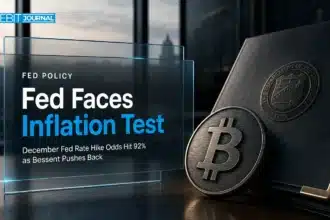


December Fed rate hike odds climbed to 92% for a quarter-point increase as Treasury Secretary Scott Bessent urged policymakers to look beyond recent oil-driven inflation. That market pricing is not a Fed decision, and officials disagree on whether easing energy costs tell the full story.
Key Takeaways
- Fed funds futures implied a 92% chance of a 0.25 percentage-point December increase, according to BeInCrypto.
- Bessent said oil had fallen $20 and gasoline was near $3.85 per gallon. October consumer prices rose 0.4% month over month.
- Governor Christopher Waller leaned toward a quarter-point move, while Chicago Fed President Austan Goolsbee disputed the view that oil explains inflation pressures.
- Major crypto tokens were sharply lower over seven days as of November 16, despite small 24-hour gains for several assets.

What happened with the December Fed rate hike
Bessent made his case on Fox News’ “Sunday Morning Futures” on November 15. According to BeInCrypto and Yahoo Finance, he argued the Fed should look ahead rather than react to past oil-driven price increases. He said oil had dropped $20 and gasoline was near $3.85 a gallon. AAA’s national average was $3.98 on November 10, the first time it had been below $4 since July, BeInCrypto reported.
Bessent said core inflation, which excludes food and energy, was near 2.5% and trending down. Official figures offer a more mixed picture: the Bureau of Labor Statistics reported that the consumer price index rose 0.4% in October from September, while the index excluding food and energy increased 0.3%. Energy prices rose 0.7%, after a 5.2% increase in September.
Futures implied a 92% probability of a quarter-point December increase, according to BeInCrypto on November 16. It’s a change in market expectations, not a commitment from the Federal Reserve. CNBC had reported 88% odds of a quarter-point move on November 10, alongside an 11% chance of a half-point increase, BeInCrypto reported.
Background: oil, core prices and the Fed’s split
The disagreement centers on how persistent inflation is. In a separate CNBC interview on November 13, Bessent described price pressure as an energy supply shock linked to the Iran war, according to Investing.com. He said the underlying economy was strong and argued against excessive tightening as the shock eased. He also cited the European Central Bank’s 2008 rate increase while oil was at $147 as a warning against reacting to energy prices without looking ahead.
But other officials have pointed to inflation beyond energy. The Associated Press reported on November 11 that Fed officials were watching price increases in categories less directly affected by oil. Chicago Fed President Austan Goolsbee challenged Bessent’s framing on CNBC on November 13, saying services and medical care were also seeing price pressure, according to Gulf Times.
Policy signals are mixed, though some officials have openly backed an increase. The Fed held its target range at 3.75%-4.00% on October 28 in a 10-2 vote. Lisa Cook and Beth Hammack preferred a quarter-point rise, according to the Federal Reserve statement. Governor Christopher Waller said on November 10 that he leaned toward a 25-basis-point increase in December. He said a 50-basis-point move should be considered if October core CPI came in around 0.3% or higher.
Higher rates tend to weigh on growth-sensitive assets, including AI stocks and crypto, according to the supplied reporting. The market data below show recent price changes but do not establish that Fed expectations caused them.

Market reaction: crypto remains under pressure
Market data supplied for this report show a mixed short-term picture on November 16. At 07:13 UTC, Bitcoin and several large-cap tokens were modestly higher over 24 hours, but their seven-day performance was negative. The figures show market weakness, but don’t prove that Fed expectations caused the declines.
| Asset | Price at 07:13 UTC | 24-hour change | 7-day change |
|---|---|---|---|
| Bitcoin (BTC) | $64,526 | +0.14% | -13.06% |
| Ethereum (ETH) | $1,812.23 | +1.11% | -14.60% |
| Solana (SOL) | $71.00 | +0.93% | -17.70% |
| XRP | $0.952981 | -0.24% | -12.61% |
The Crypto Fear & Greed Index stood at 10, classified as “Extreme Fear,” on November 16, according to Alternative.me. It is a sentiment indicator, not a Fed decision or a record of token price changes.
Higher rates tend to weigh on growth-sensitive assets, including crypto. The supplied market data do not establish how a future rate decision would affect prices or what investors have already priced in.

What to watch next
The next Fed meeting is scheduled for December 8-9, with the policy decision due December 9, according to the supplied reporting. Minutes from October’s meeting are expected Wednesday and may show how officials weighed inflation risks. BeInCrypto, citing USInflationCalculator, reported that the November inflation report is scheduled for December 10, one day after the decision.
Policymakers will therefore decide before seeing the next monthly CPI report. Oil prices and inflation outside energy are among the issues in the debate. The 92% figure is a market-implied probability, not a Fed decision, and market pricing can change as new data arrive.
Bessent said he had confidence in Fed Chair Kevin Warsh and that President Donald Trump shared that confidence, but he didn’t directly address the December decision, BeInCrypto reported. His comments set out an argument about how to read inflation, not a confirmed policy outcome. If a December Fed rate hike occurs, its size and accompanying guidance will shape how markets assess the path beyond that meeting.
FAQ
What are the odds of a December Fed rate hike?
Fed funds futures implied a 92% chance of a quarter-point increase as reported on November 16. This market pricing can change and isn’t a Fed announcement.
Why does Bessent want the Fed to look past oil?
Bessent argues that oil and gasoline prices have eased, so policymakers should focus on the outlook rather than past energy-driven inflation. Other officials say price increases in services and medical care show inflation isn’t limited to oil.
How could a Fed rate hike affect Bitcoin?
Higher rates tend to weigh on growth-sensitive assets, including crypto, according to the supplied reporting. That does not establish that a rate move caused Bitcoin’s price changes.
Sources
- Federal Reserve issues FOMC statement (www.federalreserve.gov)
- Treasury Secretary Bessent Urges Fed to Look Past Oil as Quarter-Point Hike Odds Reach 92% (BeInCrypto)
- Treasury Secretary Bessent Urges Fed to Look Past Oil as Quarter-Point Hike Odds Reach 92% (finance.yahoo.com)
This article is for informational purposes only and does not constitute financial or investment advice. Cryptocurrencies are highly volatile; always do your own research before investing.