





Ethereum stablecoin transfers have jumped to nearly $6 trillion in Q4, showing just how important the network has become for moving money worldwide. This huge flow of funds is not driven by hype, but by real financial use.
Ethereum is now handling value at a level that matches and even beats traditional payment systems. This growth is being supported by strong liquidity, very low fees, and rising trust in decentralized payment networks.
What Is the Background Behind Ethereum’s Stablecoin Growth?
The recent rise in Ethereum stablecoin activity did not happen all at once. In early 2023, quarterly transfer volumes stayed between $1 trillion and $2 trillion.
Activity picked up slowly in 2024 as DeFi recovered and big institutions returned. By 2025, growth speed up sharply, with nearly $6 trillion already processed in Q4, even before the quarter has ended.
This shows that Ethereum is no longer used just for trading and speculation. It is now being used more for moving large amounts of money, managing digital treasuries, and running decentralized financial systems.
Why Has Daily Stablecoin Volume on Ethereum Crossed $85 Billion?
Money is now moving faster on Ethereum largely because costs are low and liquidity is deep. Daily Ethereum stablecoin transfers have crossed $85 billion, pushing the network far ahead of other blockchains in real settlement activity. At the same time, the stablecoin supply has climbed past $180 billion.

With record capital velocity and $180B in stablecoin liquidity, Ethereum is seeing a level of financial movement that few systems can match. Transaction fees have dropped to almost nothing. That has made it easier and cheaper for large traders and institutions to shift funds, especially across low-risk DeFi platforms where speed and cost matter most.
A DeFi strategist in London said that transaction costs are now low enough for large investors to move big amounts of money easily, and this is allowing many more participants to enter the market.
How Did Ethereum Overtake Visa and Mastercard in Settlement Value?
Ethereum didn’t reach this position by chance. In Q4 alone, Ethereum stablecoin transfers moved more money than Visa and Mastercard.
This comparison is based on total value settled, not the number of small payments. What it really shows is that blockchain is now being used to move large sums of money, not just for everyday purchases.
A payments industry observer explained that while traditional networks are built for shopping and card swipes, Ethereum is now being used to settle big digital dollar transactions across borders and markets.
What Is the Significance of the $6 Trillion Q4 Stablecoin Figure?
The near $6 trillion in Q4 Ethereum stablecoin volume marks the strongest quarter in the network’s history. It also moved past Q3 levels well before the quarter even finished. That kind of steady growth shows trust.
People are no longer testing the system. They are using it as part of everyday financial operations. This level of activity is being driven by real usage, not short-term speculation.
Large payment movements, collateral transfers, and on-chain treasury operations have now become a regular part of how Ethereum is used.
A senior researcher at a blockchain analytics firm explained that when high settlement volume continues for multiple quarters, it means the infrastructure is no longer experimental and is being treated as reliable.
What Do ETH Price Indicators Show During This Network Expansion?
$ETH is trading around $3,131.58, up 3.24% in the past 24 hours as fresh buying interest enters the market. The Relative Strength Index is in neutral territory, indicating a balance between buyers and sellers despite the recent price rise.
The MACD is still slightly negative, showing that full bullish momentum has not yet returned. Meanwhile, the Chaikin Money Flow reading of 0.10 indicates that buying pressure is gradually building.
Even with strong Ethereum stablecoin activity on the network, $ETH’s price movement remains steady, suggesting slow accumulation rather than signs of overheating.
Is Capital Velocity on Ethereum Reaching a Structural Peak?
This development marks a significant shift in how the network is being used. With near-zero fees, record liquidity, and steady DeFi activity, Ethereum’s capital velocity has reached historic levels.
This means the same dollar is being reused more often across lending, trading, and settlement operations. Unlike past cycles that were driven mostly by leverage and derivatives, today’s Ethereum stablecoin activity reflects real financial use.
Payments, cross-border settlements, risk management, and yield strategies are now the main drivers behind the network’s growth. Experts note that this is no longer speculative activity. It is operational capital moving continuously through the ecosystem.
Could This Stablecoin Momentum Trigger the Next ETH Breakout?
The structural conditions are coming together, but clear technical confirmation has not appeared yet. The market has already absorbed nearly $6 trillion in Q4 Ethereum stablecoin volume, yet $ETH remains in a consolidation range.
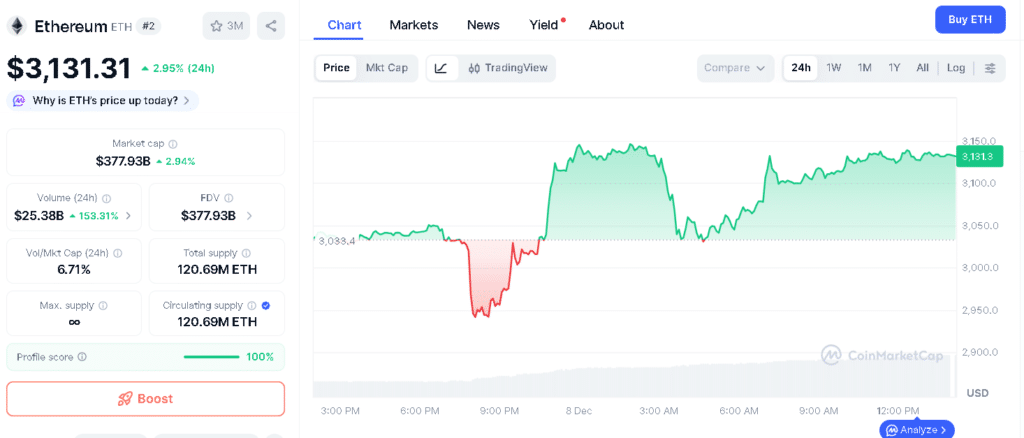
This gap between network activity and price often occurs before larger moves. Economic activity on the network is growing faster than the price is reacting.
From a broader perspective, rising settlement demand strengthens Ethereum’s long-term value as a financial base layer. Once momentum indicators catch up with on-chain activity, many traders expect volatility to return in a meaningful way.
Analysts note that price often lags behind actual usage during major adoption cycles, and the current pattern appears to reflect that same lag phase.
Conclusion
Ethereum stablecoin activity shows that a structural transformation is underway. With Q4 transfers approaching $6 trillion, daily volumes exceeding $85 billion, and total supply rising above $180 billion, Ethereum is no longer operating on the edges of finance.
It is now processing real economic value at a global scale. $ETH is trading around $3,131.58, with recovering money flow and controlled downside pressure, suggesting that the market is positioning cautiously but confidently. The rapid growth in settlements is being driven by real usage rather than hype.
Experts note that Ethereum is quietly handling the work that global finance requires. The question of a price breakout remains open, but the foundation beneath the network has rarely been stronger.
Glossary
Ethereum Stablecoin: Stablecoins on Ethereum used for quick, cheap, and secure money transfers.
Settlement Value: The total money moved or completed on a network.
Digital Treasury: Big collections of digital assets managed on blockchain by organizations.
Capital Velocity: How fast money moves through a system.
Transaction Fee: A small cost to process a blockchain transfer.
Frequently Asked Questions About Ethereum Stablecoin
How much stablecoin volume did Ethereum process in Q4?
Ethereum processed almost $6 trillion in stablecoin transfers in Q4.
Why is Ethereum stablecoin volume growing so fast?
The volume is growing because fees are low, liquidity is strong, and people trust Ethereum to move large amounts of money.
How does Ethereum compare to Visa and Mastercard?
In Q4, Ethereum settled more money in stablecoins than Visa and Mastercard, showing it can handle very large transfers.
Why are transaction fees on Ethereum low?
Fees are low because the Ethereum network is efficient, making it cheaper for investors to move money.
Is a big ETH price breakout likely after this growth?
The high stablecoin activity could help ETH price rise, but it is not certain and depends on the market.
Sources