






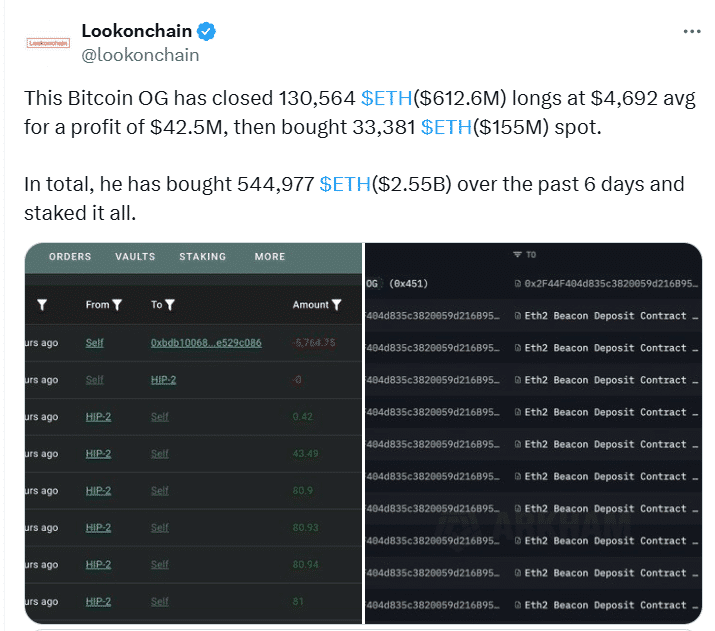
According to a recent report, Ethereum whale staking is hitting unprecedented levels, with billions of dollars worth of ETH locked in just days. A Bitcoin OG recently shifted more than $2.5 billion from BTC into ETH, staking over 544,000 coins in less than a week.
These bold moves show how whales and institutions are betting heavily on Ethereum’s future as the backbone of decentralized finance.
Whale Moves That Shocked the Market
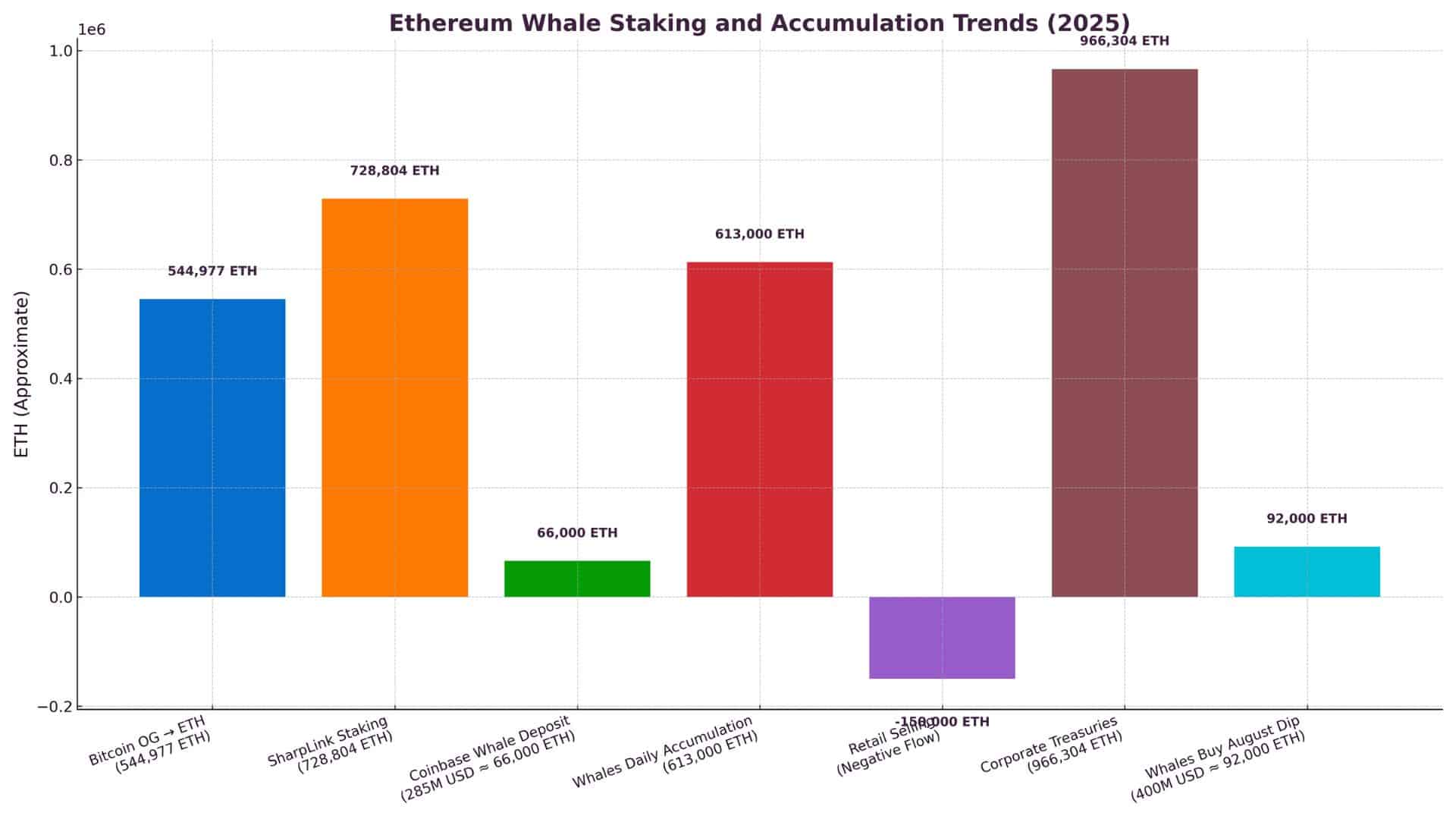
One of the most eye-catching shifts came when a Bitcoin whale liquidated over $2.6 billion and rotated it into Ethereum. Reports confirm that the whale not only bought ETH spot but also staked 544,977 ETH (≈ $2.55 billion) in just six days.
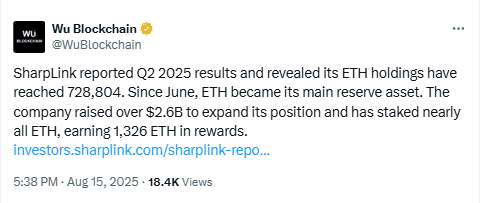
At the same time, another publicly traded company deployed $2.6 billion into 728,804 ETH, most of which is staked. Coinbase has also attracted record inflows, with a single whale depositing $285 million for liquid staking.
Such activity sends a powerful signal: whales aren’t chasing short-term pumps, they’re locking tokens to secure yield and strengthen Ethereum’s network.
Also read: Will Ethereum Hit $5K? Whale Buying and ETF Tailwinds Strengthen Prediction
Why Ethereum Whale Staking Matters
Security and Scarcity
Whale staking contributes directly to Ethereum’s proof-of-stake consensus, improving network stability. Every ETH locked also reduces the liquid supply. This tightening of circulation can support prices, especially when accumulation is combined with long-term treasuries.
Institutional Confidence
As reported here, small public companies now hold nearly a million ETH in their treasuries, up sharply from late 2024. With yield from staking averaging 3–4% annually, Ethereum is becoming a corporate treasury asset much like Bitcoin once was.
Divergence from Retail
While whales accumulate, retail investors often sell into rallies. In June, whales scooped up 613,000 ETH in a single day, even as smaller holders moved their coins to exchanges. This divide shows who’s playing the long game.
Expert Insight
Market analysts point out that “staking has become the clearest sign of conviction”.
With the Pectra upgrade raising validator limits, whales can now stake larger sums in fewer wallets, streamlining institutional adoption.
Price Outlook
Whales continue to buy dips, with more than $400 million worth of ETH absorbed during August sell-offs. If this trend holds, Ethereum whale staking could limit downside risk and build a floor before the next bullish leg.
Conclusion
Based on the latest research, Ethereum whale staking has become one of the strongest signals of long-term confidence in the market. From billion-dollar reallocations to record staking deposits, whales are reshaping Ethereum’s liquidity and strengthening its proof-of-stake system.
While retail activity often leans bearish, whales and corporate treasuries are doubling down. Their conviction suggests Ethereum’s role as a core digital asset will only grow in the coming years.
Also read: $5K Ethereum Incoming? Powell’s Dovish Signal Ignites Massive ETH Rally
Summary
Ethereum whales are making bold moves, staking billions of dollars worth of ETH in a show of confidence. From Bitcoin OGs shifting into Ethereum to institutions like SharpLink and Coinbase leading large-scale deposits, Ethereum whale staking is tightening liquidity and boosting yields.
While retail selling adds pressure, whales and corporate treasuries are signaling long-term conviction. This trend underscores Ethereum’s growing role in both institutional portfolios and crypto market dynamics.
Glossary of Key Terms
Whale – An investor who holds large amounts of a cryptocurrency.
Staking – Locking ETH to secure the network and earn rewards.
Proof of Stake (PoS) – Ethereum’s consensus system, where validators replace miners.
Liquidity – How easily an asset can be bought or sold without affecting its price.
FAQs for Ethereum Whale Staking
Q1: What is Ethereum whale staking?
It refers to large holders (whales) locking massive amounts of ETH into staking contracts, often worth billions of dollars.
Q2: Why do whales stake Ethereum?
They stake to earn yields, secure the network, and benefit from reduced circulating supply, which may support ETH prices.
Q3: How does this affect regular investors?
Whale staking can strengthen price floors, reduce volatility, and signal long-term confidence, though retail traders still face short-term risks.