







This article was first published on The Bit Journal.
Gold enthusiast and Bitcoin skeptic Peter Schiff has called out Michael Saylor Strategy’s Bitcoin-focused business plan as an “outright scam.” Schiff has publicly challenged Saylor, a co-founder of MicroStrategy (now “Strategy”), to an in-person debate at Binance Blockchain Week in Dubai.
The battle exposes deeper differences of opinion on whether Bitcoin has a place in corporate treasuries and about whether Strategy’s aggressive accumulation was really hiding serious financial danger.
Why Schiff Denounces Strategy as “Fraud”
Peter Schiff argues that the entirety of Strategy’s enterprise is a house built on flawed premise, on the faulty foundation that the company’s earnings amount to real, sustainable profits, when in reality Schiff believes they are largely unrealized Bitcoin earnings.
For Schiff, Strategy’s Q3 results are just paper profits made on Bitcoin’s rise and not actual business success.
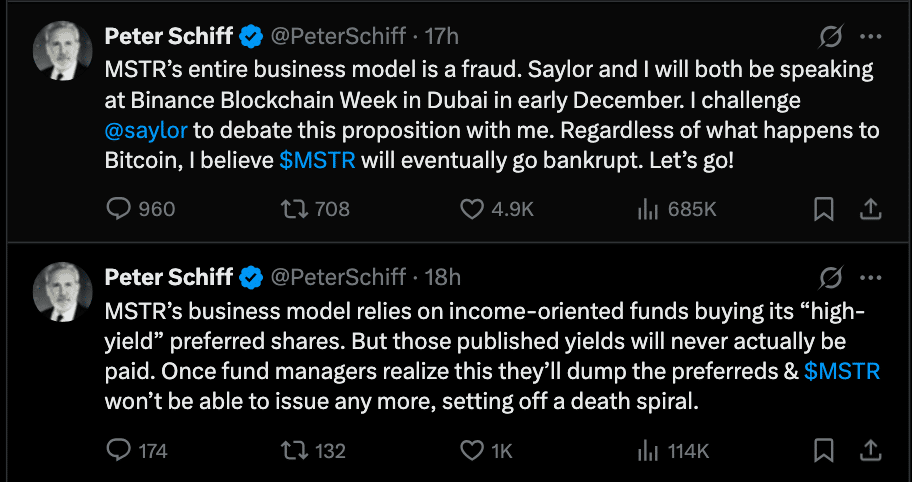
In a post on X, he wrote:
“MSTR’s business model relies on income-oriented funds buying its ‘high-yield’ preferred shares. But those published yields will never actually be paid … causing a death spiral.”
He cautions that when fund managers wake up to the fact that the dividends are not going to materialize, they will dump these preferred shares — triggering a chain reaction of financial instability for Strategy.
The Public Challenge: Debate at Binance Blockchain Week
Schiff didn’t just take the criticism lying down, he issued Saylor a challenge to debate him live in response to his allegations. The event that he suggested is Binance Blockchain Week in Dubai, which reports say will take place early December.
Schiff in his own words, said:
“MSTR’s entire business model is a fraud … I challenge @saylor to debate this proposition with me … regardless of what happens to Bitcoin, I believe MSTR will eventually go bankrupt.”
The invitation has sparked conversation throughout the crypto community, as many eagerly await Saylor’s reply.
The Financial Mechanics Under Scrutiny
Schiff doesn’t just attack the price of Bitcoin. He also raises structural concerns with the way in which Strategy raises capital and deploys that capital to acquire BTC. He believes Strategy’s model of issuing preferred shares to obtain more Bitcoin is not ultimately sustainable.
The hitch to his argument is that if those preferred shares don’t end up paying dividends or if Strategy isn’t able to issue additional debt or new equity, the model might break down. Schiff imagines fund managers dumping their high-yield preferreds, leaving Strategy exposed.
Beyond that, he warns of a death spiral; a self-reinforcing collapse if demand for preferred shares dries up and financial stress increases.
Bitcoin and Corporate Treasury Consequences
The clash between Schiff and Saylor reflects a deep philosophical schism in finance. Schiff, a vocal gold advocate for years, considers Bitcoin to be too volatile and risk laden. He thinks Strategy’s $BTC purchasing is less to do with value, and more about hype.
On the other side, Saylor is promoting Bitcoin as a treasury asset, a digital reserve that companies can hold long-term in. Schiff’s challenge calls into question this overstuffed corporate treasury playbook: Is it a substantial or a dangerously exposed financial house of cards?

Arguably, if the debate is accepted and Saylor performs well; it would prove the approach in front of institutional money and retail investors. But if he resists or falters, Schiff’s assertions could get more traction, possibly undermining confidence in Strategy’s model.
Conclusion: Watch for Saylor’s Response
Peter Schiff’s recent attacks, branding the Saylor strategy as fraud, thrusts the feud between gold’s number one advocate and Bitcoin’s corporate evangelist into an ever brighter spotlight.
All eyes are now on whether Michael Saylor will take up Schiff’s challenge to debate. An open forum might be critical, not just for their personal war of words but for Bitcoin treasury adoption in general.
However, the market may also react to what happens after the debate. If Schiff’s warnings hit a chord, it could prompt more scrutiny of Strategy’s own preferred shares, financial structure and exposure to risk tied to Bitcoin.
For those investors who have so far supported MicroStrategy’s audacious treasury thesis, it could be a defining moment.
Glossary
Bitcoin (BTC): A digital currency that runs on a decentralized computer network.
Preferred shares: A class of ownership in a company that pays a fixed dividend and has preference over common stockholders to dividends.
MicroStrategy / Strategy (MSTR): A public company led by CEO Michael Saylor that has gone all-in on Bitcoin.
Unrealized gain: A profit on an asset that has not yet been realized without selling it.
Death spiral: A situation in which financial strain leads to a quick drop in value, or even a collapse.
Binance Blockchain Week: An important crypto event hosted by Binance, which brings in leaders from blockchain and crypto.
FAQ About Peter Schiff vs Michael Saylor
Why does Peter Schiff say Strategy’s business model is a scam?
Because he thinks Strategy doesn’t earn its money from legitimate business operations but unrealized profits in Bitcoin and that it’s unsustainable for it to issue high-yield preferred shares.
What is Schiff daring Saylor to do?
He’s challenging Michael Saylor to a live public debate at Binance Blockchain Week in Dubai to defend his business model and to speak against the “fraud” allegation.
What’s at risk for preferred shares in Schiff’s view?
Schiff contends that the dividends on Strategy’s preferred shares were never likely to be paid, and if this becomes apparent to investors, they will drop the shares, causing a “death spiral”.
How much Bitcoin does Strategy (MSTR) have?
Strategy reportedly has more than 641,000 BTC.
What would happen if Schiff’s warnings proved to be correct?
If Schiff is right, Strategy may have to deal with shrinking capital, debt pressure and even insolvency if Bitcoin’s price drops.
References