






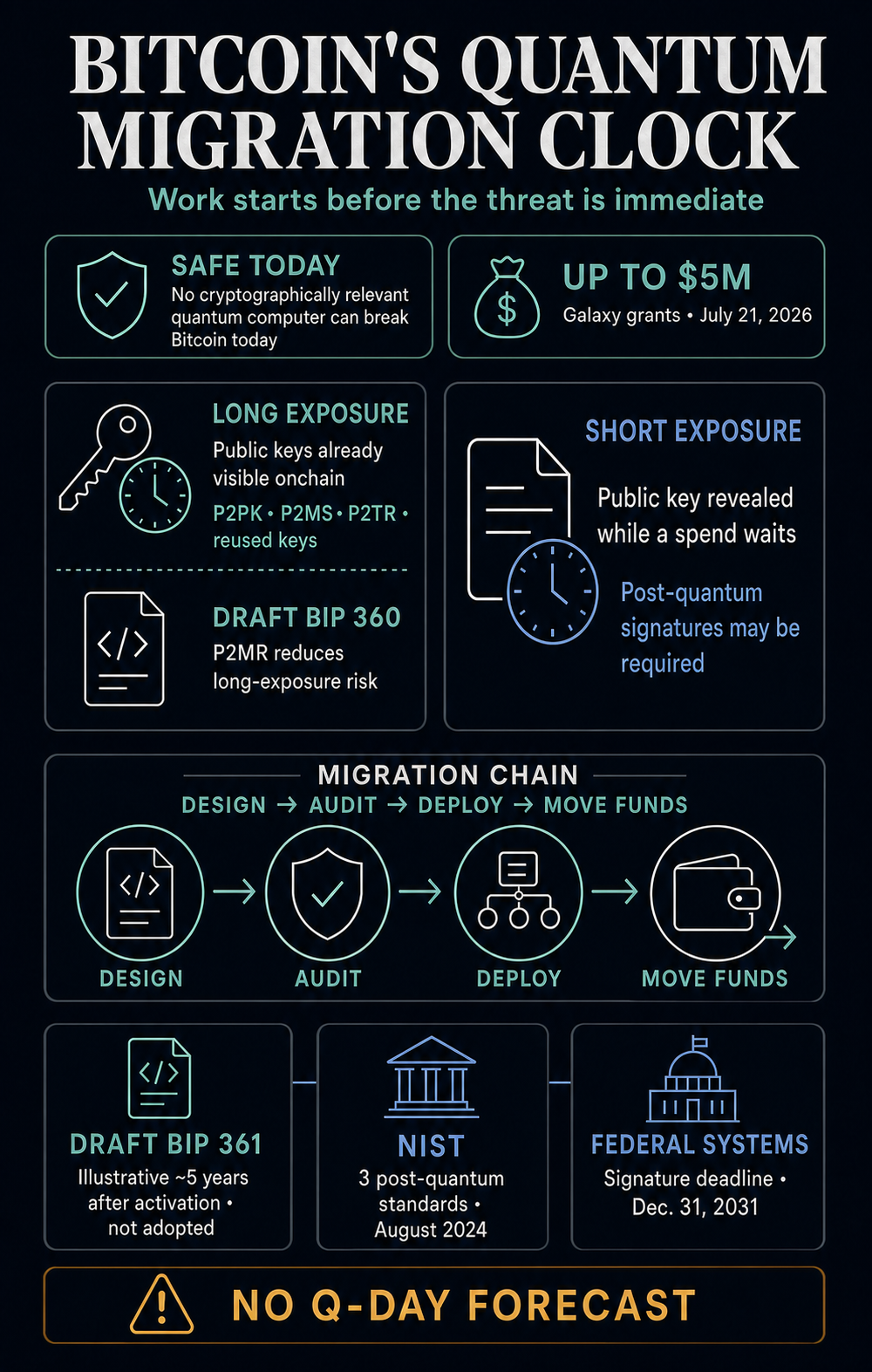
Galaxy has committed up to $5 million to developers and researchers working on Bitcoin quantum security, placing fresh funding behind a risk that has moved from distant theory into serious infrastructure planning.
The initiative does not suggest that Bitcoin faces an immediate quantum attack. Instead, it recognizes a harder truth. Changing a global monetary network can take years, while waiting for a crisis could leave developers, exchanges, custodians, miners, and holders with little room to respond.
Galaxy Funds Bitcoin Quantum Security Before Risk Arrives
The program will provide milestone-based grants for post-quantum development, including new transaction designs, quantum-resistant signature schemes, wallet migration tools, security audits, and technical research. It also establishes a dedicated research program and an advisory council involving specialists in quantum computing and cryptography.
That structure matters because Bitcoin quantum security cannot be delivered through one software patch. It requires a coordinated migration covering Bitcoin Core code, hardware wallets, custody platforms, exchanges, mining infrastructure, node software, and user funds.
Every part must work together without weakening Bitcoin’s current security model or introducing fresh attack paths.
The $5 million commitment is modest beside Bitcoin’s overall market value, yet its strategic importance could be far greater. Open-source developers often operate with limited funding, while post-quantum cryptography demands specialist knowledge, long testing periods, and independent review.
It is much like strengthening a bridge before heavier traffic arrives, rather than closing it after the first cracks appear.
Why Quantum Computing Creates a Bitcoin Risk
Bitcoin uses digital signatures to prove that a transaction was authorized by the owner of a private key. Its current ECDSA and Schnorr signatures rely on elliptic-curve cryptography.
A sufficiently powerful, fault-tolerant quantum computer could theoretically apply Shor’s algorithm to calculate a private key from an exposed public key. That would allow an attacker to create a valid signature and spend funds without the owner’s approval.
No publicly known quantum computer can perform such an attack at Bitcoin’s required scale today. The danger remains prospective, but the cryptographic weakness is well understood.
Some early Bitcoin outputs reveal public keys directly. Reused addresses may also leave keys exposed, while other public keys become visible when transactions are broadcast for confirmation.
For investors, Bitcoin quantum security is therefore a preparedness indicator rather than a near-term price warning. The meaningful signals include developer progress, reviewed proposals, test implementations, wallet support, custodian readiness, and agreement over migration rules.
Daily price volatility says almost nothing about whether the network is becoming safer.
BIP 360 Offers a Possible Starting Point
One proposal under discussion is BIP 360, which introduces Pay-to-Merkle-Root, known as P2MR.
The design removes Taproot’s key-path spending option and requires script-path spending. This limits long-term exposure because a public key does not need to remain openly visible on the blockchain before funds are moved.
P2MR could improve Bitcoin quantum security for funds whose public keys have not yet been revealed. Still, it is not a complete post-quantum signature system.
When a transaction enters the mempool, spending data can become visible before confirmation. A sufficiently advanced attacker could theoretically derive the private key and attempt to replace the transaction during that period.
The proposal also brings efficiency costs. Script-path spending requires more data than a simple Taproot key-path signature, which may increase transaction weight and fees.
That trade-off captures the wider challenge. Stronger protection must remain affordable for users and scalable enough for the network.
| Key area | What developers must solve | Why it matters |
|---|---|---|
| Signatures | Add quantum-resistant authorization | Protects ownership when keys are exposed |
| Migration | Move funds into safer output types | Reduces vulnerable legacy balances |
| Wallets | Support new addresses and recovery flows | Makes upgrades practical for holders |
| Audits | Test code and cryptographic assumptions | Limits consensus-level bugs |
| Coordination | Align nodes, miners, exchanges, and custodians | Prevents fragmented adoption |
Crypto Indicators Investors Should Monitor
The first indicator is implementation quality. A technical proposal becomes meaningful only after independent review, testing, and working code.
The second is infrastructure adoption. Wallet developers and custodians must identify exposed coins, generate safer addresses, and guide customers through migration without causing accidental losses.
A third indicator is consensus momentum. Bitcoin changes slowly by design, so broad technical agreement matters more than a company announcement or social media campaign.
Investors should also monitor transaction-size costs. Post-quantum signatures are often larger than today’s signatures, meaning they could consume more block space and affect fees, wallet design, and network capacity.
Another indicator is the progress of recognized post-quantum standards. Formal digital-signature standards such as ML-DSA and SLH-DSA are already available, although they cannot simply be inserted into Bitcoin without further engineering and consensus review.
Bitcoin quantum security must fit a decentralized network where independent participants enforce the rules and completed transactions cannot be reversed by a central authority.
Why Early Migration Planning Matters
The technical solution may be only half the battle. Moving existing funds could become the more difficult task.
Millions of holders would need compatible wallets, clear instructions, secure recovery methods, and enough time to transfer coins. Exchanges and custodians would also need to update deposit systems, withdrawal procedures, internal storage, and compliance controls.
Dormant coins create another problem. Some funds may belong to inactive holders, lost wallets, or owners who fail to migrate before a deadline. Developers would then face difficult questions about whether vulnerable coins should remain spendable.
These issues explain why Bitcoin quantum security requires discussion well before quantum machines pose an immediate danger. A rushed upgrade could create technical failures, political conflict, or losses that careful preparation might avoid.
Conclusion
Galaxy’s initiative puts money behind preparation rather than panic. It gives researchers room to test competing designs, challenge assumptions, and build migration tools before quantum computing becomes an urgent threat.
The central question is not whether quantum technology will influence cryptography someday. It is whether Bitcoin can coordinate a secure transition before that risk becomes operational.
With early funding, open review, and patient engineering, Bitcoin quantum security can develop through a measured migration instead of an emergency response.
Frequently Asked Questions
Is Bitcoin under a quantum attack now?
No. Current quantum computers cannot break Bitcoin’s signatures at the scale required.
What will the $5 million fund?
It will support signature research, transaction proposals, migration tools, implementation reviews, and security audits.
Can BIP 360 make Bitcoin fully quantum-proof?
No. It reduces public-key exposure but does not provide a complete post-quantum signature replacement.
Could quantum-resistant upgrades increase fees?
Yes. Larger scripts and signatures may use more block space, which could raise transaction costs.
Glossary of Key Terms
Shor’s algorithm: A quantum algorithm capable of breaking certain forms of public-key cryptography.
Public key: Cryptographic data used to verify that a transaction carries a valid signature.
P2MR: A proposed Bitcoin output design that removes Taproot key-path spending.
Mempool: The waiting area where valid transactions remain before miners confirm them.
Post-quantum signature: A digital signature designed to resist attacks from advanced quantum computers.
Disclaimer: This article is provided for informational purposes only and does not constitute investment, financial, or legal advice.
Sources