





This article was first published on The Bit Journal.
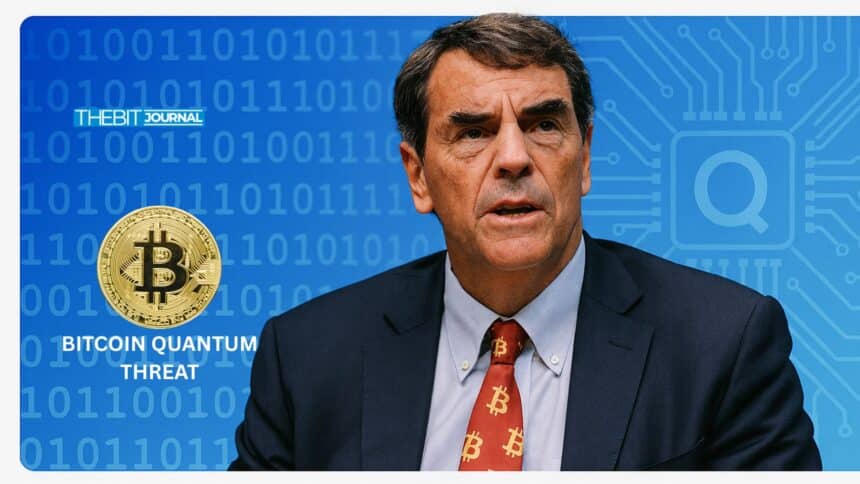
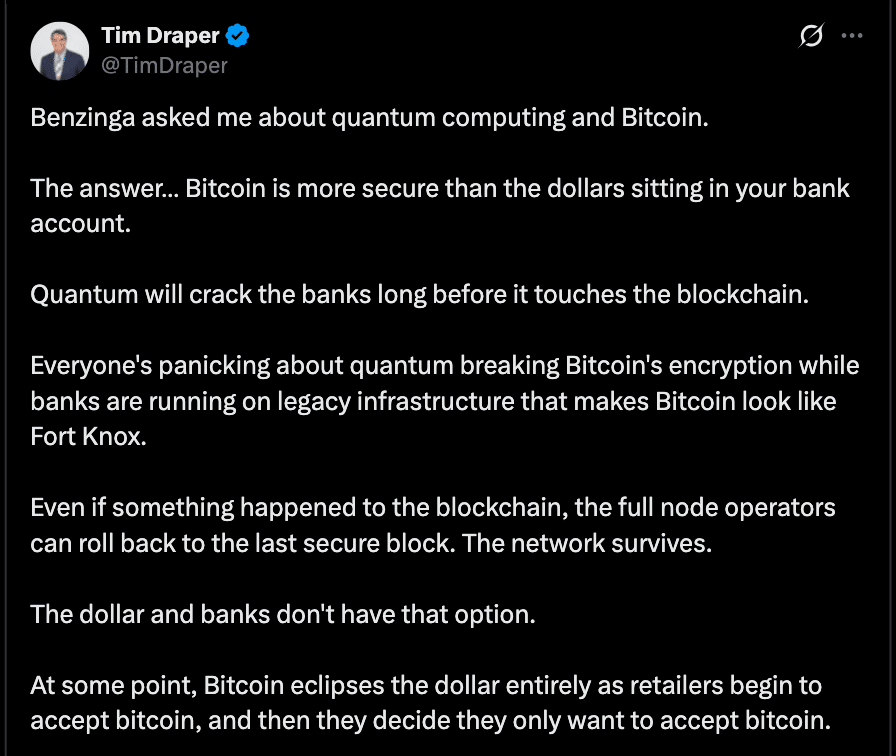
Bitcoin quantum threat risks are being discussed again this week as billionaire investor Tim Draper argues that old-fashioned banks, not Bitcoin, were likely to be the first in line to get taken down by quantum computers.
In a recent post on X, Draper touched points on the growing concern that advances in quantum computing might one day break Bitcoin’s crypto. He said the real weak spot is in old bank structures; these are the ones that rely on complicated and often aging systems to handle payments, customer accounts, and communications.
“Quantum will crack the banks long before it touches the blockchain,” Draper said in his post, pointing out that investors were focusing on the wrong threat.
Why Draper Thinks Banks Are More Vulnerable
Draper’s argument is both about the tech as well as the way the banking system is laid out.
Banks are run through a load of centralized infrastructure like payment processors, messaging systems, trading platforms, databases and other things that all need to be protected from quantum attacks. According to Draper, securing all those interconnected systems against future quantum attacks is going to be harder than upgrading a decentralized blockchain network like Bitcoin.
Bitcoin, on the other hand, runs on a distributed network of nodes that all work together to validate transactions and keep the ledger up to date.
Draper has been saying it repeatedly that he considers his Bitcoin holdings safer than cash in a traditional bank account because the network can just adapt if a new security threat pops up.
A lot of Bitcoin advocates are starting to agree with him, saying that decentralized networks may be more agile when it comes to dealing with new security challenges.
The Quantum Threat Is Real But So Is Bitcoin’s Response
Draper’s comments should not be taken to mean that quantum risk doesn’t exist.
The crypto industry has spent much of 2026 discussing post-quantum security since research from Google Quantum AI suggested that breaking the crypto systems used by Bitcoin might only require 500,000 physical qubits, roughly 20 times fewer than previous estimates.
Researchers also estimated at least a 10% chance of a so-called “Q-Day” by 2032, when quantum computers become capable of breaking current public-key cryptography.
That research led to renewed discussion around Bitcoin Improvement Proposal 360 (BIP-360), which introduces quantum-resistant address formats as a possible future defense mechanism.
Some developers and security researchers are also proposing ways to help users move funds into quantum-resistant wallets before such quantum threats go practical.
The challenge is that upgrading Bitcoin requires general consensus among developers, miners, node operators, and users.
Draper’s Recovery Argument
One of the things Draper pointed out is that Bitcoin has a way to recover from a major security event.
If something serious went wrong, he said, the full-node operators could get together and roll the network back to the last safe block and then implement some fixes through consensus-driven upgrades.
While such a process would be complex and controversial, Draper believes it provides Bitcoin with a resilience mechanism that traditional financial systems lack.
However, not everyone agrees with him.
Some researchers have been warning that a complete switch to quantum-resistant crypto in a blockchain ecosystem could take years and would require a coordinated effort that is probably too big for any one group to manage.
Others argue that centralized financial institutions could potentially implement security mandates faster because regulators and governments can directly enforce upgrades.
Bitcoin Adoption Keeps Draper Hopeful for the Future
While security is a big issue for Bitcoin, Draper still thinks the future of Bitcoin is closely tied to adoption trends.
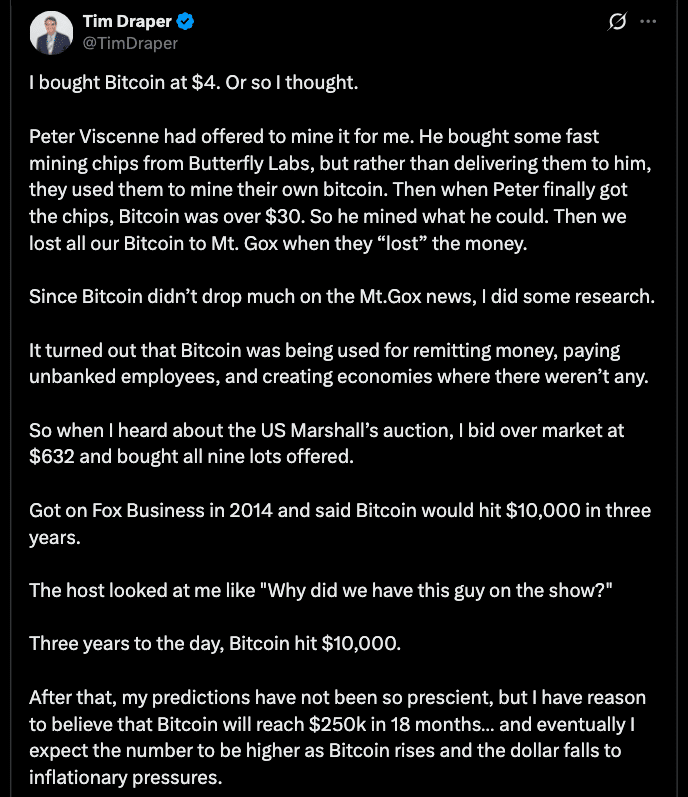
Recently, Draper reiterated his long-standing Bitcoin target that BTC will hit $250,000. He says that inflation fears, weakening interest in fiat currencies and more businesses starting to accept Bitcoin will keep demand high over the long term.
Draper also suggested that in the future, Bitcoin might play a role in machine to machine payments, artificial intelligence, robotics and online commerce. He also believes that as technology continues to evolve, decentralized networks might be better equipped to adapt than traditional banking systems.
Conclusion
The whole Bitcoin quantum threat discussion is unlikely to disappear anytime soon.
Some big breakthroughs have been made lately but experts agree that quantum computers that can actually break Bitcoin’s security aren’t existing yet. The question is whether blockchain networks and the banks can get ready before they do.
Draper still believes that Bitcoin is in a better position than the banks to navigate this future.
Glossary
Quantum Computing: Advanced computing technology that uses quantum mechanics to solve certain problems much faster than classical computers.
Cryptography: The mathematical methods used to secure digital communications and financial transactions.
Blockchain: A decentralized ledger that records transactions across a distributed network.
Node Operator: A participant who runs the software that helps keep a blockchain network up and running.
Post-Quantum Cryptography: Security methods designed to remain resistant to future quantum computer attacks.
Frequently Asked Questions About Bitcoin Quantum Threat
What did Tim Draper say about quantum computers and Bitcoin?
He said that he thinks quantum computers are probably more likely to compromise the banks before they try to break Bitcoin.
Can quantum computers break Bitcoin right now?
No. Experts agree that current quantum computers are not powerful enough to break Bitcoin’s cryptography.
Is Bitcoin preparing for quantum threats?
Yes. Developers are discussing quantum-resistant upgrades, including proposals such as BIP-360.
Does Draper still think Bitcoin will hit $250,000?
Yes. He recently reaffirmed his long-term $250,000 Bitcoin forecast.
References