



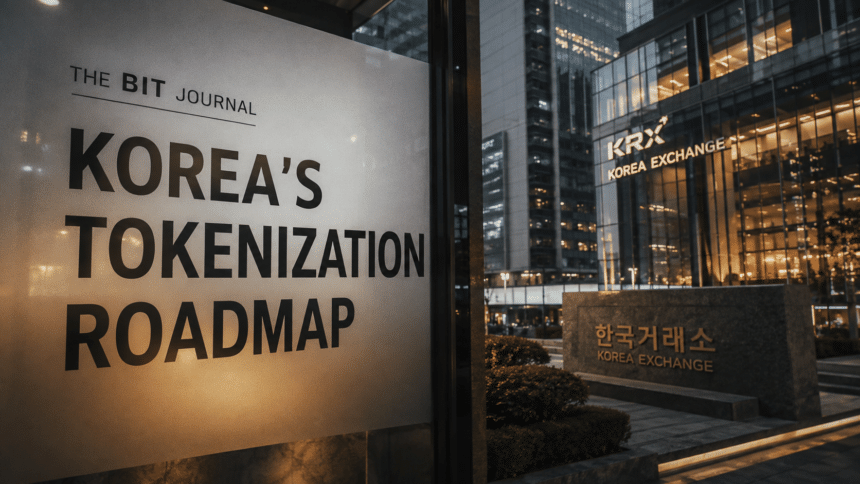

South Korea’s financial regulators have moved tokenization out of the pilot phase and onto the statute book’s calendar. On September 4, 2026, the Financial Services Commission and the Financial Supervisory Service unveiled a three-phase roadmap under which tokenized versions of traditional securities, including stocks, bonds and funds, receive legal recognition beginning February 4, 2027.
The date is not aspirational. It is anchored to amendments to the Act on Electronic Registration of Stocks and Bonds and the Capital Markets Act, passed by the National Assembly in January 2026, which recognize distributed ledgers as a valid securities registration tool. What regulators published on September 4 is the operating plan for that legal authority.

Three phases, one direction
Phase one, starting in February 2027, covers the Electronic Registration Act framework and brings legal recognition to tokenized money market funds and bonds for institutional investors, unlisted stocks held through trust structures, and publicly offered fractional investment securities. Phase two expands tokenization to all publicly offered securities. Phase three builds on-chain payment infrastructure linked to stablecoins, effectively connecting the tokenized securities market to digital settlement money.
The later phases are deliberately conditional. Regulators said the timing of phases two and three depends on the results of the first phase, the pace of technology adoption by market participants, and the progress of stablecoin legislation still pending in the National Assembly. That caveat matters: the full vision, a capital market where securities are issued, traded and settled on-chain against won-denominated stablecoins, requires a legal framework for the settlement asset that does not yet exist.
Guardrails for retail, licenses for institutions
The roadmap distinguishes between different investor-protection measures. For non-monetary trust beneficiary certificates, model standards suggest an individual subscription ceiling equal to the smaller of KRW30 million or 5 percent of issuance. This is not a blanket cap on every tokenized security. Retail net purchases on each OTC exchange have an annual KRW100 million limit. Existing financial firms can handle tokens within their licensed scope, subject to prior FSS consultation for intermediation. Issuer account management entities need at least KRW4 billion in equity and must meet staffing, IT and cybersecurity requirements.

The FSC plans proposals to amend subordinate rules by the end of September 2026. Infrastructure preparations will involve the Korea Securities Depository and securities firms ahead of the first phase. The roadmap also sets out testing and continuity expectations for distributed-ledger systems.
Why Korea’s timetable matters beyond Korea
The timetable matters because the roadmap extends beyond fractional assets toward conventional stocks, bonds and funds. The broader scope remains phased: the first stage is limited, and later expansion does not yet have a fixed implementation date.
For context, The Bit Journal previously covered how US securities law applies to tokenized securities. That is a separate jurisdiction, but it highlights the distinction between changing an ownership-record technology and changing the legal rights attached to a security.

The domestic policy puzzle
The roadmap also lands in the middle of Korea’s unresolved stablecoin debate. The Bank of Korea has taken a cautious line on won-denominated stablecoin issuance, and a Bank of Korea issue note released the same week warned that fiat-stablecoin trading pairs can transmit depreciation pressure to local currencies. Phase three of the FSC’s plan explicitly depends on stablecoin legislation that lawmakers have not yet passed. Korea is, in effect, building the securities side of an on-chain market before settling the rules for the money that will settle it.
For financial professionals, the takeaway is that tokenization in Asia has shifted from proofs of concept to dated regulatory deliverables. Korea’s caps, capital requirements and depository-centered architecture offer an early template for how a major market intends to put listed securities on-chain without disintermediating its existing gatekeepers.
Frequently asked questions
What did South Korea announce?
The FSC and FSS published a three-phase roadmap giving tokenized stocks, bonds and funds legal recognition from February 4, 2027, expanding to all publicly offered securities, and ultimately building on-chain payment infrastructure linked to stablecoins.
What is covered in phase one?
Institutional money market funds and bonds, unlisted stocks held through trust structures, and publicly offered fractional investment securities, all under the amended Electronic Registration Act.
Are there limits on retail investors?
The proposed subscription ceiling for non-monetary trust beneficiary certificates is the lower of KRW30 million or 5 percent of issuance. The annual retail net-purchase limit is KRW100 million per OTC exchange. The scope of each measure matters.
Who can issue and handle tokenized securities?
Licensed financial firms can handle them within existing licenses. Issuers managing their own accounts need at least KRW4 billion in equity capital and must meet IT and cybersecurity standards.
When will the detailed rules arrive?
The FSC plans to propose revisions to subordinate legislation by the end of September 2026. Preparations by the KSD and securities companies precede the first phase in February 2027.
Does the plan depend on stablecoin legislation?
Yes. Phase three, on-chain settlement linked to stablecoins, depends on pending stablecoin legislation, as well as phase one results and technology adoption by market participants.
Risk disclosure
Tokenized securities remain subject to market, technology, custody and regulatory risks, and Korea’s later roadmap phases are conditional on legislation that has not yet passed. Timelines announced by regulators can change. This article does not constitute a recommendation to invest in any tokenized product.
Disclaimer: This article is for informational purposes only and does not constitute investment, legal or tax advice. Digital assets are volatile and may be subject to regulatory restrictions in your jurisdiction. Always do your own research and consult a licensed professional before making financial decisions.
Primary source: FSC policy roadmap, September 4, 2026.