






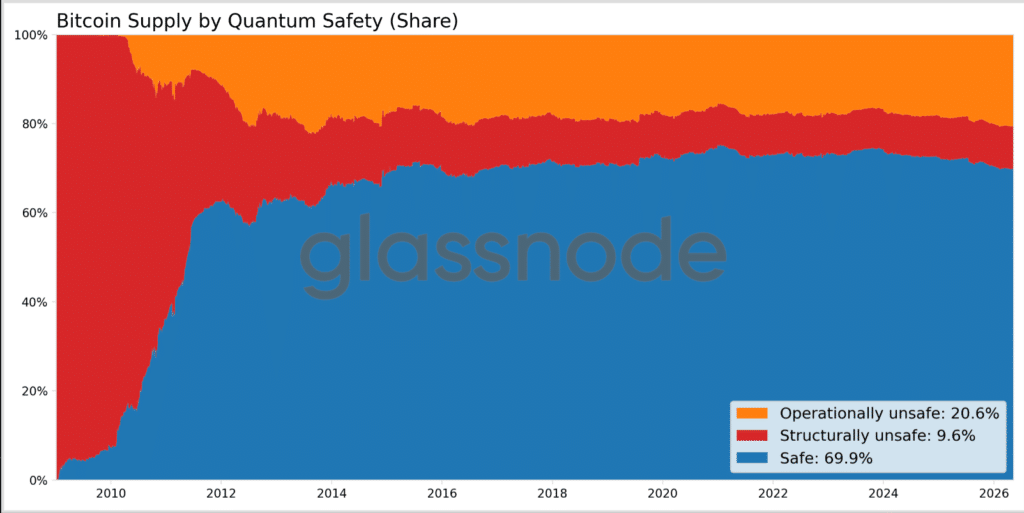
Bitcoin quantum computing concerns are increasingly focusing on custodial infrastructure after Glassnode’s latest on-chain research showed that 6.04 million BTC, equal to 30.2% of Bitcoin’s circulating supply, is currently held in outputs whose associated public keys have been published on-chain, meaning they were revealed through prior transaction spends.
The findings place exchanges at the center of measurable exposure due to address reuse and operational wallet practices tied to large custodial reserves. Glassnode’s analysis also showed that operational exposure now represents the largest share of potentially vulnerable Bitcoin compared with structurally exposed legacy wallet formats. Even so, the report frames Bitcoin quantum computing exposure as a measurable custody issue rather than evidence of an immediate threat to the Bitcoin network.
How Does Bitcoin Quantum Computing Exposure Develop On-Chain?
Bitcoin quantum computing exposure begins with Bitcoin’s transaction structure. Public keys generally remain hidden until coins are spent. Once a wallet signs a transaction, the associated public key becomes permanently visible on-chain. In theory, a large, fault-tolerant quantum computer running Shor’s algorithm could eventually derive private keys from those visible public keys.

However, such systems would require major advances in error correction, qubit stability, and computational scaling before becoming operationally viable. The report focuses specifically on “at-rest exposure,” meaning Bitcoin stored in outputs where public keys are already visible. This differs from on-spend exposure, where public keys appear only during transaction broadcasting or settlement.
Glassnode divided the exposed supply into two categories. Structural exposure accounts for 1.92 million BTC, representing 9.6% of issued supply, while operational exposure totals 4.12 million BTC, or 20.6%. It noted that operational exposure remains largely reversible through improved custody procedures and address management.
Why Are Exchanges Emerging as the Main Pressure Point?
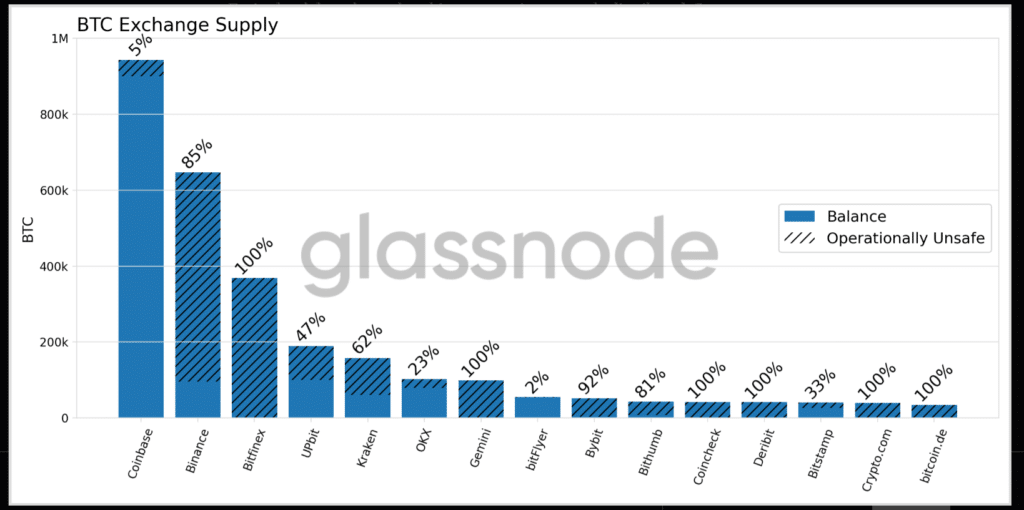
The largest share of Bitcoin quantum computing exposure comes from operational behavior rather than flaws in Bitcoin’s underlying protocol. The exchanges alone account for around 1.66 million exposed BTC, equal to more than 8% of the total issued supply. Roughly half of all Bitcoin held by labeled exchanges falls into the exposed category under the methodology, compared with less than 30% of non-exchange supply.
The exposure is tied largely to address reuse, partial spending patterns, and insufficient change-output rotation. Custodial architecture, however, varies widely across the industry. Many major exchanges use layered defenses such as multi-signature authorization systems, threshold-signature setups, hardware security modules, and offline cold storage.
These systems can increase operational difficulty for attackers because multiple approvals or distributed signing processes may still be required even if one key becomes vulnerable. Multi-signature or threshold-signature setups raise the attacker’s burden but are not quantum-proof unless the underlying signature algorithms are replaced with post-quantum equivalents. They increase operational complexity for attackers but do not fully remove cryptographic vulnerability.
Some firms maintain stronger operational controls than others. Binance showed 85% exposure across labeled Bitcoin balances under the framework. Based on DeFiLlama figures showing more than $40 billion in Bitcoin reserves on the platform, that methodology places over $34 billion worth of BTC into the exposed category. Bitfinex, Crypto.com, and Gemini each showed 100% exposure among labeled balances.
Coinbase recorded only 5% exposure, placing it among the lowest-risk large custodians in the dataset. Fidelity maintained exposure near 2%, while Grayscale stood near 50%. WisdomTree, Robinhood, and Revolut showed close to 100% exposure under the same framework. Government-linked wallets tied to the United States, the United Kingdom, and El Salvador maintained near-zero exposure levels with operational safety rates above 99% for several years.
How Realistic Is a Quantum Attack Against Bitcoin?
The report does not suggest that Bitcoin quantum computing attacks are imminent. It also avoids estimating a precise timeline for practical exploitation. Quantum researchers remain divided on when fault-tolerant systems capable of challenging modern cryptography could emerge. Estimates vary, while many researchers place Shor-capable machines years to decades away because of scaling and error-correction challenges.
Even in a future scenario involving capable systems, large-scale theft would remain operationally complex. An attacker would need enough computational speed to derive private keys and broadcast transactions before custodians could react. Active hot wallets processing withdrawals would likely face different risks than deeply secured cold-storage systems protected through multisig structures, manual approvals, or delayed settlement controls.
Some cryptographers and Bitcoin developers argue that practical quantum attacks remain distant enough for post-quantum signature migration proposals to emerge before systemic risks materialize. The analysis instead frames the issue as a visibility map showing where public-key exposure already exists on-chain today rather than as a prediction of imminent exploitation.
Which Wallet Structures Are Structurally Exposed?
Structural exposure refers to wallet outputs where public keys are visible by design instead of through operational mistakes. This category includes early Pay-to-Public-Key outputs, where keys are revealed immediately, legacy bare multisig structures, and modern Taproot outputs, where public-key-related information can become visible under specific spending conditions.
Glassnode classified 1.92 million BTC as structurally exposed under this framework. Some of these holdings may never migrate to safer address structures because many early Satoshi-era wallets are believed to be inactive or permanently lost. The report also referenced BIP-360’s proposed Pay-to-Merkle-Root structure, which seeks to reduce long-term public-key visibility tied to Taproot outputs.
The proposal is not considered a complete post-quantum solution and would not automatically migrate existing wallets. The distinction matters because Bitcoin quantum computing discussions are increasingly moving from theoretical protocol debates toward measurable on-chain exposure patterns.
What Steps Can Custodians and Investors Take Right Now?
The largest portion of measurable exposure can already be reduced without changing Bitcoin’s consensus rules. Security specialists say custodians can lower operational exposure by retiring addresses after use, rotating change outputs more aggressively, and separating hot wallets from long-term cold storage systems. Industry observers also point to the growing use of threshold-signature and multisig systems alongside third-party audits focused on address reuse and wallet management practices.
Institutional investors are simultaneously reviewing wallet segregation policies, custody disclosures, and cold-storage procedures more carefully before allocating large Bitcoin positions. Retail users, meanwhile, are often advised to avoid address reuse for long-term holdings and favor custodians that publicly disclose wallet-rotation and reserve-management standards.
Could Exposure Differences Shape Institutional Trust?
The uneven distribution of exposure across exchanges, ETF issuers, and sovereign entities highlights how operational discipline may increasingly influence institutional trust in custodial providers. Platforms managing continuous withdrawal activity naturally face greater operational exposure than deeply isolated cold-storage systems. The gap between exchange-linked exposure levels and sovereign wallet safety rates also suggests that wallet management practices, rather than scale alone, remain the defining factor in measurable exposure.

On-chain exposure is dynamic and custodians can migrate balances rapidly, meaning exposure levels may shift significantly over time. Glassnode emphasized that the data should not be interpreted as evidence of immediate systemic danger. Instead, the analysis provides a measurable framework showing where visible exposure exists today and where operational improvements remain possible.
Conclusion
Bitcoin quantum computing exposure is increasingly becoming a measurable custody issue as exchanges and institutional platforms continue managing large Bitcoin reserves in outputs with visible public keys. Analysis shows that operational practices such as address reuse and insufficient wallet rotation account for the largest share of exposed supply, while structural exposure tied to legacy wallet types remains a longer-term challenge.
Although practical quantum attacks remain uncertain in both timing and technical feasibility, custodians already have operational tools available to reduce measurable exposure without waiting for protocol-level upgrades. The broader discussion around Bitcoin security is also increasingly shifting toward custody discipline and wallet architecture alongside advances in cryptographic research.
Glossary
Bitcoin Quantum Computing: Quantum tech risks to Bitcoin security.
Custodial Wallets: Crypto wallets controlled by exchanges.
Cold Storage: Offline storage for protecting digital assets.
Quantum-Safe Wallets: Wallets built against future quantum attacks.
On-Chain Data: Public transaction data recorded on blockchain.
Frequently Asked Questions About Bitcoin Quantum Computing
Why are crypto exchanges facing higher quantum risk?
Crypto exchanges hold large amounts of Bitcoin and often reuse wallet addresses, increasing exposure.
How much Bitcoin is currently exposed?
Glassnode reported that around 6.04 million BTC has visible public key exposure.
Which exchanges showed high exposure levels?
Binance, Bitfinex, Crypto.com, and Gemini showed high exposure in the report.
Can exchanges reduce quantum computing risk?
Yes, exchanges can lower risk by using fresh wallet addresses and stronger custody practices.
Which firms showed lower Bitcoin exposure?
Coinbase and Fidelity showed lower exposure levels compared with many other platforms.
Sources