







This article was first published on The Bit Journal.
The development of Ethereum is no longer being led primarily by price. Rather, the network is experiencing a purposeful technical turnaround in the pursuit of greater decentralization, user sovereignty, privacy and genuine trustlessness; an argument co-founder Vitalik Buterin has reiterated and is shown in ecosystem developments.
While markets tumble and some users are obsessed with price action, the image that Buterin conveys is clear: Ethereum 2026 is about getting back to foundational principles that have been eroded in many cases by centralized infrastructure and convenience-driven design.
Vision Beyond Price: Restoring Trustlessness
Ethereum co-founder Vitalik Buterin has insisted that the network’s latest path, much of it dependent on third-party services, is a drift away from its original vision of decentralized authority and verifiable truth.
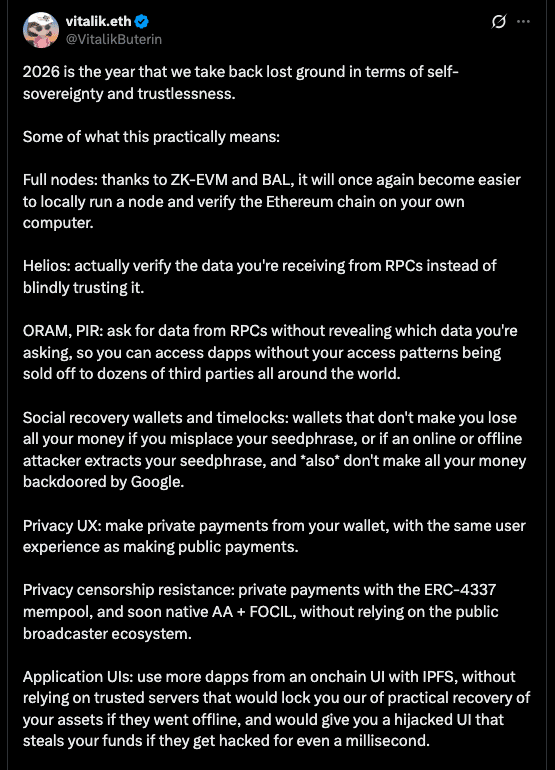
In a series of posts on X, Buterin heralded Ethereum 2026 as a year to “take back lost ground” in trustless design. Echoing his sentiment, an X account called Ethereum Daily also noted, “Ethereum Enter God Mode in 2026.”
This year’s focus is on making sure the protocol allows users to verify blockchain data themselves and not relying on centralized middlemen such as RPC providers serving most wallet queries.
Buterin’s Ethereum 2026 stance is that the real breakthroughs may not be seen in price charts. Instead, the network is making technical improvements to validate Ethereum in such a way that its built-in trustlessness becomes an everyday use, everything from how nodes are operated and private transactions to resilient decentralized applications.
Improved Operation of Nodes and Personal Verification
Another part of Ethereum’s 2026 plans is making full node operation accessible again to everyday users.
Full nodes enable users to independently verify the state and transactions in blockchains, something that has become increasingly difficult as hardware requirements have increased and state sizes have grown.
Due to technological advancements like Zero-Knowledge Ethereum Virtual Machines (ZK-EVM) and Block Access Lists (BAL), running a node on personal hardware is becoming much more approachable.
These technologies compress computational intensity and efficiency in how nodes read and validate chain data. They break down the barriers that once lifted verification up to the level of only large data centers and centralized services.
A specific instance of this change is the creation of Helios, which is a light client that allows local validation to data provided by RPC servers.
No longer do users have to rely on the integrity of third-party APIs for balance or transaction information as their wallets can validate that the blockchain responses they receive are legitimate.
This puts basic validation back in the hands of users and is a big step towards eliminating blind trust in intermediaries.
Privacy Features And Control Over User Data
Privacy has always been a weakness in public blockchains, given that every transaction and interaction is visible on the primary ledger.
Ethereum 2026 involves aggressive actions to narrow that gap. Tools that’ve been taking hold are Oblivious RAM (ORAM) and Private Information Retrieval (PIR). The technologies enable users to request blockchain data from nodes without revealing which specific addresses or actions they are querying, helping protect user behavior from being tracked and resold by analytics firms or data brokers.
In addition to data-access privacy, Ethereum is moving wallet design forward by allowing private transactions and safer wallet rescue options to become more user-friendly.
Social recovery wallets and time-locked transaction protections now mean users no longer face catastrophic seed phrase loss, which has long been a UX frustration. It’s an approach that balances between self-custody security and recovery ease-of-use for everyday participants.
This focus on privacy and secure self-custody aligns with the general mood in the community about preserving financial sovereignty in a space that continues to span regulation, usability, and decentralization.
DApps That Are Always on, All the Time
Another aspect of the Ethereum 2026 technical turnaround is limiting the dependence decentralized applications have on centralized servers.
A lot of today’s dApps rely on this off-chain infrastructure: a front-end server providing the user interface, or a centralized RPC endpoint delivering blockchain state data.
When these services go down, or are shut down, the respective dApp becomes shut down as well, even when its smart contracts still exist on a blockchain.
In 2026, developers will increasingly migrate toward fully on-chain interfaces, which are typically live-hosted via decentralized protocols such as InterPlanetary File System (IPFS).
By doing this, these applications are usable even if a developer moves on from supporting it or centralized servers fail. This transition shows the “walkaway” concept promoted by Buterin, which assure that users and developers can walk away without harming the protocol.

A Structural, Long-Term Ethereum Change
The latest roadmap developments and Buterin’s focus on decentralization point to a change in Ethereum technology that goes beyond short-term market cycles.
As of this writing, ETH was hovering at around the $2,994 level in what is typically market volatility, but the point is that this price performance is secondary to the architectural resilience gains being made.
The combination of reduced node barriers, enhanced privacy, user-centric wallet innovations, and resilient dApp infrastructure aligns with Ethereum’s founding principles of trustlessness and credible neutrality.
In Buterin’s words: “Every compromise of values that Ethereum has made up to this point … we are making that compromise no longer.”
Conclusion
What 2026 looks like for Ethereum is a technological turn in the direction of decentralized governance, strong privacy, on-demand verification, and fully autonomous Dapps.
Vitalik Buterin’s latest roadmap prioritizes an investment in core protocol values over near-term price behaviours, designed to make big structural changes that won’t betray the network years down the line.
This is a needed reset as Ethereum aims to return to its original promise of trustless technology that can both empower individuals and institutions.
Glossary
ZK-EVM (Zero-Knowledge Ethereum Virtual Machine): Technology that allows for the validation of computation with zero-knowledge proofs at much less hardware cost to operate a node.
Block Access List (BAL): A structure to make reading blockchain data more efficient for nodes, thereby reducing resource consumption and enhancing performance.
Helios: A lightweight client library that allows wallets to validate blockchain data locally instead of totally trusting external RPC servers.
Oblivious RAM (ORAM): A privacy-preserving method that hides what data was accessed when computing on or querying the data to the user.
Private Information Retrieval (PIR): A cryptographic method that permits a user to obtain data from a server without disclosing which portion of the data is being requested.
Frequently Asked Questions About Ethereum 2026
What is Ethereum’s tech change in 2026?
Ethereum 2026 technical change is a unified movement to enhance decentralization, simplify node operation and support more privacy while developing truly resilient decentralized applications by putting protocol values before price discovery.
Why is node accessibility important?
By facilitating the operation of a node, more people would be able to independently verify the blockchain, decreasing reliance on centralized providers and increasing trustlessness in how trustless the integrity of the network is.
How does Helios alter the way in which blockchain data on Ethereum is verified?
Helios allows wallets to verify that they received authentic data from external services, no longer relying blindly on third-party operators.
What privacy improvements are coming?
Ethereum is integrating mechanisms such as ORAM and PIR to hide user access patterns, which protect users from activity surveillance and data resale.
References
Analytics Insight
FastBull
AInvest
coinlive
AMBCrypto