







In sobering reminder of the promise and peril of blockchain, reports have shared that Coinbase has lost $300,000 from one of its corporate wallets; not from a big hack, but from a misconfigured 0x swapper smart contract. Reports claim that MEV bots pounced as soon as permissions were misapplied and drained funds before the issue could be fixed. Coinbase’s chief security officer confirmed the incident but said customer funds were not affected.
Accidental Approval Opens the Floodgates
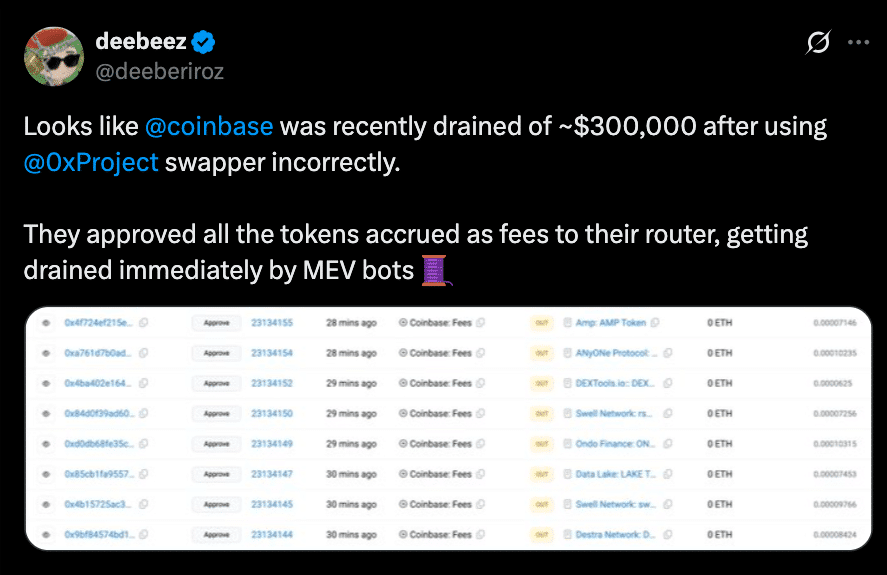
Security researcher “deeberiroz” from Venn Network was the first to sound the alarm. Coinbase accidentally approved token allowance to a swapper contract meant for decentralized trading, not for holding funds. This allowed MEV bots to front-run and drain the balance quickly.
Coinbase’s CSO, Philip Martin, called it “an isolated issue” from updates to a DEX-associated corporate wallet and said no user assets were compromised.
What Are MEV Bots and How Did They Win?
MEV stands for Maximal Extractable Value; the profits bots and miners can make by manipulating transaction ordering. These bots watch public mempools and can wait for mistakes like Coinbase’s approval error.
As soon as the allowance was live, the bots executed a quick extraction, pulling funds before Coinbase could revoke access. This wasn’t a big hack but an opportunistic exploit that made a clean, fast profit from a brief authorization oversight.
Vulnerability Is Systemic: Even Big Players Aren’t Immune
This occurrence has shown that no one including industry leaders, can take permission security for granted. To defend against this kind of threat, experts advise Private and MEV-protected routing through tools like CoW Swap or MEV-resistant RPCs; Token allowance auditing, making sure corporate contracts only get minimal, intended access.
Advanced solutions like zero-knowledge proofs or trusted execution environments to verify balances without exposing details.
The irony is brutal as a global exchange network with top-notch risk management can still get caught out by smart contract norms.
MEV as a Crypto Threat
Even though his affected Coinbase but it’s a bigger DeFi and Web3 problem. Token launches, NFT drops and liquidity events have all been MEV bots targets.
Solving the MEV problems often requires protocol-level changes and better dev tools. Public addresses of high profile individuals or institutions can be targets when allowances are mismanaged.
Coinbase was safe at the customer level but still got hit.
Conclusion
Based on the latest research, the MEV bots attack that cost Coinbase $300,000 via a misconfigured 0x swapper shows a hard truth. Permission mismanagement, even in institutional settings, can lead to instant and total loss of funds. Spokesperson Philip Martin called it an isolated incident, but it’s a wake-up call for crypto infrastructure.
As adoption grows, so must vigilance. Smart contracts, wallet logic and internal workflows must be hardened across all layers or the next exploit might just find a bigger target.
For in-depth analysis and the latest trends in the crypto space, our team offers expert content regularly.
Summary
Coinbase lost $300,000 when MEV bots exploited a misconfigured 0x swapper contract due to an unauthorized token approval. MEV bots pounced and drained the wallet. The incident, confirmed by Coinbase’s CSO, affected only corporate wallets, not user funds.
FAQs
What is an MEV exploit?
Maximal Extractable Value; the profit bots and miners extract by manipulating transaction order, front-running or exploiting smart contract misconfigurations.
Were customer assets affected in this Coinbase case?
No. Coinbase said the exploit only hit their fee-receiving corporate wallet. User funds were safe.
How did the exploit happen?
Coinbase approved token access to an exposed swapper contract. MEV bots jumped in and drained before revoke.
What can crypto companies do to avoid similar incidents?
They can use private MEV-protected channels, review contract allowances thoroughly, use multi-sig controls and explore tech solutions like zero-knowledge verification.
Glossary
MEV (Maximal Extractable Value) – Financial gain bots can extract through transaction order possibilities in blockchains.
MEV Exploit – An attack using MEV techniques to extract value quickly, often via front-running or flash tactic.
Swapper Contract – A decentralized finance smart contract for token swaps not custody; usually not meant to receive allowance.
Private RPC/MEV Protection – Infrastructure setups that hide transactions from public mempools, reducing exploitable execution windows.
Sources