




Uniswap governance is moving toward a decision that could reshape how UNI holders think about supply and value. A fresh proposal now sitting in front of the community would introduce the protocol’s first sustained UNI burn mechanism, and early voting numbers suggest the idea has real momentum behind it.
At press time, support stood at 74%, a figure that puts the plan on track for approval unless sentiment shifts sharply in the days ahead. For a token that has spent years leaning on governance incentives rather than genuine scarcity, this marks a meaningful turning point, and it is worth walking through exactly what is on the table.
What the UNI Burn Mechanism Actually Changes
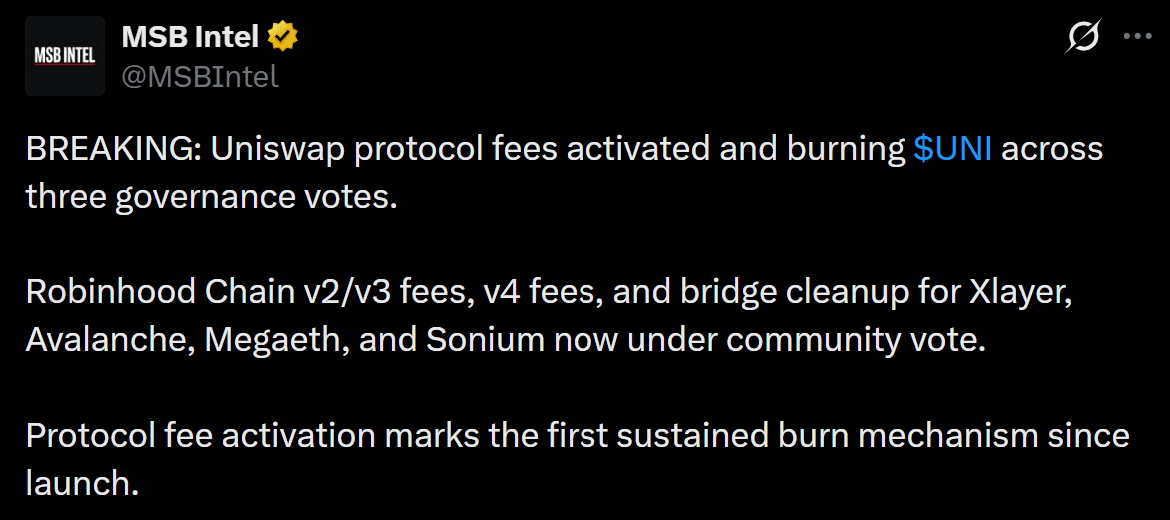
The proposal is not a single up-or-down vote as it bundles three separate governance decisions, and all three need to pass for the UNI burn mechanism to function as intended. The first activates protocol fees on Robinhood Chain.
The second concerns the rollout of Uniswap v4. The third handles bridge infrastructure across the remaining chains where Uniswap operates. Taken together, these three pieces form the backbone of a system designed to link UNI’s supply directly to how much the protocol gets used, rather than how generous the next incentive round happens to be.
That distinction matters more than it might sound. Plenty of tokens have burn programs on paper, yet most of them depend on discretionary decisions or marketing pushes. This UNI burn mechanism, by contrast, is built to run on autopilot once fees start flowing, which gives it a kind of durability that ad hoc burns rarely have.
How the TokenJar System Feeds the UNI Burn Mechanism
If the votes go through, protocol fees will begin landing in what the proposal calls TokenJar accounts. From there, users can step in and buy enough UNI to burn the token completely, and in exchange they collect their share back from the jar.
It is a fairly elegant loop once it clicks: fees generate demand for UNI, that demand removes UNI from circulation, and the whole cycle repeats itself as long as trading activity keeps flowing through the protocol. The UNI burn mechanism, in other words, does not rely on a foundation pulling a lever. It relies on ordinary usage doing the work.
Protocol Revenue Behind the Numbers
None of this matters much without revenue to back it, and Uniswap’s current figures give the plan some real teeth. According to DefiLlama data, Uniswap is generating roughly $5 million per day in protocol fees, which annualizes to somewhere near $50 million.
As v4 deployments expand and Robinhood Chain pulls in more swap volume, that fee base has room to climb further, and every increase feeds directly into the UNI burn mechanism’s fuel supply. Still, it is worth being honest about scale here. Even with strong revenue, the projected burn rate remains modest against UNI’s total supply, so nobody should expect this to trigger overnight scarcity. It is a structural shift, not a fireworks show.
Robinhood Chain and the Real-World Adoption Test
The clearest early signal of whether any of this pans out is coming from Robinhood Chain, which crossed $1 billion in cumulative swap volume within days of launching. That kind of traction, arriving that fast, suggests Uniswap is reaching a crowd well beyond its usual DeFi-native user base, and rising wallet interactions back up the idea that this is not just speculative churn.
The real question, though, is retention. Plenty of chains post eye-catching launch numbers only to see activity fade once the novelty wears off. If Robinhood Chain manages to hold onto its users and keep transaction counts climbing, it becomes a genuine long-term engine for the UNI burn mechanism rather than a one-week headline.
Why the UNI Burn Mechanism Matters for Long-Term Holders
For UNI holders who have watched the token trade mostly on governance sentiment and broader market cycles, this proposal offers something closer to a fundamentals-driven thesis. If network activity keeps expanding, the UNI burn mechanism gives the token a supply story tied to actual demand instead of speculation alone, and that is the kind of setup analysts tend to respect over the long run.
Conclusion
The 74% approval figure signals that Uniswap’s community is ready to try something more substantial than another incentive tweak. Whether the UNI burn mechanism ends up mattering in a meaningful way depends less on the vote itself and more on what happens next across Robinhood Chain, v4 adoption, and daily trading volume. Scarcity built on real usage tends to age better than scarcity built on promises, and this proposal gives Uniswap a real shot at proving that out.
Frequently Asked Questions
What is the UNI burn mechanism?
It is a proposed system that uses Uniswap’s protocol fees to remove UNI tokens permanently from circulation through TokenJar accounts.
How does the UNI burn mechanism work?
Fees collected by the protocol go into TokenJar accounts. Users buy enough UNI to burn it, then claim their share from the jar in return.
Why did the community vote on this now?
Uniswap’s growing protocol revenue, combined with strong early volume on Robinhood Chain, gave the proposal a practical foundation to build on.
Will the UNI burn mechanism affect UNI’s price immediately?
Unlikely in a dramatic way. The projected burn rate is modest compared to UNI’s total supply, so any price effect would likely play out over time.
What happens if the votes do not all pass?
Since the proposal bundles three governance votes together, the UNI burn mechanism only takes effect if all three components are approved.
Glossary of Key Terms
UNI burn mechanism – A system that permanently removes UNI tokens from circulation using protocol-generated fees.
TokenJar account – A designated on-chain account where protocol fees accumulate before being used to facilitate token burns.
Protocol fee – A charge collected by Uniswap on trading activity, used to fund operations, incentives, or in this case, burns.
Token scarcity – A reduction in circulating token supply, often viewed as a factor that can support long-term value.
Governance vote – A community decision-making process where token holders vote on proposed protocol changes.
Disclaimer: This content is for informational purposes only and should not be interpreted as financial or investment advice.
Sources