

Last updated: November 20, 2026
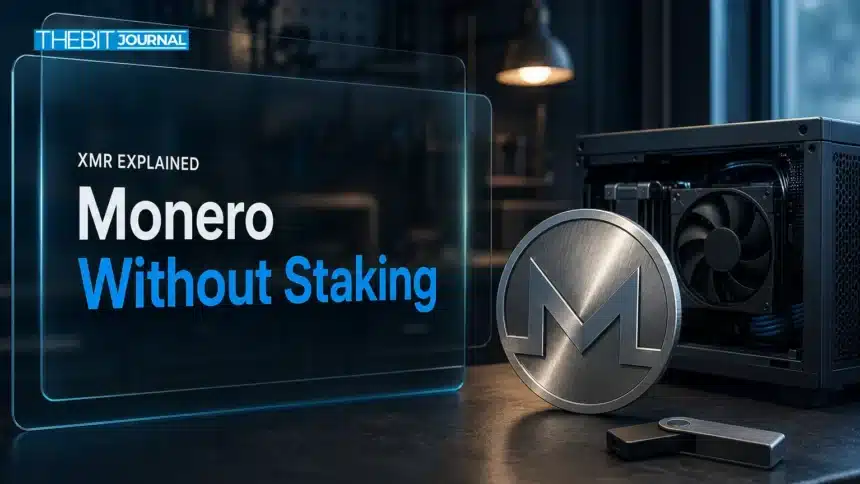
A Monero staking guide needs to start with a clear answer: Monero has no native staking, because its network uses proof of work rather than proof of stake. XMR holders cannot delegate coins to a protocol validator to earn staking rewards, but they can learn about mining and assess the risks of third-party yield offers.
Quick answer
You cannot stake XMR on the Monero network. Monero uses the RandomX proof-of-work algorithm, and miners help secure the network in exchange for block rewards. A service advertising XMR staking may involve a separate arrangement, such as lending or custody, rather than protocol staking.
What this Monero staking guide means for XMR holders
Staking is a feature of proof-of-stake networks: participants commit or delegate tokens to help validate transactions under that network’s rules. Monero works differently. According to the official Monero technical specifications, the network uses RandomX mining and proof of work. There is no native XMR staking function or protocol staking yield.
Mining is not another name for staking. A miner contributes computing work to compete to add blocks, while a staker on a proof-of-stake network participates under a different consensus model. Monero’s documented target block time is two minutes. Its permanent tail emission provides 0.6 XMR per block, or 0.3 XMR per minute, to incentivize miners, according to the official Monero FAQ. These are network-level details, not a promised payout to any individual miner.
Privacy features don’t change the consensus mechanism: XMR still relies on mining, not staking.
How to handle a Monero staking guide search
There are no steps for staking XMR on Monero itself. Use these checks to distinguish native network features from other products and to understand the actual alternative.
- Check the claim against Monero’s protocol. Look for the term proof of work and RandomX in official documentation. If an offer calls itself native Monero staking, that description does not match the protocol.
- Ask what the service does with your XMR. A third party might lend, custody, or otherwise use deposited coins. That is a separate arrangement, not validation through Monero staking. Read how funds are handled and what conditions apply.
- Learn the mining options. The official Monero mining documentation describes solo mining, pool mining, and P2Pool. Solo mining is described as the most decentralized and private option; P2Pool is decentralized and offers frequent payouts. Mining requires computing resources and does not assure a payout.
- Understand the hardware trade-off. Monero’s official mining guide says CPUs and GPUs can mine using RandomX, but CPUs are more efficient. Hardware, electricity costs, and operating conditions affect whether mining is practical for a participant.
- Check wallet and software details independently. Use project documentation to understand mining and wallet software. Never share a seed phrase with a service promising rewards, and don’t install software from an unverified link.

Monero staking and mining compared
This comparison separates the network’s actual consensus process from products that may use staking language in marketing. The distinction matters because their risks and sources of any return are different.
| Option | How it works | Key point |
|---|---|---|
| Native XMR staking | Not available on Monero | The network uses proof of work, not proof of stake. |
| Solo mining | A miner contributes computing work independently | Monero’s documentation describes it as the most decentralized and private mining option. Results are not assured. |
| Pool mining | Miners coordinate through a pool | It is a mining arrangement, not staking. Check the pool’s terms and custody model. |
| P2Pool | Decentralized mining pool approach | The project describes it as decentralized, with frequent payouts. |
| Third-party XMR yield | A service may custody, lend, or otherwise use deposited XMR | It is not Monero protocol staking. Risks depend on the service and its terms. |
The official Monero mining guide provides the documented participation options. A wallet holding XMR does not automatically earn a network reward.

Common mistakes and risks
Confusing a yield offer with protocol staking. The word “staking” in a service’s description doesn’t make it a Monero network feature. Ask where any claimed return comes from and what happens to deposited coins. A third party may fail, restrict withdrawals, or lose access to funds.
Expecting a fixed mining payout. Mining rewards depend on participation in proof of work; they aren’t a fixed yield for simply holding XMR. Costs such as electricity and hardware can also affect the outcome. The official documentation explains the mining choices, but it doesn’t promise individual profits.
Ignoring security and volatility. Crypto assets can lose value, and wallets, exchanges, mining software, and yield services each carry different risks. Scams may impersonate wallet or mining providers. Keep recovery words private and verify software sources before using them. No arrangement removes the risk of loss.
Relying on old software instructions. Network software changes over time. The Monero project’s GitHub releases page showed version 0.18.5.4, published October 17, 2026, as its latest release in the research available for this article. Check current official project materials before following version-specific directions.
Monero staking guide FAQ
Can you stake Monero for rewards?
No. Monero uses proof of work and RandomX, so the protocol has no native staking process or staking yield. Mining is the network’s documented participation route for contributing computing work.
Is Monero mining the same as staking?
No. Mining uses computing resources to take part in proof of work. Staking involves a proof-of-stake network’s own validation rules. Monero’s mining options include solo mining, pool mining, and P2Pool.
Why does a platform advertise XMR staking?
It may be using “staking” loosely for a separate product, such as lending or a custodial yield service. That doesn’t make it native Monero staking. Read the terms, understand who controls the funds, and account for counterparty, withdrawal, and loss risks before relying on the label.
Sources
- Monero Technical Specification (docs.getmonero.org)
- Mining Monero (docs.getmonero.org)
- Monero price and market data (CoinGecko)
This article is for informational purposes only and does not constitute financial or investment advice. Cryptocurrencies are highly volatile; always do your own research before investing.