





A clash of titans in cryptocurrency treasuries
The world of digital assets is currently experiencing one of its most exciting rivalries: Peter Thiel vs Michael Saylor. The discussion centers on whether corporate treasuries formed around cryptocurrency reflect daring innovation or a bubble ready to explode.
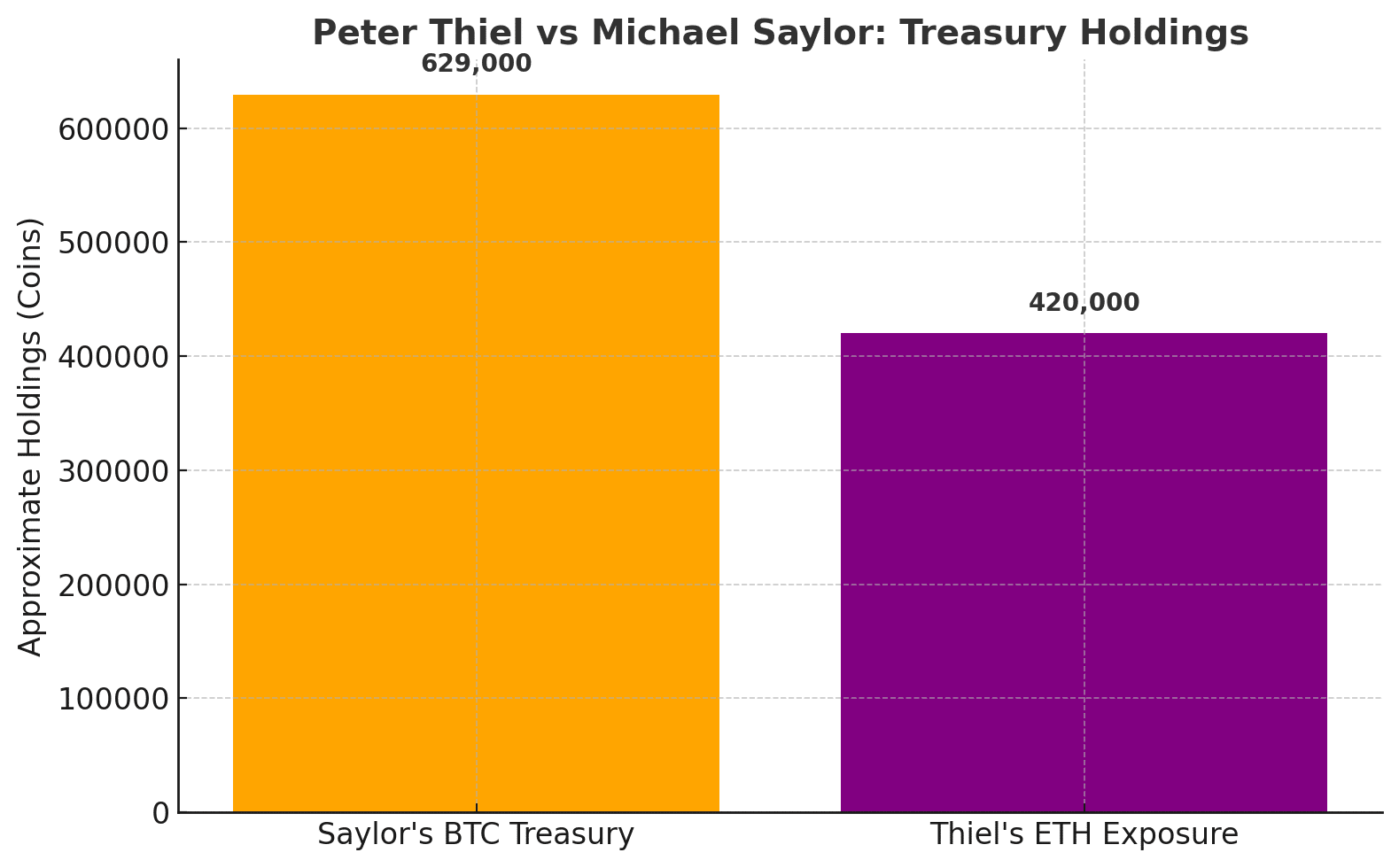
Michael Saylor, the outspoken CEO behind Strategy, has nearly fanatical conviction in Bitcoin. His business currently owns over 629,000 BTC, making it one of the largest corporate treasuries of its sort. His strategy has been straightforward but aggressive: acquire funds via equities, debt, and convertible instruments, then invest that money directly in Bitcoin.
Peter Thiel, on the other hand, has created a more diverse portfolio. Rather than buying cryptocurrency in bulk, his funds have invested in firms like as ETHZilla and BitMine Immersion, which have evolved into Ethereum treasury vehicles. This provides him both equities upside and cryptocurrency exposure without focusing just on one asset.
The contrast between Peter Thiel vs Michael Saylor illustrates not only tactics but philosophy—one sees Bitcoin as the ultimate digital reserve, while the other sees Ethereum and diversified exposure as the more adaptive long-term gamble.
Michael Saylor’s “Infinite Money Glitch”
Saylor’s model has received equal parts acclaim and criticism. By exploiting financial markets, he has transformed his firm into a Bitcoin proxy. Every time Bitcoin increases, the firm’s share price rises, allowing it to issue more shares and purchase even more BTC. Some researchers refer to this as the “infinite money glitch.”
However, skeptics fear that if markets turn, the cycle might cascade downward. If Bitcoin falls and the company’s share price falls, the firm’s ability to raise cheap money may deteriorate, leaving it overleveraged. One market expert openly stated on X that “Saylor’s play works when BTC is bullish, but the risk is catastrophic if sentiment flips.”
Nonetheless, Saylor believes Bitcoin is the most stable long-term asset. He has frequently claimed that inflation, currency depreciation, and institutional acceptance make BTC the only plausible corporate reserve.
Peter Thiel’s Diversified Ethereum Gambit
In contrast, Thiel has followed a strategy that combines venture capital instincts with cryptocurrency acceptance. Thiel is banking on Ethereum’s broader value by investing in firms such as ETHZilla, which has shifted from biotech to Ethereum holdings, and BitMine, which finances ETH accumulation via operations.
For Thiel, the appeal is Ethereum’s function as the foundation of decentralized finance. While Saylor emphasizes Bitcoin’s scarcity, Thiel anticipates development in staking, smart contracts, and institutional DeFi. “Ethereum is the platform play,” a Thiel-aligned investor stated. “It’s not just an asset; it’s an economy.”
The difference between Peter Thiel vs Michael Saylor is therefore glaring. Saylor has focused on risk in Bitcoin as a store of wealth, whereas Thiel has chosen exposure through equity interests in Ethereum-centric enterprises that can bring both token and corporate development.
Market Risks and Regulatory Shadows
Both options have increasing dangers. The price of corporations largely reliant on crypto assets has begun to fall, with some trading near or even below the net asset value of their holdings. This shows that investors are growing impatient with premium pricing based on hype rather than fundamentals.
There is also a regulatory issue. Direct Bitcoin holdings are subject to stricter reporting requirements, while indirect exposure via Ethereum-treasury corporations may attract further attention. If authorities determine that such vehicles are too opaque or dangerous, Thiel’s diverse investments may meet unanticipated challenges.

At the same time, observers believe that the fight between Peter Thiel vs Michael Saylor will compel authorities to finally clarify the laws for corporate crypto treasuries. Clarity might determine which model succeeds.
Which Bet Wins the Long Game?
The market remains indecisive. Saylor’s business continues to collect BTC, bolstering its belief that Bitcoin is a once-in-a-generation asset. Thiel’s portfolio, however, has quietly grown, with ETH holdings and stock positions in treasury-related companies increasing.
Bloomberg experts recently noted that the treasury craze has subsided, but both men remain unfazed. Saylor describes Bitcoin as digital gold, whereas Thiel sees Ethereum as digital oil. In the discussion between Peter Thiel vs Michael Saylor, each side offers a distinct view of the future of money.
Conclusion
The struggle between Peter Thiel vs Michael Saylor is more than just a duel of millionaires. It reflects two opposing viewpoints on how digital assets fit into the business sector. Is Bitcoin the ideal reserve asset, free from inflation and political control? Is Ethereum, with its flexible environment, the better treasury bet?
The answer may not be known until the following market cycle evaluates both techniques. What is known is that Thiel and Saylor are redefining corporate finance. Whether their investments prove prescient or irresponsible, their impact on the crypto treasury age is apparent.
FAQs for Peter Thiel vs Michael Saylor
Q1: What is the debate between Peter Thiel vs Michael Saylor about?
It centers on whether corporate crypto treasuries should be concentrated in Bitcoin, as Saylor believes, or diversified into Ethereum-focused companies, as Thiel prefers.
Q2: How much Bitcoin does Michael Saylor’s company hold?
Saylor’s firm controls about 629,000 BTC, making it the largest corporate Bitcoin treasury.
Q3: What companies has Peter Thiel invested in for Ethereum exposure?
His funds have invested in ETHZilla and BitMine Immersion, both of which focus on building Ethereum treasuries.
Q4: What risks do these strategies face?
Key risks include market downturns, stock valuations decoupling from crypto assets, and regulatory uncertainties.
Glossary
Crypto Treasury: A corporate strategy of holding crypto assets as part of balance sheet reserves.
Net Asset Value (NAV): The underlying value of a company’s holdings, often compared to its market price.
Infinite Money Glitch: A term critics use to describe raising capital to buy Bitcoin, boosting share prices, and raising more capital in a cycle.
Staking: Locking Ethereum or other tokens to secure the network and earn yield.
Diversification: Spreading investments across multiple assets to reduce risk.
Digital Reserve Asset: A crypto asset treated as a store of value, similar to gold.